





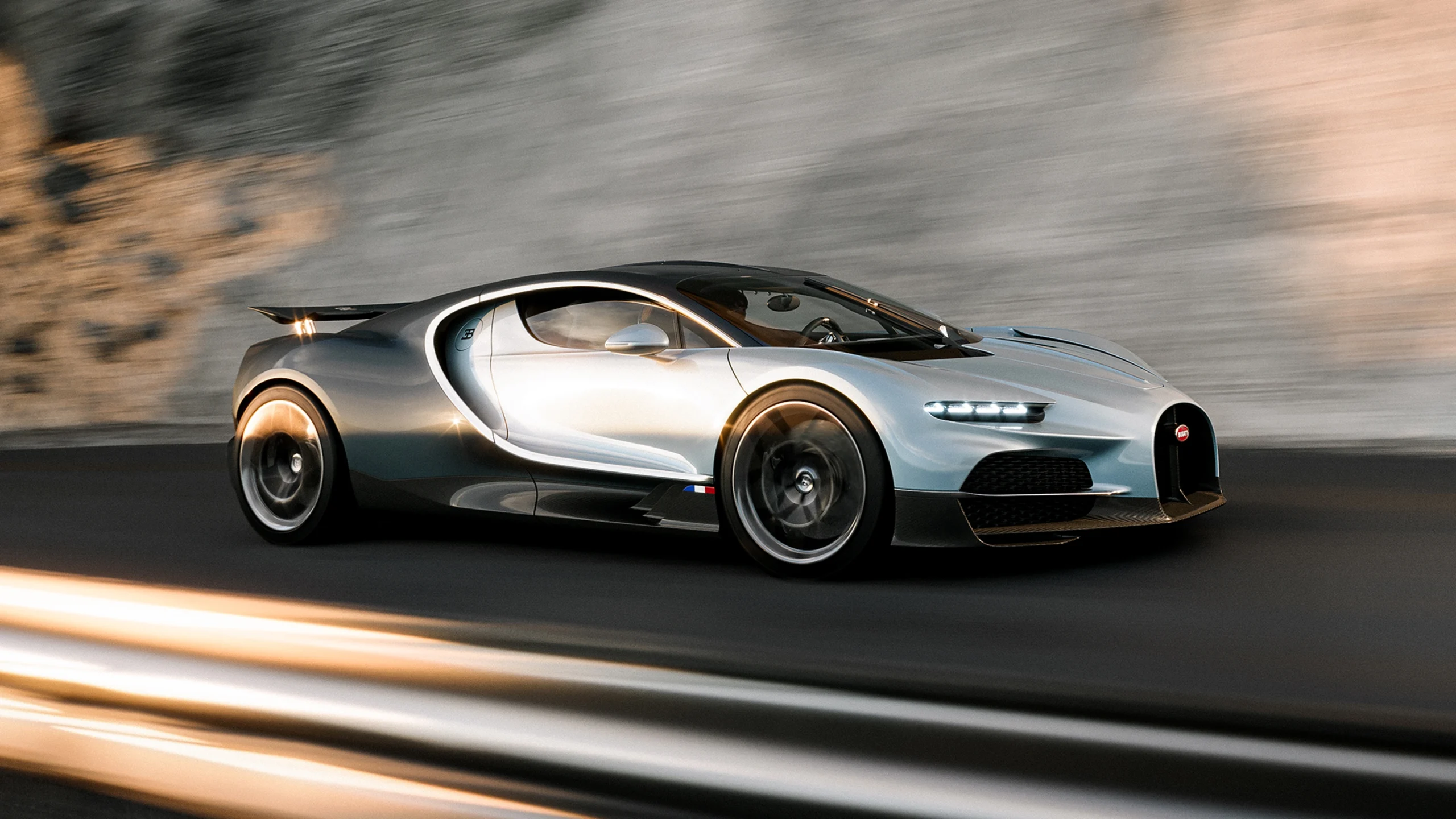

Speed has always been the ultimate flex in the automotive world. Horsepower increases, lap times decrease, but nothing sparks more excitement than this simple question: How fast can it go? From desert highways, runways, and even closed race tracks, manufacturers have spent decades chasing numbers that once seemed impossible, yet engineering continues to push further with each new attempt. Owning these powerful machines is a curious kind of luxury. It’s like having a superyacht waiting in the marina—you don’t always chase the horizon every weekend, but somehow, the thrill comes from knowing that you can. The fun fact that every car on this list can storm past 400 km/h (250 mph), speeds so outrageous that only a tiny fraction of owners will ever witness them firsthand. Still, the existence alone is incredible; it makes you wonder what the coming years will be like.
Before we break down each car in detail, here’s a quick overview of our list that rose to the top. These picks showcase the machines setting the benchmark for outright speed, power, and acceleration in today’s relentless performance race.
- Fastest car in the world: Yangwang U9 Xtreme
- Fastest EV in the world: Yangwang U9 Xtreme
- Most powerful car on the list: Yangwang U9 Xtreme
- most Powerful engine setup: Bugatti Tourbillon
- Quickest car (0–100 km/h): Rimac Nevera
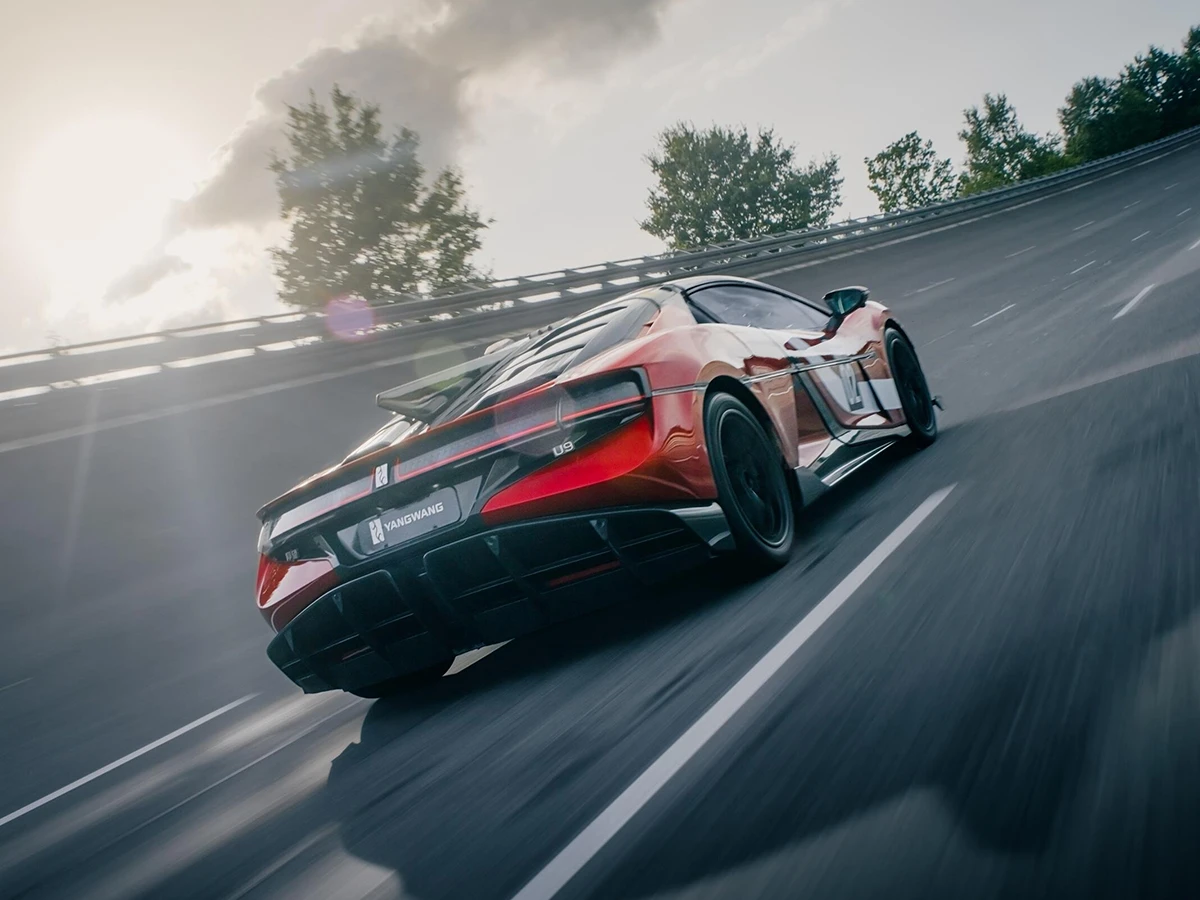
- Top Speed: 496.22 km/h – 308.34 mph
- Acceleration (0–100 km/h): Not Available
- Powertrain: Quad-Motor Electric System
- Maximum Power: 3,027hp – 2,226 kW
- Maximum Torque: Not Available
- Transmission: Direct-Drive Electric
- Coefficient of Drag: 0.27 Cd
- Price: Not Available
The first highlight on our list was Yangwang U9 Xtreme’s arrival in Papenburg, Germany, where it broke the world record at 496.22 km/h (308.34 mph) and made hypercars look over their shoulders. For years, manufacturers like SSC North America, Koenigsegg, Hennessey, Rimac, and the formidable Bugatti Chiron Super Sport 300+ have competed fiercely to set new records. Suddenly, an electric challenger from a newer brand has surged ahead of them all.
With only 30 cars available worldwide, this really shows just how rare it will be. The Yangwang U9 Xtreme truly demonstrates what happens when engineers dream big, pushing beyond what’s easy or even sensible. It’s definitely a bold move of the century. Yangwang didn’t stop at straight lines either, pushing the car towards serious circuit credibility by chasing the Nürburgring Nordschleife lap record. It has already achieved a lap time of 6:59.157, which is impressive but still hasn’t surpassed some of the latest models, such as the Porsche 911 GT3 RS 992, which set a Nürburgring lap time of 6:44.848 back in October 2022.
That record really highlights how the hypercar is transforming the automotive world. These machines are becoming rarer, more extreme, and equipped with advanced technology, with speedometers approaching the 500 km/h mark. You can sense where engineering is heading too.
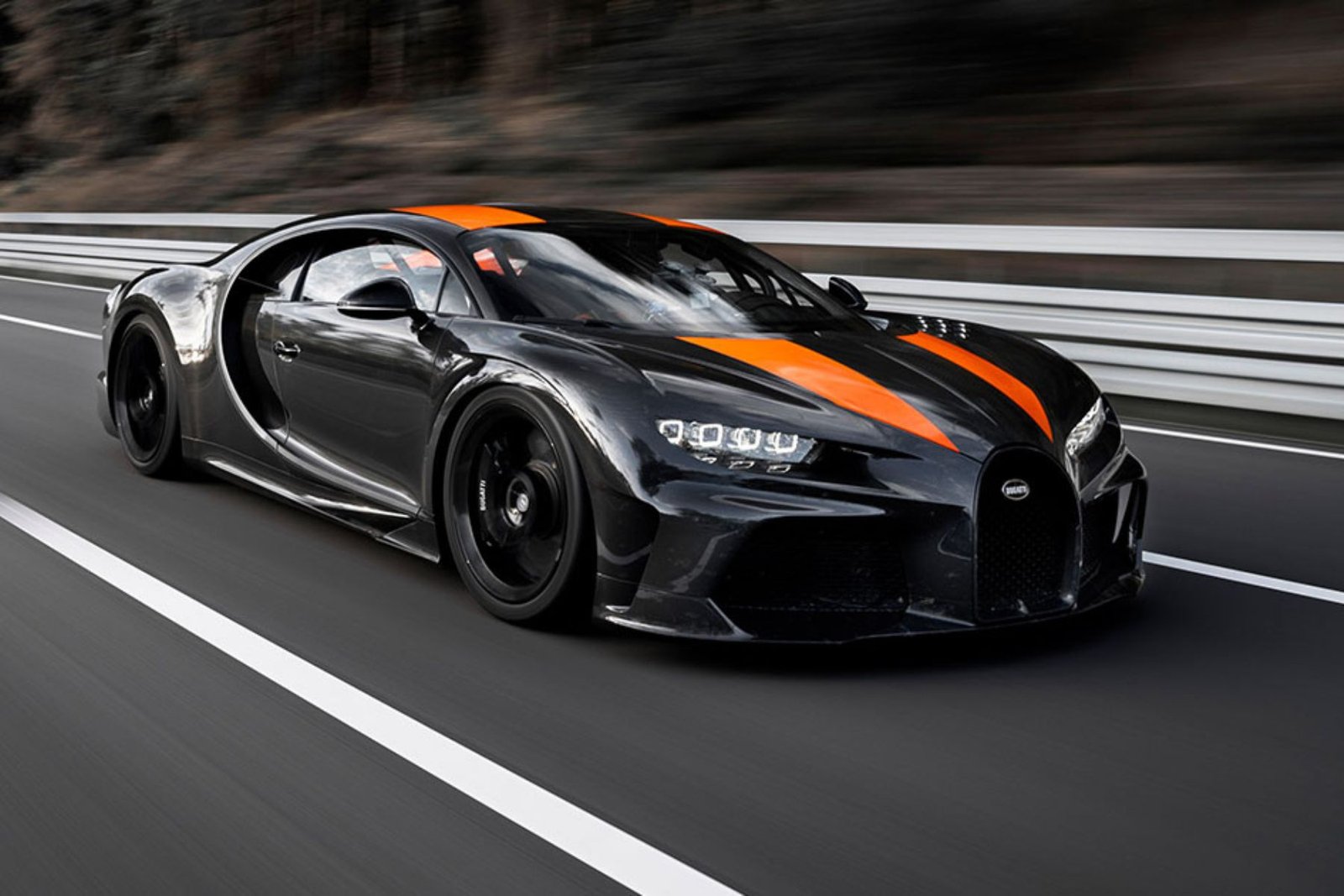
- Top Speed: 490.48 km/h – 304.77 mph
- Acceleration (0–100 km/h): 2.4 Seconds
- Engine: 8.0-litre W-16, Quad-Turbo
- Maximum Power: 1,578 hp – 1,160 kW
- Maximum Torque: 1,180 lb-ft
- Transmission: 7-Speed Dual-Clutch Automatic
- Coefficient of Drag: 0.35 Cd
- Price: From USD $3.5 Million
Before anyone dared to break world records, the Bugatti Chiron Super Sport 300+ was the first production car to ever reach the 300+ mph (480 km/h) threshold, rewriting record books at Volkswagen Group’s Ehra-Lessien facility. Behind these numbers was brute force from the legendary 8.0-litre W-16 Quad-Turbo engine, producing 1,578 hp, 1,180 lb-ft of torque, and a drag coefficient of 0.35, making it the second fastest car in the world after SSC Tuatara.
Being the first to break through the barrier gives Bugatti a prestige that no ranking can erase. It’s worth noting that even though the Bugatti Chiron Super Sport 300+ can reach these remarkable speeds, Bugatti has installed a speed limiter on all its high-performance vehicles, including the brand-new Bugatti Tourbillon. That said, Bugatti states the Bugatti Chiron Super Sport 300+ is limited to 273 mph (440 km/h), and no, the speed limiter will not be removed.
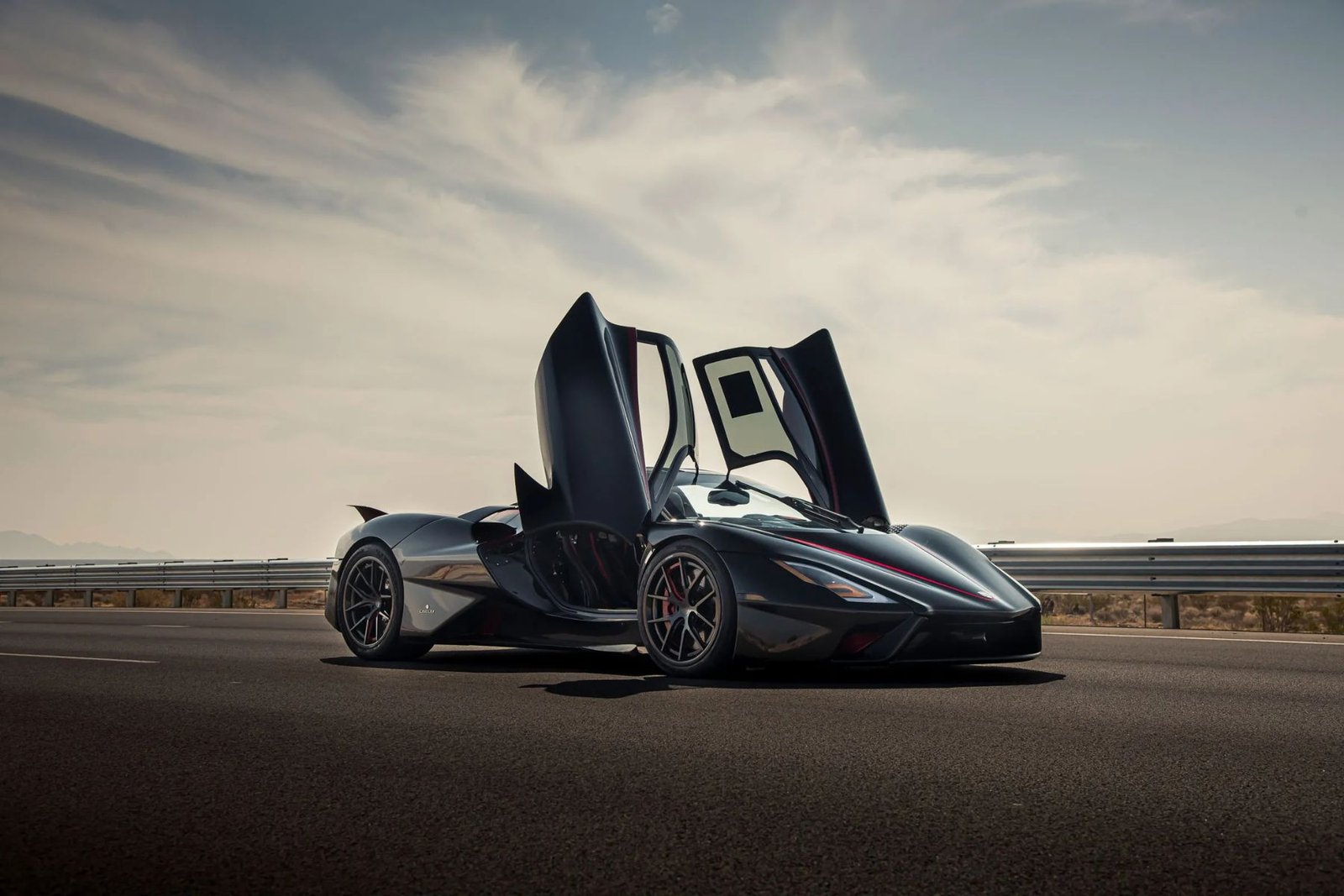
- Top Speed: 475 km/h – 295 mph
- Acceleration (0–100 km/h): 2.7 Seconds
- Engine: 5.9-litre V8, Twin-Turbo
- Maximum Power: 1,750 hp – 1,300 kW
- Maximum Torque: 984 lb-ft
- Transmission: 7-speed CIMA Single-Clutch Automated Manual
- Coefficient of Drag: 0.279 Cd
- Price: From USD $1.6 Million
Want a dramatic car? Then we’ve got a short story for you. When SSC North America announced that the Tuatara had surpassed the 300 mph (482 km/h) benchmark on a Nevada highway, fans jumped out of their seats and the automotive world paused. The company claimed a top speed of 331.15 mph (552.91 km/h). If true, it would have beaten the Bugatti Chiron Super Sport 300+ by nearly 39 mph (63 km/h). But a few days later, the internet started scrutinising the run, and SSC was forced to respond.
In a public statement, the brand admitted the mistake. “If it hasn’t been made clear up to this point, we would like to acknowledge officially that we did not reach the originally claimed speeds of 331 MPH or even 301 MPH in October of 2020,” the post read. “We were truly heartbroken as a company to learn that we did not reach this feat, and we are in an ongoing effort to break the 300 MPH barrier transparently, officially, and undoubtedly.”
Instead of walking away, the company decided to regroup, improve transparency, and try again with proper timing equipment and independent verification. The redemption run took place over a 2.3-mile stretch at Johnny Bohmer Proving Grounds at Space Florida’s LLF, Kennedy Space Centre, where the Tuatara achieved a confirmed top speed of 295 mph (475 km/h) in May 2022. But who knows, they might break that record soon.
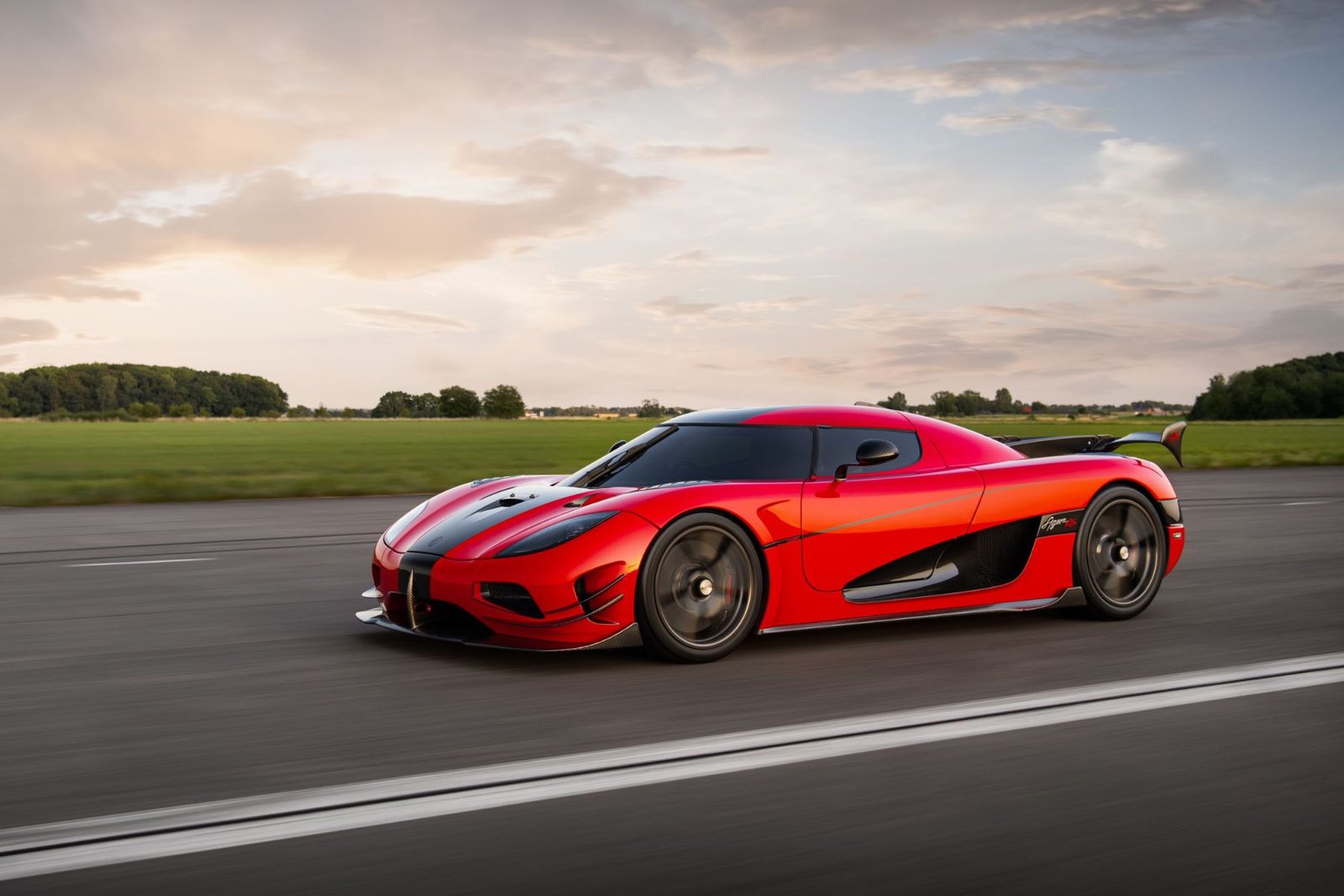
- Top Speed: 446.97 km/h – 277.87 mph
- Acceleration (0–100 km/h): 2.9 Seconds
- Engine: 5.0-litre V8, Twin-Turbo
- Maximum Power: 1,176 hp – 865 kW
- Maximum Torque: 940 lb-ft
- Transmission: 7-speed CIMA Single-Clutch Automated Manual
- Coefficient of Drag: 0.33 Cd
- Price: From USD $2.55 Million
Back in 2017, Koenigsegg tested their wheels on a closed 11-mile highway outside Las Vegas, Nevada, with the Agera RS and left the hypercar world speechless by setting five world records. Among these was the highest two-way top speed average at 277.87 mph (447.18 km/h). In a single direction, it reached an impressive 284.55 mph (457.93 km/h), and the best part was that this was an actual customer’s car, not even a prototype.
The car featured an optional one-megawatt package that boosted output to 1,341 hp and 1,011 lb-ft of torque, helping it crush a 0–249–0 mph challenge in just 33.29 seconds. This figure isn’t just impressive; it places the Agera RS among the top tier of high-performance vehicles and confirms why it is one of the most powerful machines on this list.
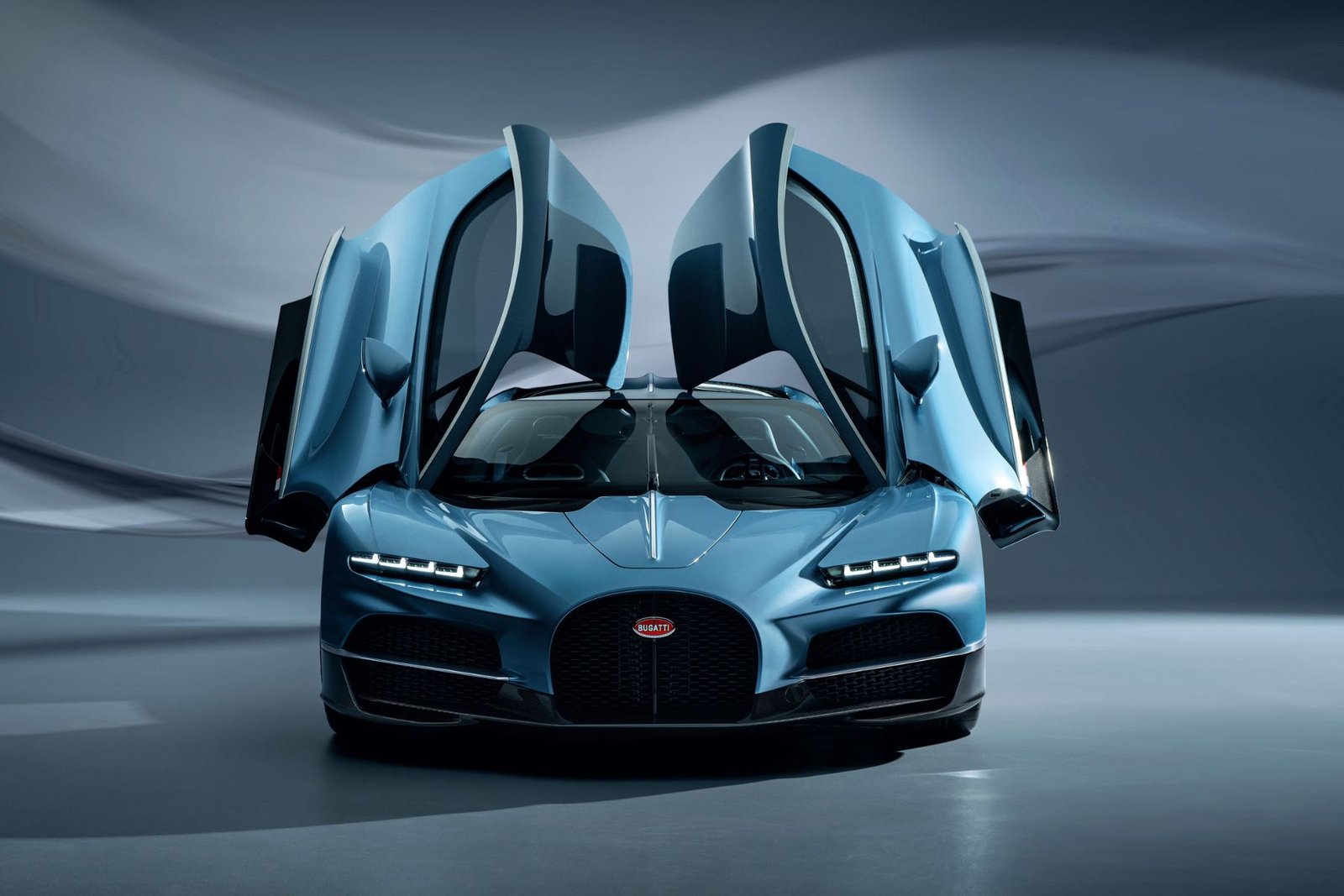
- Top Speed: 445 km/h – 276 mph
- Acceleration (0–100 km/h): 2.0
- Engine: 8.3-litre V16, Naturally Aspirated
- Maximum Power: 1,800 hp – 1,342 kW
- Maximum Torque: 1464 lb-ft
- Transmission: 8-Speed dual-Clutch Automatic
- Coefficient of Drag: 0.36 Cd
- Price: From USD $4 Million
Here’s an interesting twist in the Bugatti story. While the Bugatti Chiron Super Sport 300+ holds the legendary 300-mph record, the Tourbillon is actually the fastest machine customers can fully access and comes with a speed key that reaches a top speed of 276 mph (445 km/h). In other words, this is the king of all kings in modern Bugatti models.
What makes that even more impressive is the transformation happening behind the driver. The famous quad-turbo W16 is gone, replaced by a brand-new 8.3-litre naturally aspirated V16 developed with Cosworth, already a monster in its own right. Add a Rimac-sourced hybrid system, and total output rises to 1,800 horsepower with torque of 1,464 lb-ft, which borders on outrageous. The result is violent acceleration that hits 100 km/h in two seconds — and the kind of effortless high-speed confidence that has always defined the brand.
It also feels like there’s more to come. With Mate Rimac now leading, many think another official run is simply a matter of time. When that happens, don’t be surprised if the Tourbillon exceeds its current published limits. But we’ll see how things go.
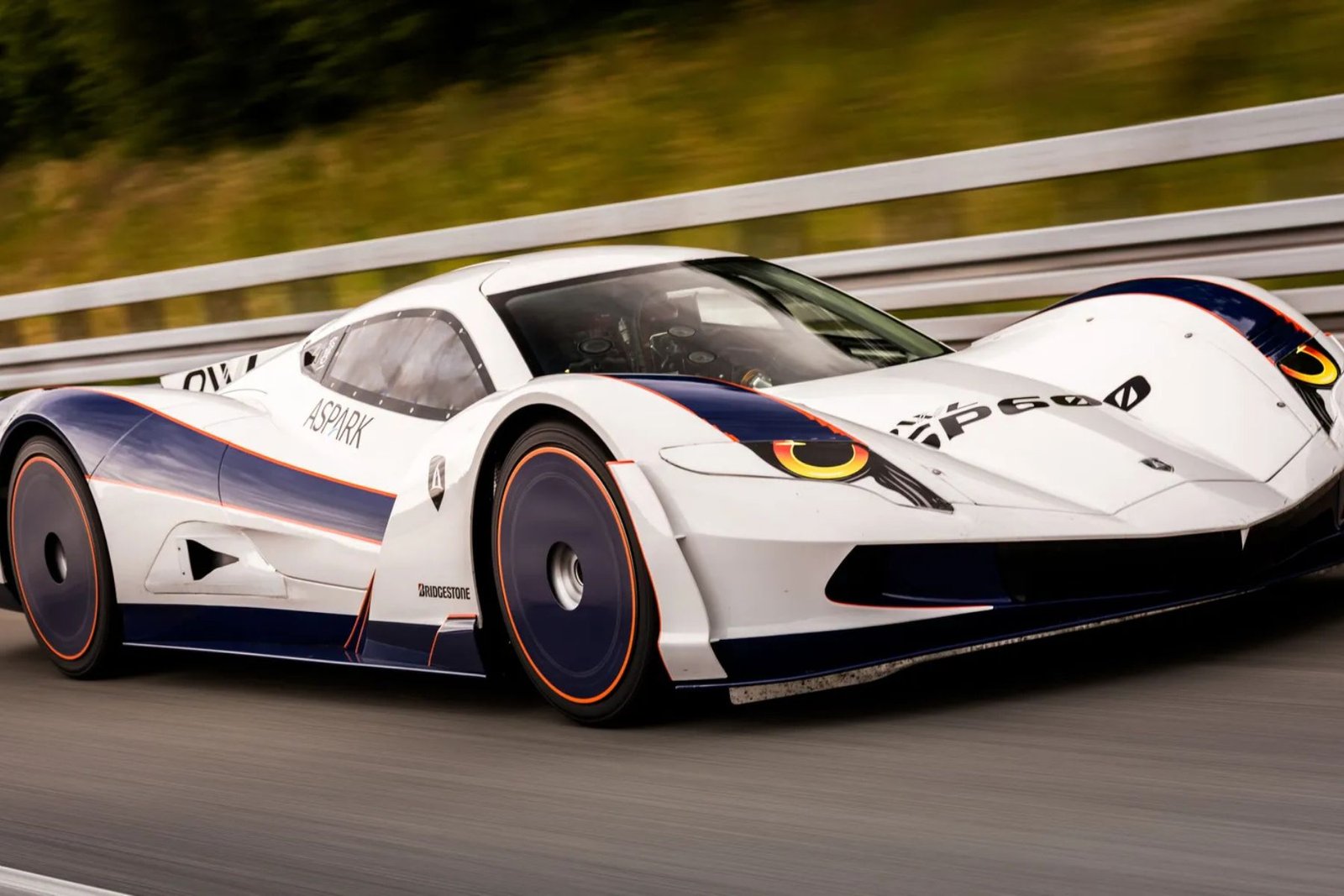
- Top Speed: 438.7 km/h – 272.59 mph
- Acceleration (0–100 km/h): 1.78 Seconds
- Powertrain: Quad-Motor Electric System
- Maximum Power: 1,953 hp – 1,456 kW
- Maximum Torque: 1,416 lb-ft
- Transmission: Direct-Drive Electric
- Coefficient of Drag: Not Available
- Price: From USD $4.2 Million
This is a wildcard that most people won’t see coming. Aspark Owl SP600 may bear a Japanese badge, but much of its engineering and production work originated in Italy, giving it a fascinating international flavour. The Owl SP600 became one of the fastest evolutions of the project in 2024, racing Marc Basseng, who pushed it to a staggering top speed of 272.59 mph (438.7 km/h), verified by Guinness World Records.
There is still some debate about the run’s format, but the Owl SP600 features a Quad-Motor Electric System that delivers 1,952 horsepower and 1,416 lb-ft of torque, along with a compact, lightweight carbon-fibre battery pack. This results in a 0–100 km/h sprint in just 1.78 seconds, making this machine not only a top-speed monster but also one of the fastest-accelerating electric vehicles ever built.
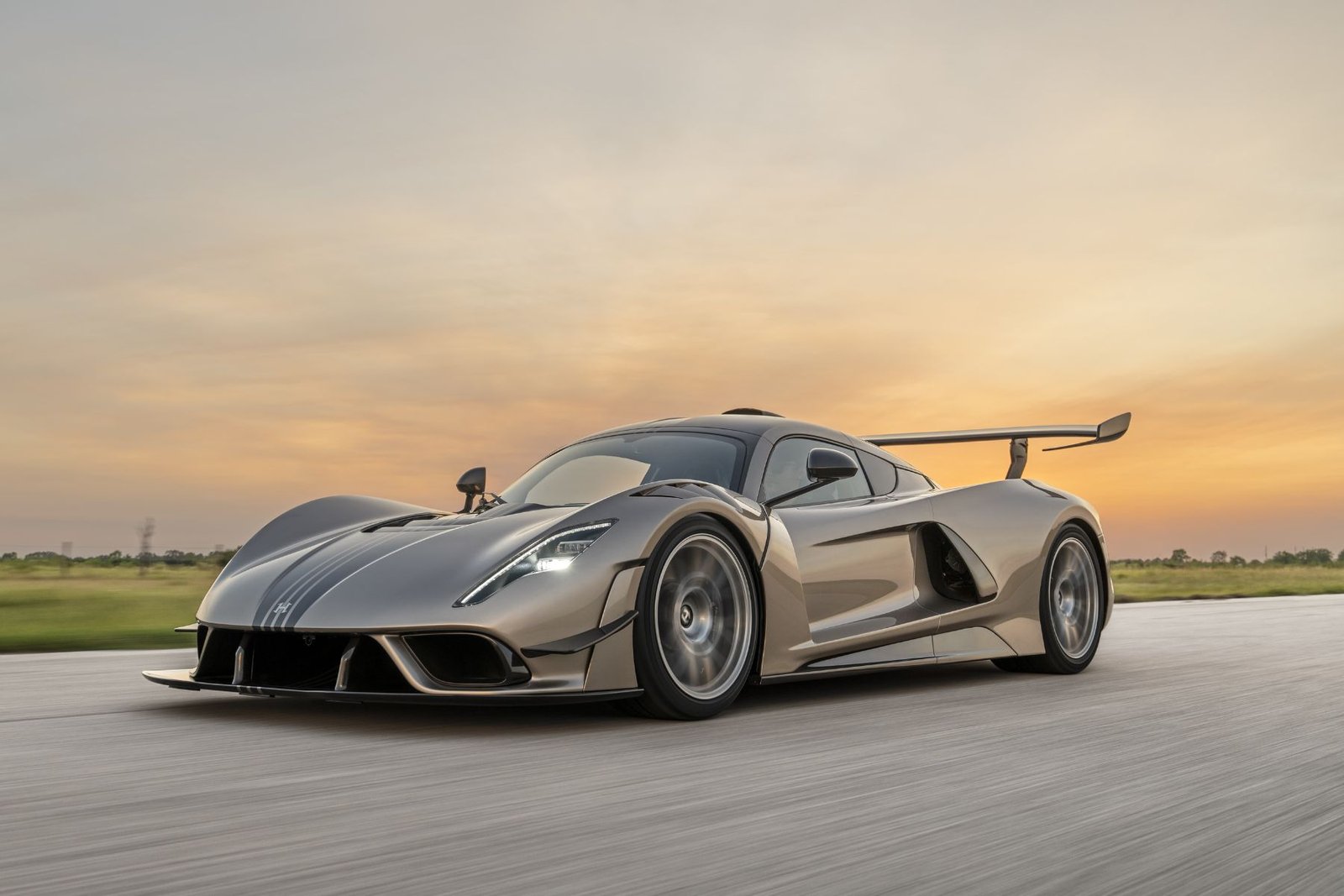
- Top Speed: 437 km/h – 271.6 mph
- Acceleration (0–100 km/h): 2.6 Seconds
- Engine: 6.6-litre V8, Twin-Turbo
- Maximum Power: 1,817 hp – 1,355 kW
- Maximum Torque: 1193 lb-ft
- Transmission: 7-Speed CIMA Single-Clutch Automated Manual
- Coefficient of Drag: 0.33 Cd
- Price: From USD $1.6 Million
North America refuses to stay quiet, so the battle for speed continues among other contenders. The Venom F5 answers Hennessy’s challenge to reach that benchmark, armed with a brutal 6.6-litre twin-turbo V8 producing 1,817 horsepower and 1,193 lb-ft of torque. Its aerodynamic design features a body shaped to cut through the air with a 0.33 drag coefficient, making it a machine built for one purpose only—to go faster than anyone else.
Even after its fellow American challenger, SSC Tuatara, was caught up in a controversial fake attempt, Hennessy’s timing couldn’t be better. The spotlight returned to the US with the Venom F5, which achieved a verified speed of 271.6 mph (437 km/h), instantly placing it among the top elites.
Many fans continue to speculate that Venom F5 could go even further, which is why the search for the right runway or track is ongoing. According to John Hennessey, founder of Hennessey, 2024 was expected to be the year the Venom F5 would officially break the 300mph barrier, and we have been patiently awaiting the results ever since.
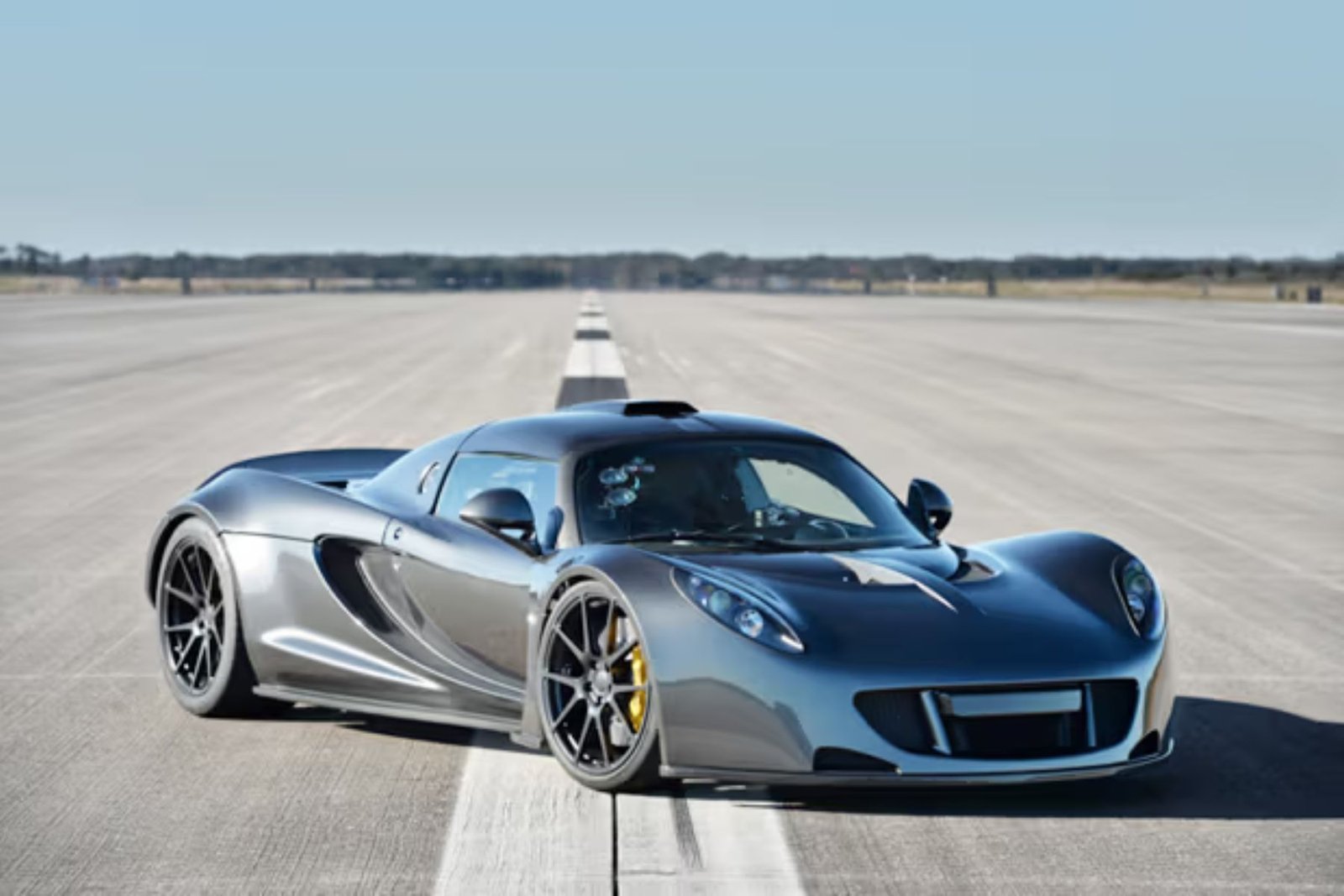
- Top Speed: 435.31 km/h – 270.49 mph
- Acceleration (0–100 km/h): 2.9 Seconds
- Engine: 7.0-Litre GM LS7 V8, Twin-Turbo
- Maximum Power: 1,244 hp – 928 kW
- Maximum Torque: 1,155 lb-ft
- Transmission: Ricardo 6-Speed Manual
- Coefficient of Drag: 0.33 Cd
- Price: From USD $1.4 Million
Before Venom F5 arrived, Hennessey had already created a giant killer with the Hennessey Venom GT. This project didn’t originate in a boardroom or with a billion-dollar development plan; it was a daring experiment that became serious, and progress followed.
“One day I joked about putting the Venom 1000 Twin Turbo engine (from the Viper) in the back of a Lotus Exige,” John Hennessey once said. “Then I thought, let’s do a sketch and see what that might look like. When I saw the sketch, I stopped laughing and really started to seriously think about this idea.”
A few years later, this project finally hit the asphalt on February 14, 2014, and the rest was romance. The Venom GT roared down the Space Shuttle landing runway at the John F. Kennedy Space Center, reaching a speed of 270.49 mph (435.31 km/h), and Guinness recognized that record. Just when the car didn’t feel outrageous enough, the owners decided to install an audio system tuned by Steven Tyler.
Looking back, Hennessey’s early vision now reads almost like a prophecy. “A mid-engine design like the Ford GT will put the weight of the motor and transmission over the rear tyres, giving better traction. Design as much downforce as we will need to have a car that handles like a kart on the road or race track. At the same time, we also have a car with the best power-to-weight ratio possible, giving unmatched acceleration. This is how the Venom GT concept was born.” A 270-mph missile with rock-and-roll. Only in America.
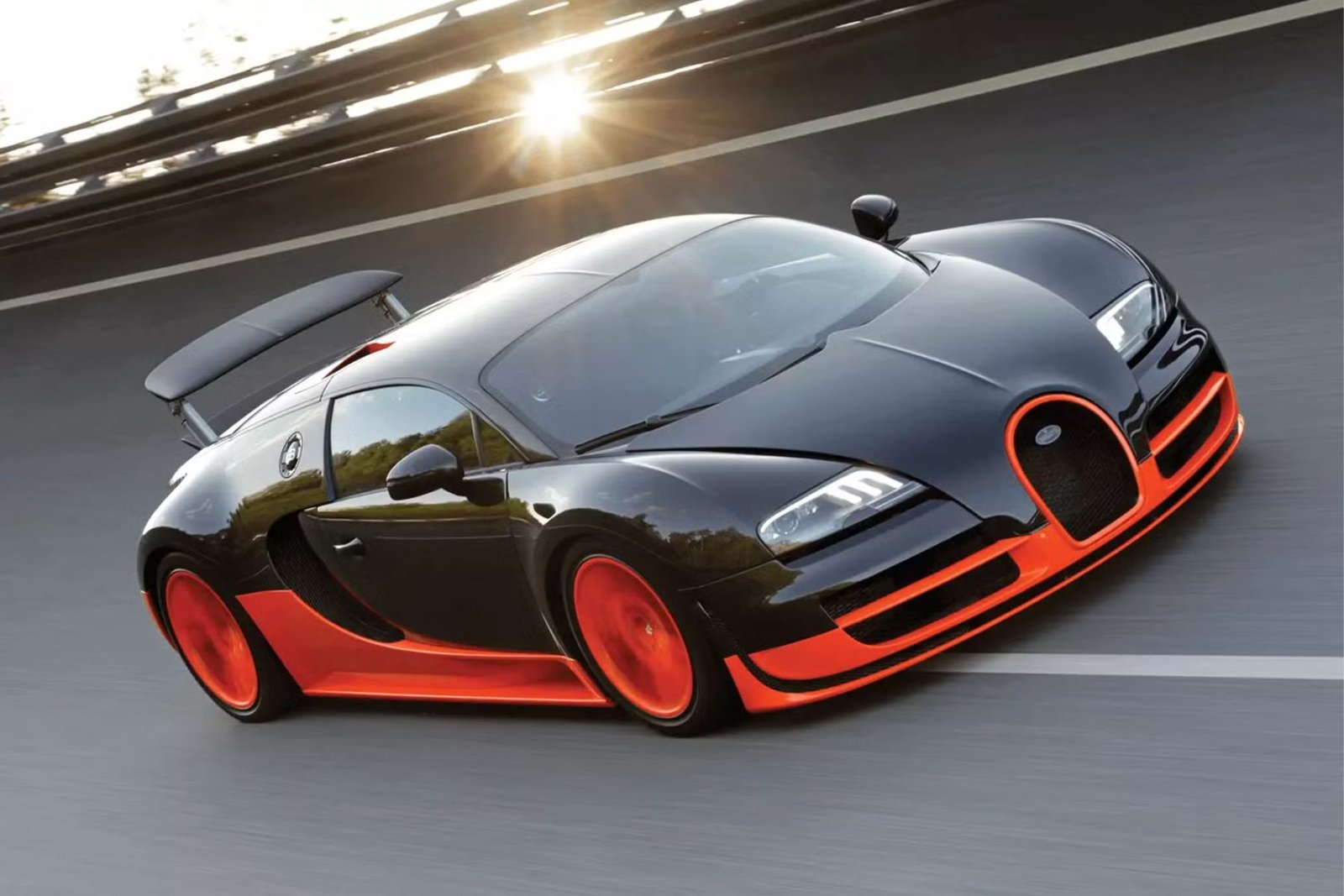
- Top Speed: 431.07 km/h – 267.85 mph
- Acceleration (0–100 km/h): 2.5 Seconds
- Engine: 8.0-Litre W-16, Quad-Turbo
- Maximum Power: 1,200 hp – 882 kW
- Maximum Torque: 1,106 lb-ft
- Transmission: 7-Speed Ricardo Dual-Clutch Automatic
- Coefficient of Drag: 0.36 Cd
- Price: From USD $2.4 Million
Before the electric missiles and boutique challengers, this was the car that made the world talk about the years to come of how fast it was. When the Bugatti Veyron Super Sport stormed down at Ehra-Lessien in 2010, it achieved a two-way average of 267.86 mph-431.07 km/h, a figure that seemed impossible at the time. Overnight, Bugatti had created a hypercar headline into a completely new era of speed.
Of course, there were some complications. Questions arose about the differences in specifications between the record car and the vehicles delivered to customers. Production versions were electronically limited to 258 mph, while the Bugatti version used to attempt the record could go faster, nearly 270 mph in one direction, before establishing the famous average. Guinness eventually changed how it handled earlier records, leading to the Veyron’s title being disqualified under the newer rules. Nevertheless, the performance itself was never erased.
Back then, a 1200 hp engine with over 1,100 lb-ft of torque sounded like a bullet with incredible speed. The Bugatti Super Sport changed the definition of speed and reset expectations across the industry and among competitors with its capabilities. Later, including Bugatti’s own Bugatti Chiron Super Sport 300+, it will climb even higher and showcase what Bugatti will bring next.
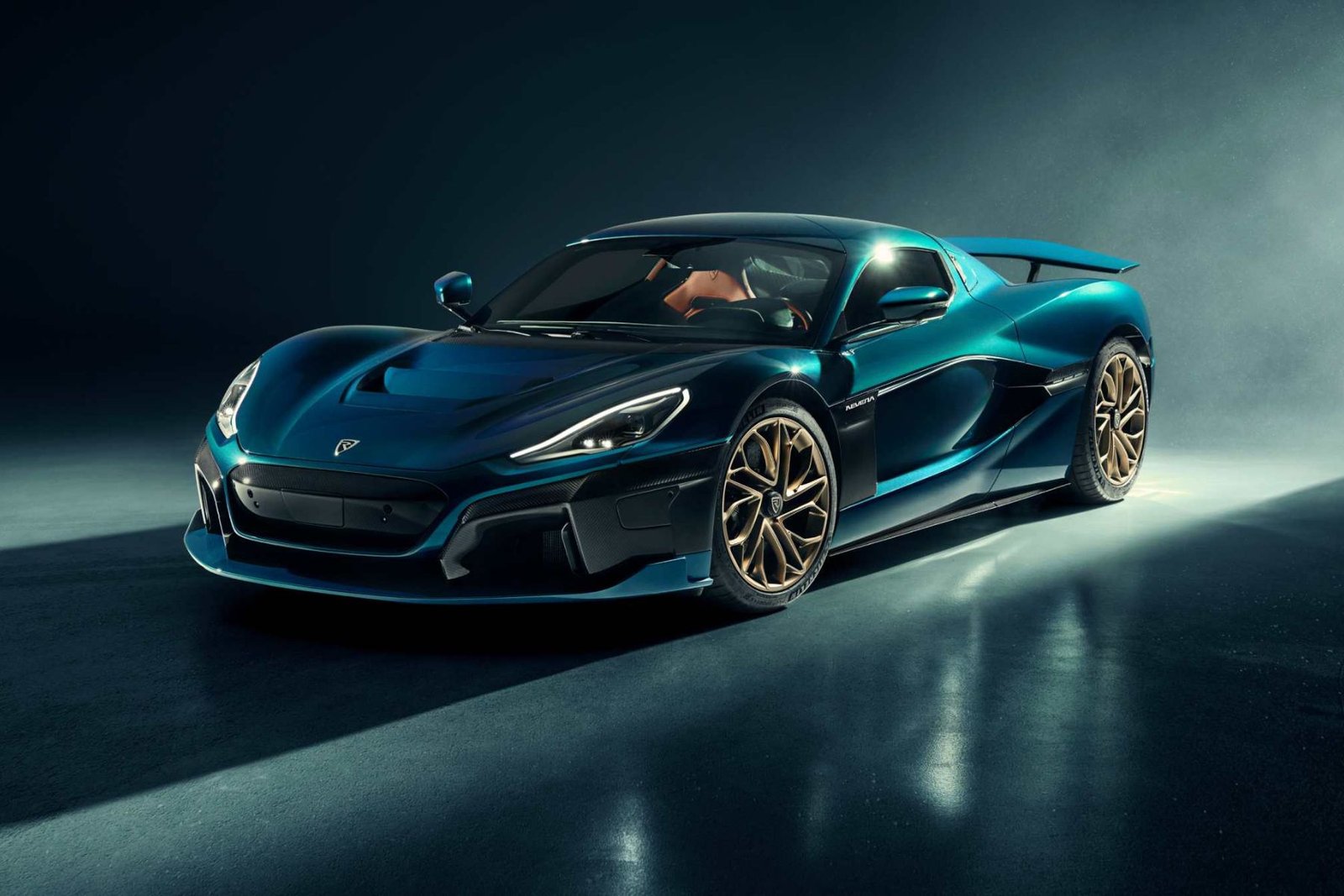
- Top Speed: 412 km/h – 256 mph
- Acceleration (0–100 km/h): 1.8 Seconds
- Powertrain: 4x Independent Surface-Mounted, Carbon-Sleeve, Permanent-Magnet Electric Motors
- Maximum Power: 1,888 hp – 1,388 kW
- Maximum Torque: 1,741 lb-ft
- Transmission: Single-Speed Direct-Drive Transmission
- Coefficient of Drag: 0.30 Cd
- Price: From USD $3 Million
The company behind the Nevera has one of the most fascinating origin stories in modern automotive history. Rimac Automobili was founded by Mate Rimac in 2009, starting as a bold startup with big ideas about electric vehicles. Over time, that small ambition has transformed into a technology leader and eventually led to the Bugatti Rimac partnership. But before any corporate alliances, Rimac had already proven it could set records on its own with the Rimac Nevera.
Electric cars were known for explosive launches and limited top-end performance, but the Nevera tore that idea. With four motors operating independently, the car produces 1,888 horsepower and reaches 100 km/h in 1.8 seconds, then continues to a verified top speed of 256 mph.
Just when you thought it was the end, Rimac turned the volume up again. This time with the Nevera R, featuring more power, improved aerodynamics, and tyres designed to handle the madness, all in the works to reach higher performance records. We’re definitely excited for that.
At one time, each of these cars was proudly among the top 10 fastest in the world. However, as records were broken, technology has advanced, and Top Speeds keep climbing, which means even the giants eventually make way for the next Tier. But it gives you that timeline of their origins and current standing. Although these machines are no longer in today’s rankings, they have left a significant mark on history over the years.
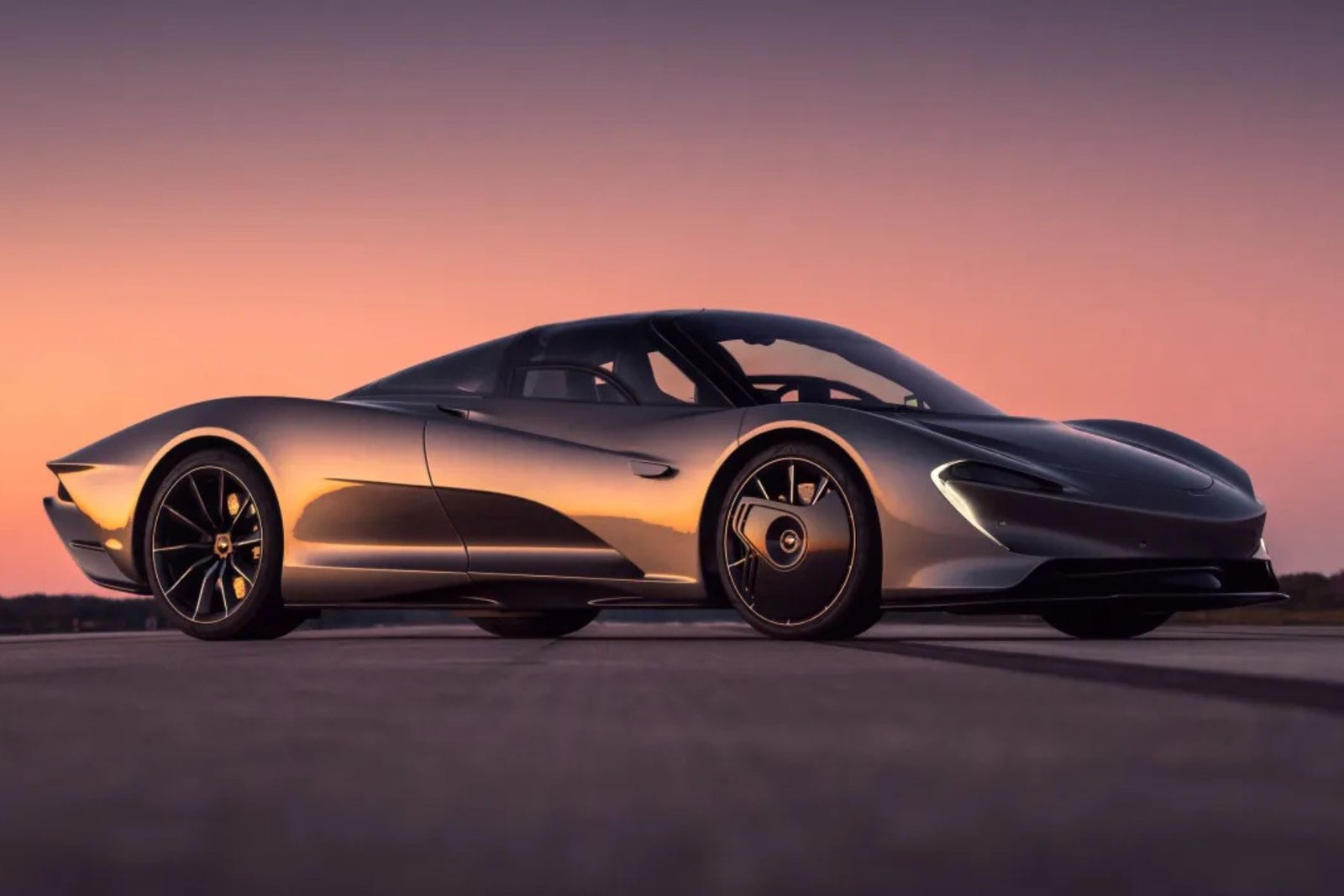
- Top Speed: 403 km/h – 250 mph
- Acceleration (0–100 km/h): 3 Seconds
- Engine: 4.0-litre V8, Twin-Turbo
- Maximum Power: 746 hp – 556 kW
- Maximum Torque: 590 lb-ft
- Transmission: 7-Speed Graziano Dual-Clutch
- Coefficient of Drag: 0.278 Cd
- Price: From USD $2 Million
Some cars attempt to dominate the list with outrageous horsepower numbers; however, the McLaren Speedtail took a different approach. This one is rated at only 746 hp and still reaches a top speed of 250 mph (403 km/h). Now that’s incredible. McLaren relied on the car’s shape, balance, and efficiency to outperform expectations, instead of focusing on mechanics with a 4.0-litre V8, Twin-Turbo, and 590 lb-ft of torque.
McLaren stretched the body into a long, flowing shape designed to cut smoothly through the air, and that aerodynamic profile — supported by the remarkably low 0.278 Cd figure — allows the Speedtail to accelerate in a way that feels smooth and almost relaxed, making it one of the most attractive hypercars on our list, if not one of our favourites overall.
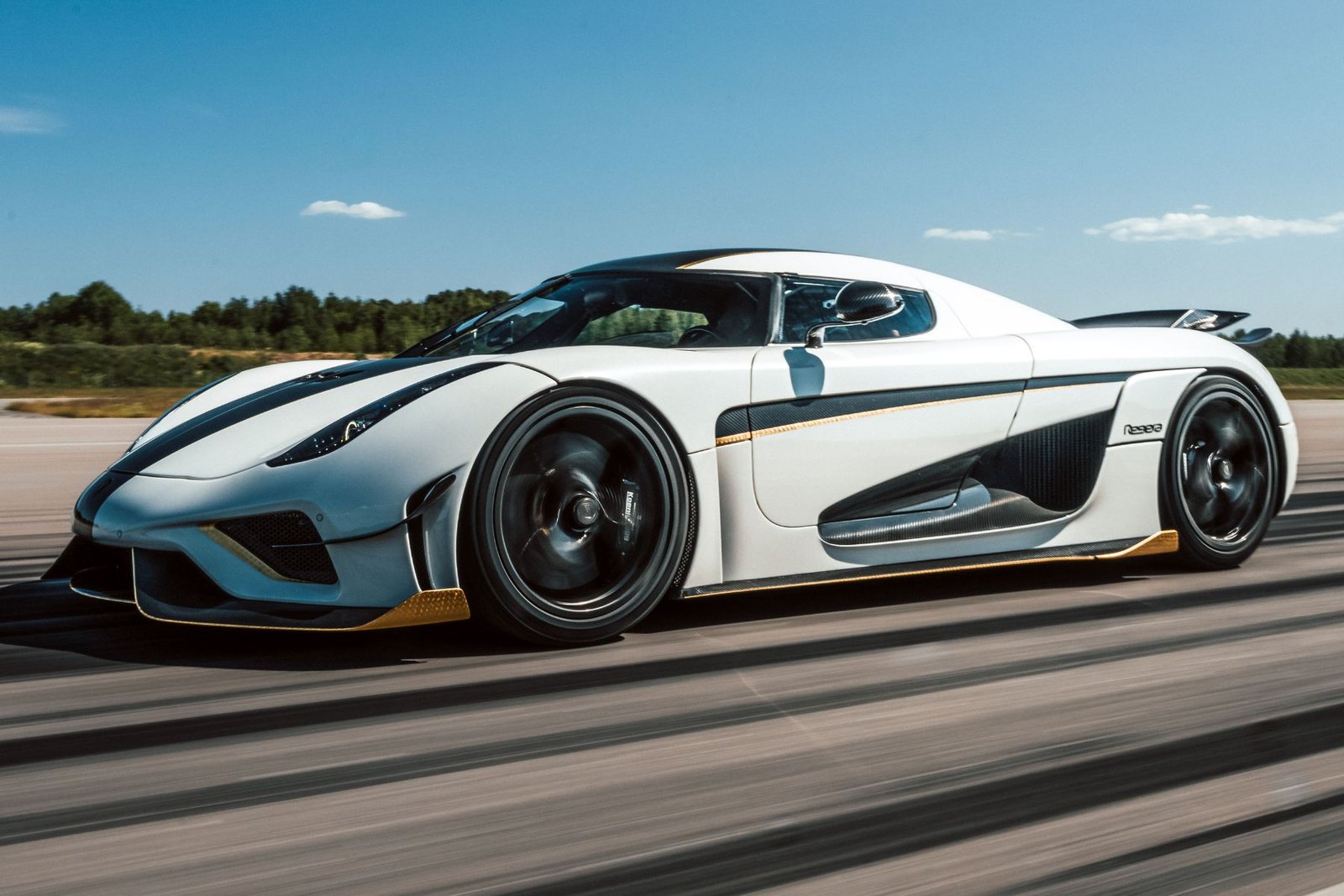
- Top Speed: 400 km/h – 249 mph
- Acceleration (0–100 km/h): 2.8 Seconds
- Engine: 5.0-litre V8, Twin-Turbo
- Maximum Power: 1,500 hp – 1,119 kW
- Maximum Torque: 944 lb-ft
- Transmission: Koenigsegg Direct Drive Transmission (KDD)
- Coefficient of Drag: 0.278 Cd
- Price: From USD $1.9 Million
When Koenigsegg introduced the Regera, it didn’t want to join the horsepower race like its competitors. The brand had a different idea; instead of increasing gears, horsepower, and complexity, Christian von Koenigsegg aimed to deliver infinite acceleration—the feeling of one continuous, unbroken push that never loses its rhythm. It sounded crazy at the time, but it worked and people loved it.
The Regera features a twin-turbo V8 combined with an electric torque system capable of delivering 1,500 horsepower to the rear wheels. But how exactly, you might ask? Well, the secret lies in a Direct Drive System, which avoids traditional gearboxes with shifting ratios, providing a smooth, continuous power surge that gradually builds, creating a sensation of acceleration rather than a sudden launch. Its official top speed is 400 km/h, limited by the electronic limiter; many believe there is still additional headroom that hasn’t been utilised. We’ll see what the Swedish powerhouse comes up with next.
Speed records are frequently accompanied by bold claims and online debates, making it difficult to distinguish marketing from fact. For this reason, we rely exclusively on independently verified results rather than manufacturer claims or theoretical projections. Each car included has proven its performance under documented conditions, supported by timing data, official runs, or widely recognized validation. This ranking reflects actual achievements, not hypothetical possibilities.