


Cars

Mercedes-Benz Goes Full Gangster With The Vision Iconic

Reading Time: 7 minutes

Share via

Our team of editors and experts thoughtfully chooses each product. If you decide to buy through one of our links, we may earn a commission. Learn more. Want to know how we test products? Click here for more details.

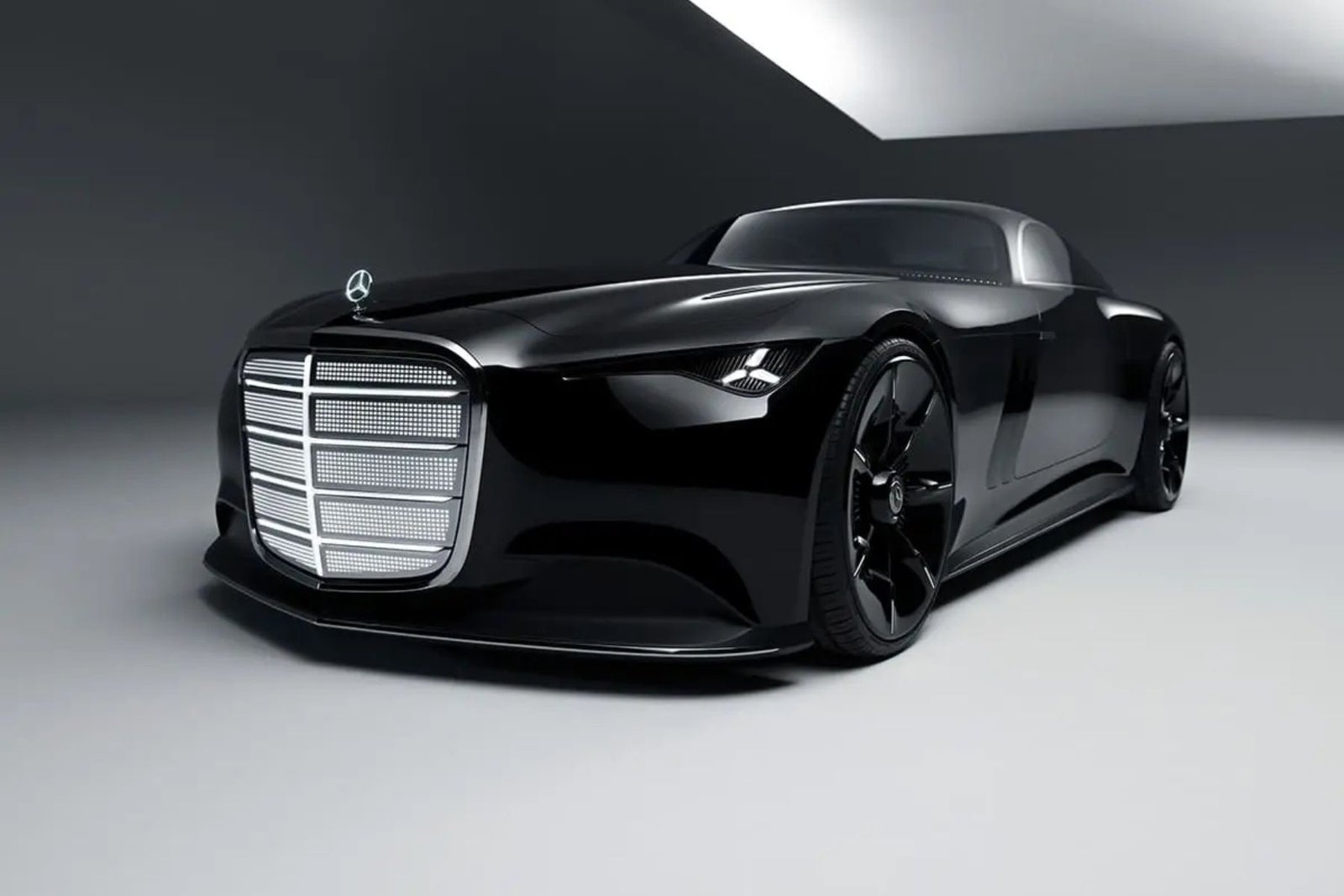
Ever wanted to arrive at a wedding in full gangster mode, dressed head to toe in a blacked-out tuxedo, sunglasses on, and hell of confidence dialled all the way up, and own the room? That’s exactly what you are looking at, even though this is a concept by Mercedes-Benz called the ‘Vision Iconic’. Even though it will almost certainly never see a production line, the Vision Iconic feels like it’s making a dramatic entrance, and yet it dangerously is aware of its surroundings.

Mercedes-Benz calls it the Vision Iconic, and while the name might be bold, the design supports it. In an era where many concept cars feel awkward or overdesigned, this one manages to look genuinely good, leaning into exaggerated luxury. It definitely takes inspiration from the 1930s and 1940s and grand concepts like the Cadillac 16, the Maybach Excelero, and even the Daimler Double-Six, all of which feature a modern cinematic edge.

The Vision Iconic isn’t about what will hit showrooms next year, but about reminding everyone of what the brand is capable of when it allows creativity to lead. As Markus Schäfer explains, “Vision Iconic embodies our vision for the future of mobility,” adding, “With groundbreaking innovations such as neuromorphic computing, steer-by-wire, solar paint, and Level 4 highly automated driving, along with state-of-the-art technology, we are setting new standards for the electric and digital age. This beautiful vehicle is a testament to our commitment to making the mobility of tomorrow a reality today.”
Mercedes-Benz Vision Iconic | Image: Mercedes-Benz

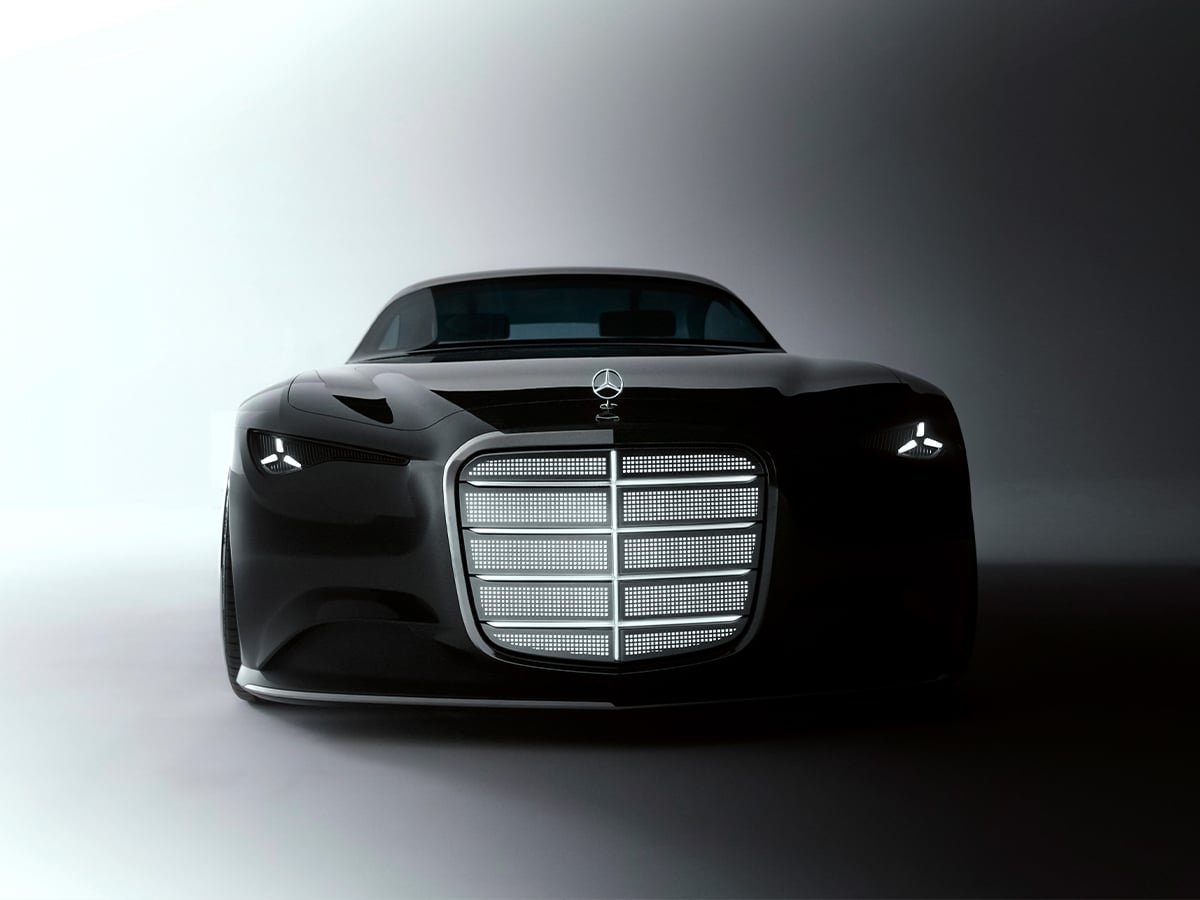
Let’s start with the front end, where the Vision Iconic immediately grabs everyone’s attention with its grille. Its upright stance is a nod to some of Mercedes-Benz’s most commanding luxury cars, including the 600 Pullman and the W108 and W111 sedans, but the execution feels completely modern. The wide chrome trim around the smoked-glass grille, along with the small lights tucked into the design, give the Vision Iconic its character. One thing is certain: that front grille isn’t just for show; it delivers that strong Mercedes-Benz presence, reasserting some of the authority and prestige many fans think has been lost in recent models.

Speaking about the headlights, they really nailed it, didn’t they? They’re thin, sharp, and they definitely complement the car’s overall look like little star lights. They’ve got all the latest lighting tech and don’t detract much from the overall design, and I think that hits the sweet spot, mixing old ways with modern lighting innovations and what Mercedes-Benz does best.
Mercedes-Benz Vision Iconic | Image: Mercedes-Benz

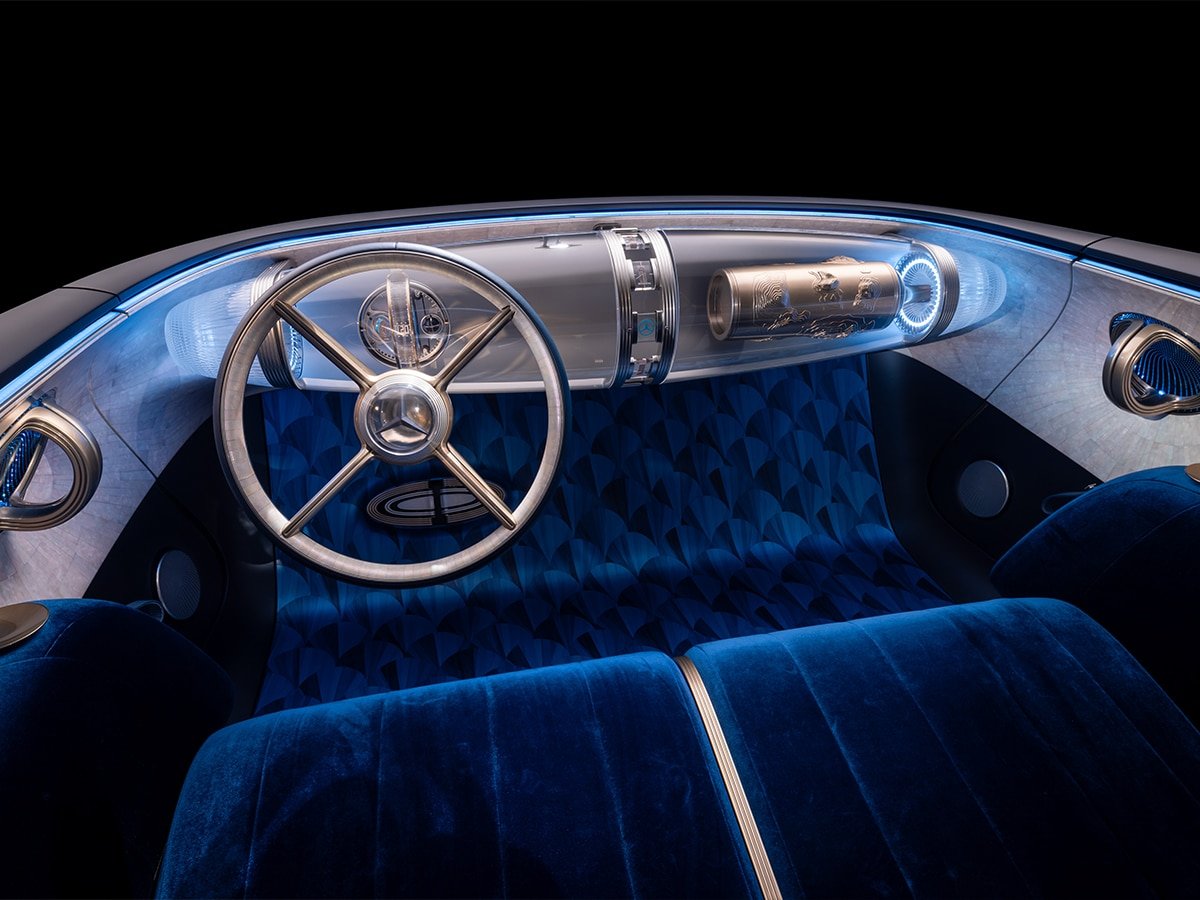
This is where things get interesting, especially once automation comes into play. Mercecedes uses the Vision Iconic to explore options beyond driving, and the end result feels more like a rolling lounge than a traditional cockpit. The entire dashboard feels like a floating, glass-like centerpiece inspired by the classic Zeppelin structure, giving it that old 30s and 40s vibe, and I gotta say, it definitely grabs our attention.

That’s not all from the floating centre structure; if you take a closer look, inside sits a decorative surface finished in mother-of-pearl marquetry, which continues onto the door panels and wraps around beautifully polished brass door handles. The rear seating area is framed by a glowing star pattern, while up front, the driver and passenger share an old-school bench seat trimmed in deep blue velvet. Add in a boat-style four-spoke steering wheel and a floor finished in straw marquetry, and the whole space feels more like an Art Deco salon than anything you’d expect from a modern concept car.

What’s interesting is how the technology is presented here because it doesn’t demand attention. When the door opens, the cabin activates with a fully analogue-style animation inspired by luxury chronograph watches—a small detail that feels surprisingly satisfying. One of the four clock-like displays is even shaped like the Mercedes star and functions as an AI companion. It’s a curious blend of traditional luxury and futuristic technology, and they seem to complement each other well. The real question is: how should we view this car?
Mercedes-Benz Vision Iconic | Image: Mercedes-Benz

Interestingly, despite all the talk about automation, Mercedes-Benz hasn’t forgotten the moments when you actually want to drive. One of the more radical ideas shown here is the introduction of steer-by-wire technology, marking a first for the brand. There’s no mechanical link between the steering wheel and the front wheels, which initially sounds strange, but when combined with rear-axle steering, it aims to make a vehicle of this size feel much more manageable. In theory, it allows for quicker responses at low speeds and greater stability at higher speeds, giving drivers a sense of control even in something as long and imposing as the Vision Iconic.

With that said, the Vision Iconic leans toward the future, where driving becomes an optional feature, similar to a Tesla. The Vision Iconic envisions an advanced urban assistance system that manages point-to-point travel within city environments, operating at an improved Level 2 standard. On highways, it shifts to a Level 4 automated driving system that takes full control, and the cabin transforms entirely, allowing the driver and passenger to relax and enjoy browsing or listening to music. As the brand itself states, “the car becomes a luxurious lounge,” as the interior design begins to better reflect what’s happening.

Not much has been said about the powertrain technology yet, but Mercedes has been experimenting with concept cars, such as the Mercedes-AMG GT XX concept from last summer, to understand how it will sustain itself in the future. The brand has been exploring the idea of using ultra-thin solar coatings on the vehicle’s exterior, turning the bodywork into an energy-harvesting surface. Pretty impressive, right? This idea creates a photovoltaic layer that could generate enough power to cover up to 12,000 kilometres of driving per year for a mid-size SUV. It’s not a promise just yet, but it does show how luxury and technology are evolving.
Mercedes-Benz Vision Iconic | Image: Mercedes-Benz

The Vision Iconic launch extended beyond just the car, with the overall presentation resembling a scene from a Great Gatsby dream. Alongside the concept, Mercedes-Benz revealed a curated collection of bespoke outfits for both men and women, inspired by the glamour and excess of 1920s and 1930s luxury. Dark blue tones and silver-gold accents run throughout the collection showcased during Shanghai Fashion Week.

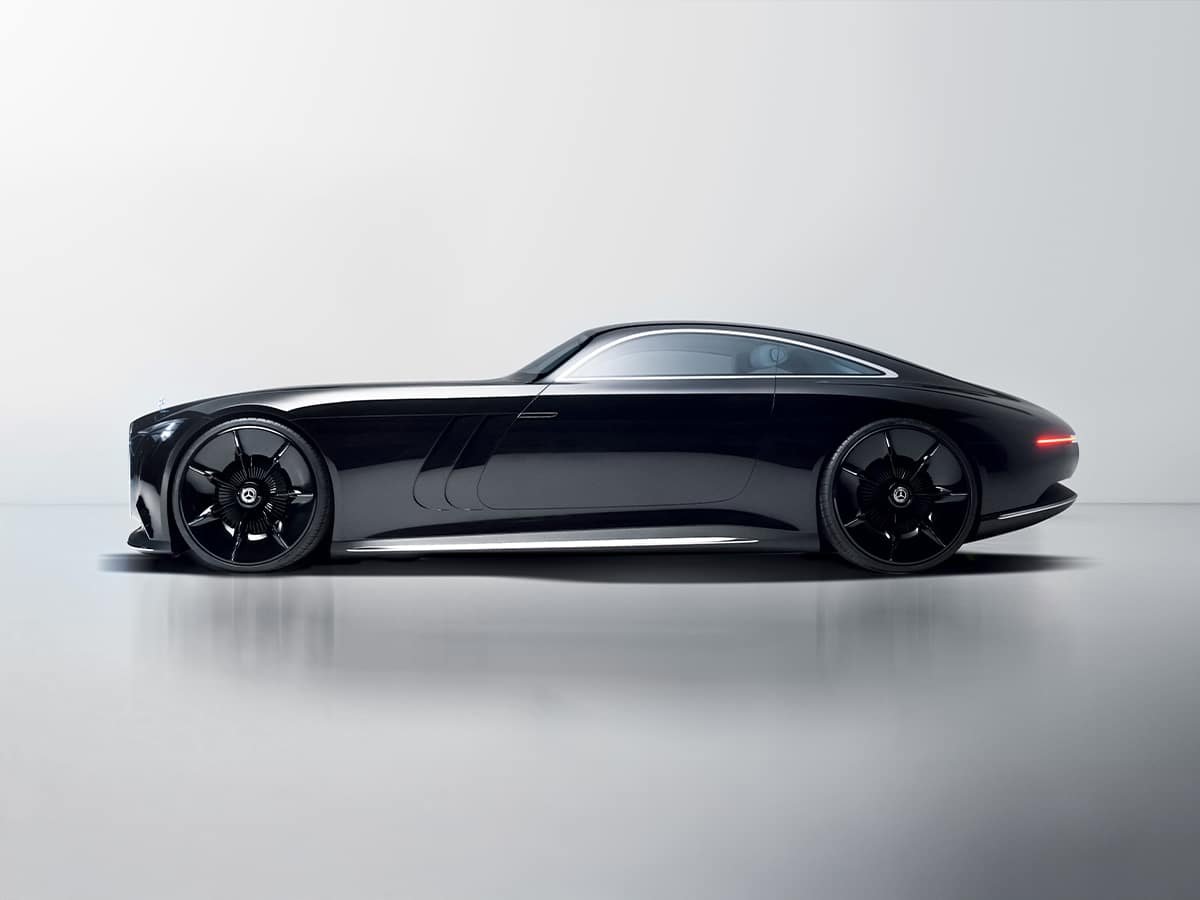
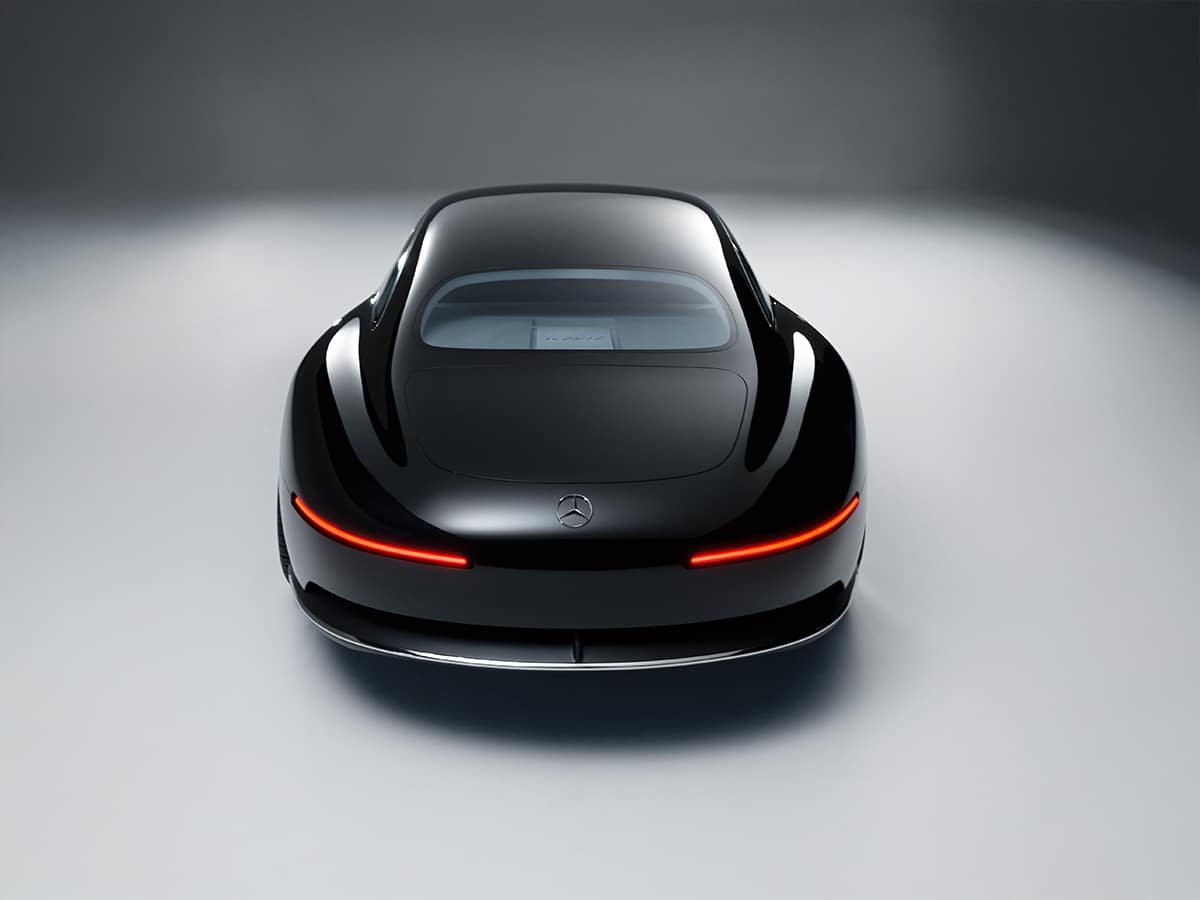
As Gorden Wagener puts it, “Inspired by the golden era of automotive design of the 1930s, this show car embodies the pure essence of Mercedes-Benz,” he says. “With its seemingly hood giving it a majestic presence, sculptural flowing lines, and a touch of Art Deco, it rises to become a true icon of automotive beauty. The interior with its continuous bench seat and the elegant rear, evoking memories of the legendary 300 SL. Our Vision Iconic is more than just an automobile – it is a sculpture in motion, a homage to timeless elegance, and a statement for the future. The symbiosis of traditional craftsmanship, state-of-the-art technology, and an unmistakable design language makes it the ultimate expression of value, prestige, and grace: the most beautiful, most prestigious kind of thing.”

Of course, this remains exactly that, a design concept. It’s highly unlikely that the Vision Iconic will ever go into production, but that’s not really the point. Its purpose is to spark conversation, challenge expectations, and show other brands what Mercedes-Benz looks like when it dreams without limits.


Mercedes Benz
About the Author
Previous Post
OMEGA’s New Vision for the Speedmaster Dark & Grey Side of the Moon
Next Post
2026 Porsche 911 GT3 (992.2) Review: Why Everyone Is Trying To Buy This Car?

Related Articles

The 3 Best Foldable Phones You Can Buy Right Now

Reading Time: 11 minutes

Our team of editors and experts carefully selects each product. If you choose to purchase through one of our links, we may earn a commission. Learn more. Do you want to know how we test products? Click here for more details.

Once considered a futuristic fantasy, foldable phones are now a reality — but let’s be honest, the technology is still finding its footing. We’re still in the early stages, where foldable devices are maturing quickly but haven’t fully captured the mainstream market yet. Most people are still holding on to traditional smartphones, waiting for foldables to either become more durable, more affordable, or simply more “normal” before making the switch.

However, if you’re even slightly curious, there’s something truly exciting about this new wave of devices. Imagine unfolding a compact phone to reveal a screen large enough for immersive gaming, multitasking like a pro, or watching your favorite Netflix show with a genuine cinematic feel — all from a device that still fits in your pocket. That’s the magic that foldable phones aspire to: the convenience of a regular smartphone combined with the flexibility of a small tablet.

Although the foldable phone market remains relatively small compared to traditional flagships, it is experiencing rapid growth. Brands like Samsung, Google, and others continually push boundaries, offering improved designs, sturdier hinges, brighter screens, and more innovative software enhancements that genuinely make folding your phone feel practical — rather than merely a flashy gimmick.

If you’re ready to explore something different (and undeniably cooler), here’s a look at the three best foldable phones available for purchase right now — the ones that demonstrate the future of smartphones are already here.

CHECK OUT: The 5 Best Android Phones You Can Buy Today

Quick Picks: Best Foldable Phones at a Glance

Samsung Galaxy Fold 6 | Image: Samsung

Samsung Galaxy Fold 6

  • Brand: Samsung
  • Model: Galaxy Z Fold6
  • Display: 7.6-inch QXGA+ Dynamic AMOLED 2X (Main); 6.3-inch HD+ Dynamic AMOLED 2X (Cover)
  • Processor: Qualcomm SM8650-AC Snapdragon 8 Gen 3
  • Memory: 12GB RAM
  • Storage: 256GB, 512GB, or 1TB options
  • Camera: Rear: 50MP Wide + 12MP Ultra-Wide + 10MP Telephoto, Front (Cover): 10MP
  • Price: From USD $1,899

If you’re serious about diving into the world of foldables, the Samsung Galaxy Z Fold6 is the one leading the pack. Samsung didn’t reinvent the wheel this year, but they polished nearly everything. The design feels more natural in hand, featuring a slightly wider cover screen that’s easier to type on without feeling cramped — a significant improvement that many users immediately noticed. Once you unfold it, the 7.6-inch AMOLED display remains as impressive as ever, providing an ideal setup for gaming, streaming, or multitasking.

Most users agree that day-to-day performance is buttery smooth, whether you’re switching between apps, editing photos, or even shooting videos. (And yes, the ability to film in up to 8K at 30fps is a significant plus.) People also appreciate practical upgrades like the side-mounted fingerprint sensor, enhanced hinge durability, and IP48 dust and water resistance, which finally provide a bit more peace of mind for everyday use.

That said, it’s not all perfect. Some users mention that the crease in the middle of the display — while slightly less noticeable than before — is still present and catches the light at certain angles. Others point out that the phone’s sheer size and weight make it feel more like carrying two phones stacked together rather than a sleek, ultra-portable device. With a starting price around $1,899 USD, it’s definitely a luxury purchase, not something everyone will easily justify.

Still, most real-world users who took the plunge agree on one thing: once you become accustomed to the Fold6’s larger screen and flexibility, it’s very difficult to return to a traditional phone. If you seek the best foldable experience available today — and are okay with a few quirks — the Galaxy Z Fold6 remains the foldable to beat.

Google Pixel 9 Pro Fold | Image: Google Store

Google Pixel 9 Pro Fold

  • Brand: Google
  • Model: Pixel 9 Pro Fold
  • Display: 7.9-inch OLED (Main); 6.4-inch OLED (Cover)
  • Processor: Google Tensor G4
  • Memory: 12GB RAM
  • Storage: 256GB or 512GB
  • Camera: Rear: 50MP Main + 48MP Ultra-Wide + 48MP Telephoto, Front (Cover): 9.5MP, Inner: 8MP
  • Price: From USD $1,799

If Samsung’s Fold feels like a polished powerhouse, the Google Pixel 9 Pro Fold offers a fresh, smarter alternative. Users seem to love the Pixel Fold’s natural “passport-style” design — it is wider and shorter than the Galaxy Fold, which makes it feel more like a regular phone when closed and less like a TV remote. That alone makes it more comfortable for one-handed use, and many users indicate they prefer the way it feels in daily life.

Where the Pixel 9 Pro Fold truly excels is in the software experience. Google’s version of Android is clean, intelligent, and fully optimized for a folding device. App continuity operates seamlessly, split-screen multitasking feels smooth, and overall, the phone doesn’t just fold — it intelligently adapts when you do. If you’re looking for a folding phone that feels polished on the inside, not just on the outside, this one gets it right.

Cameras represent another significant advantage for the Pixel 9 Pro Fold. It easily outperforms most other foldables in real-world photography. The 50MP main sensor captures crisp, detailed images, and Google’s integrated AI tools such as Magic Eraser and Best Take make photo editing effortless. Users frequently highlight how simple it is to capture amazing photos without needing to worry much about lighting or settings — a feature for which Pixel phones have long garnered praise.

Yet again, it does have some downsides. Some users point out that the crease running down the center of the Pixel Fold’s display is slightly more visible compared to Samsung’s design. Others note that while the Tensor G4 chip is fast and efficient for everyday tasks, it doesn’t quite match the raw gaming and processing power of Snapdragon chips under heavy use. Although durability appears to be better than the first generation, some still feel cautious about how the hinge and screen will hold up after a year or two of intense use.

That said, with a starting price of around $1,799 USD, the Pixel 9 Pro Fold is slightly more affordable than Samsung’s top-tier Fold, making it a serious contender. If you want a foldable that feels like a regular phone when closed, offers incredible cameras, and provides one of the smartest Android experiences available today, the Pixel 9 Pro Fold delivers. It’s not just about looking different; it’s about making the foldable life feel natural.

Samsung Galaxy Z Flip 6 | Image: Samsung

Samsung Galaxy Z Flip 6

  • Brand: Samsung
  • Model: Galaxy Z Flip6
  • Display: 6.7-inch FHD+ Dynamic AMOLED 2X (Main); 3.4-inch Super AMOLED Cover Display
  • Processor:  Qualcomm SM8650-AC Snapdragon 8 Gen 3
  • Memory: 12GB RAM
  • Storage: 128 GB, 256GB or 512GB options
  • Camera: Rear: 50MP Wide + 12MP Ultra-Wide, Front: 10MP
  • Price: From USD $1,099

If the Galaxy Fold is all about going big, the Samsung Galaxy Z Flip6 is all about being compact and stylish. This foldable is designed for those who don’t want a mini tablet in their pocket — they simply want a phone that folds in half, feels great in hand, and looks even better when opened. Real-world users appreciate how satisfying the flip motion is, reminiscent of snapping shut a classic flip phone, but with a stunning 6.7-inch AMOLED display waiting inside.

One of the most praised updates to the Flip6 is its improved cover screen. At 3.4 inches, it’s larger and smarter than ever, allowing you to check messages, control music, access widgets, and even reply to texts without opening the phone. Users report it finally feels useful, not just decorative, making quick interactions much more convenient. Samsung has clearly listened to feedback from previous generations, enhancing the small screen experience significantly.

When it comes to performance, the Flip6 stands out thanks to the Snapdragon 8 Gen 3 and a solid 12GB of RAM. Daily tasks such as messaging, social media, and streaming are smooth and quick, while light gaming runs without any significant issues. The 50MP main camera is a considerable upgrade from earlier Flip models, delivering brighter and sharper shots even in challenging lighting conditions. Furthermore, users appreciate that the Flip6 avoids the typical black, silver, or gray options — it offers a range of fun colours, finally allowing people to choose a phone that truly feels personal and unique.

Of course, there are still a few trade-offs. Some users mention that the crease remains visible and noticeable when scrolling, though it’s not a dealbreaker. Others point out that battery life is decent but not outstanding — it’ll last a full day with moderate use, but power users might find themselves recharging before bed. While the Flip6 feels more durable than previous models, foldable screens are still softer than traditional glass, so it’s something to consider if you’re hard on your phones.

The Samsung Galaxy Z Flip6 is one of the most accessible foldable phones available today. It’s fun, stylish, and practical enough for everyday use. If you want a foldable that fits easily in your pocket, delivers solid performance, offers fresh colour options, and turns heads every time you flip it open, the Galaxy Z Flip6 is undoubtedly the best compact foldable on the market right now.

Key Things to Ask Yourself Before Picking Up a New Phone

Before diving into buying your next Foldable Phone, it’s worth slowing down and asking yourself a few real questions. Nowadays, the options are endless — massive screens, incredible cameras, lightning-fast chips — but not every feature justifies an extra cost. The key is understanding what you truly need versus what merely sounds appealing. Establishing the right priorities saves money and ensures you end up with a phone that genuinely fits your daily life. Whether you seek raw performance, a great camera, long battery life, or something new in your hand, clarifying your must-haves will make your decision much easier.

Here are a few insightful questions to consider before making your move:

  1. How much are you willing to spend?
    Set your budget early. Whether you’re looking at a $350 mid-ranger or a $1,500 flagship, knowing how much you want to spend keeps you focused. Expensive doesn’t always mean better for your needs — and these days, you can get a seriously good phone without breaking the bank.
  2. What do you really need it for?
    A killer camera? All-day gaming? Just browsing and texting? Be honest about how you’ll actually use your phone. If you’re not pushing the limits with games or heavy editing, you probably don’t need a top-tier processor — and you could save a lot of money picking something smarter for your lifestyle.
  3. How important is the camera to you?
    If photography matters, don’t just look at the megapixel count. Find out how the phone performs in real-world situations like low light, fast motion, and portrait shots. A good camera setup can seriously upgrade your daily experience — especially if you’re capturing memories or building your social media feed.
  4. Do you care about software and updates?
    Stock Android is clean and easy to use, while other brands add more features and customizations. Think about what you prefer — a simple, straightforward phone or one loaded with extras. Also, if you plan to hold onto your device for a few years, make sure it’ll get regular updates to keep things smooth and secure.
  5. What little extras make a big difference to you?
    Wireless charging, water resistance (IP68), fast charging, stylus support — small features can change how you use your phone every day. Decide what matters most and check if your pick includes it. Sometimes it’s those extras that turn a good phone into a great one.
SamsungGooglePixel
About the Author

Related Articles

arrow_drop_up