













Watches

Neil Armstrong’s Iconic Omega Speedmaster Moonwatch Is Hitting the Auction Block

Reading Time: 6 minutes

Share via

Our team of editors and experts thoughtfully chooses each product. If you decide to buy through one of our links, we may earn a commission. Learn more. Want to know how we test products? Click here for more details.

When Neil Armstrong became the first human to walk on the Moon in July 1969, he was not just making history — he was immortalising a moment in time. Now, over half a century later, a remarkable piece of that legacy is making headlines: Armstrong’s personal 18K gold Omega Speedmaster Professional, a commemorative watch gifted by Omega following the Apollo 11 mission, is heading to auction.

Only 28 of these solid gold Speedmasters were ever made, with 26 reserved for astronauts involved in NASA’s Mercury, Gemini, and Apollo missions. Armstrong’s watch, number 17, was given to him on November 25, 1969, during a black-tie gala in Houston to honour the Apollo crew. The caseback engraving states: “Astronaut Neil A. Armstrong, Gemini 8 – Apollo 11”, alongside the words: “To mark man’s conquest of space with time, through time, on time.” It’s not just a watch—it’s a symbol of the greatest human achievement of the 20th century.
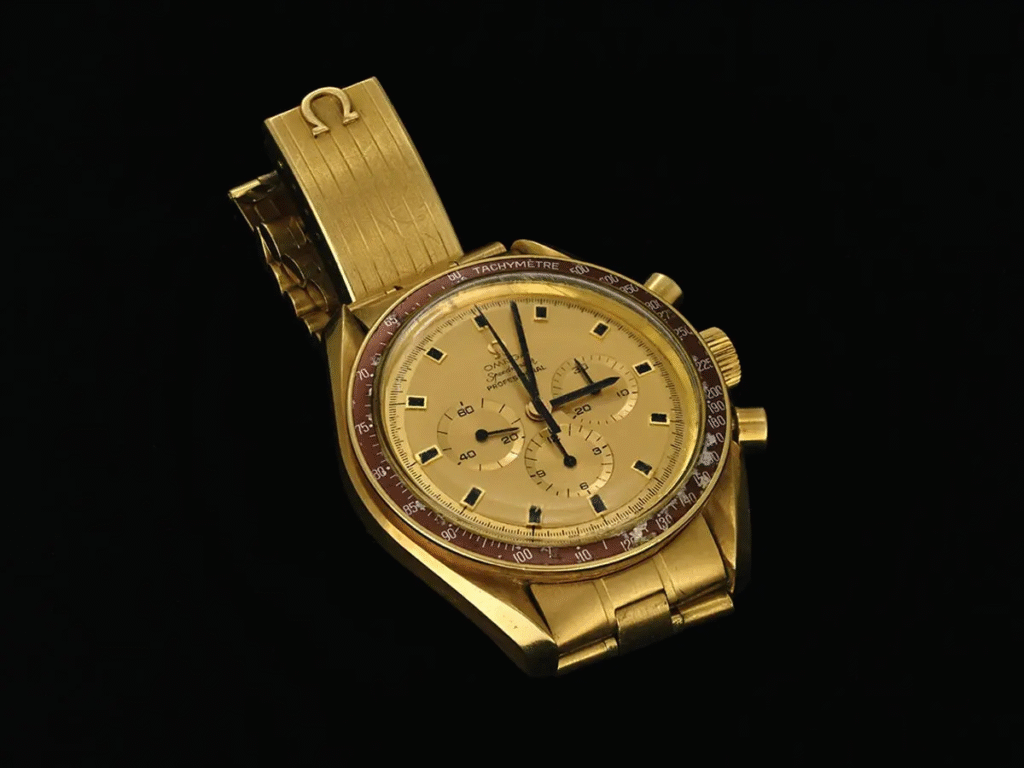
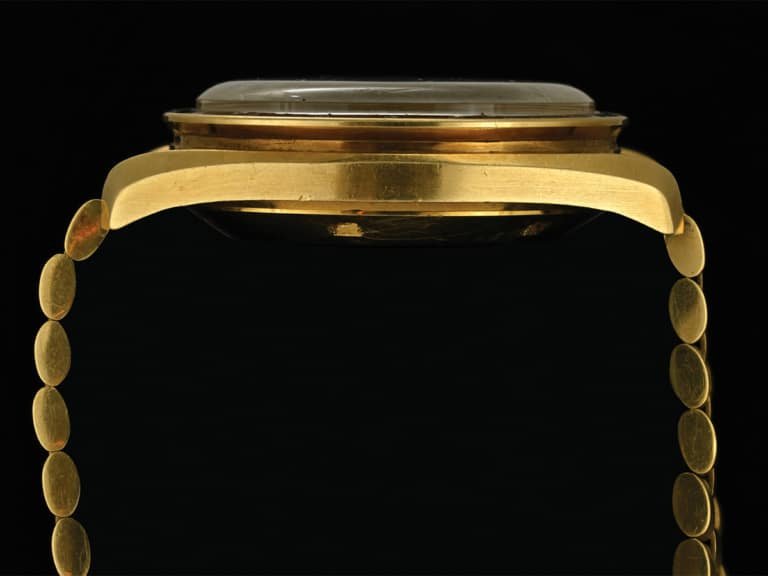
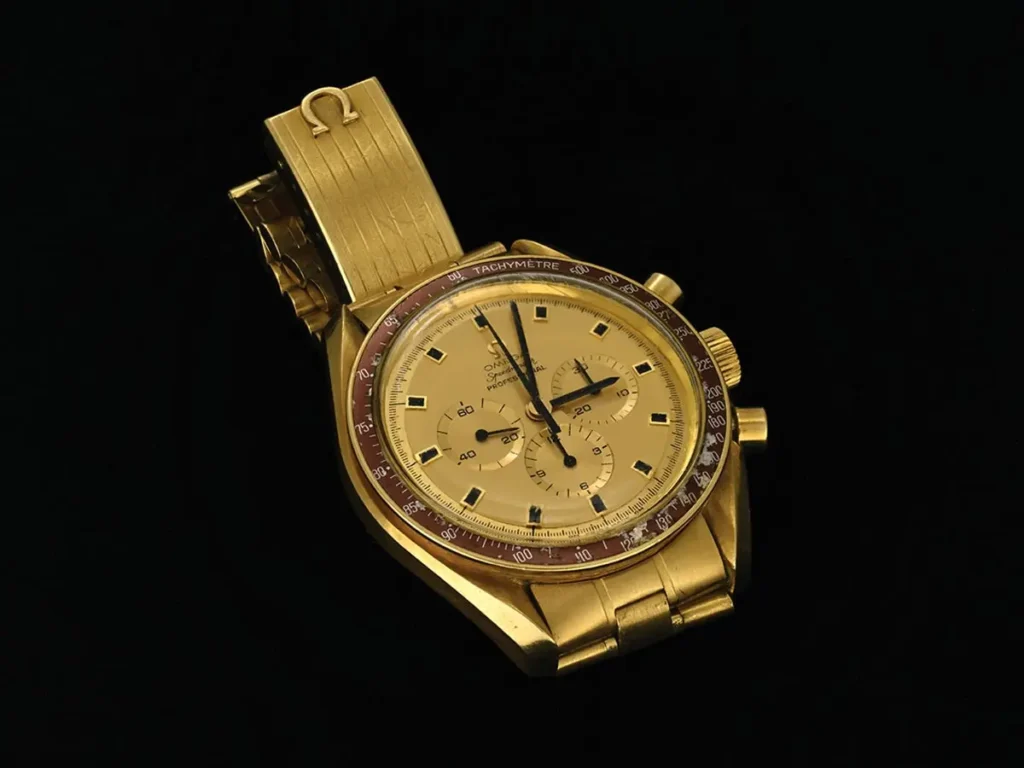
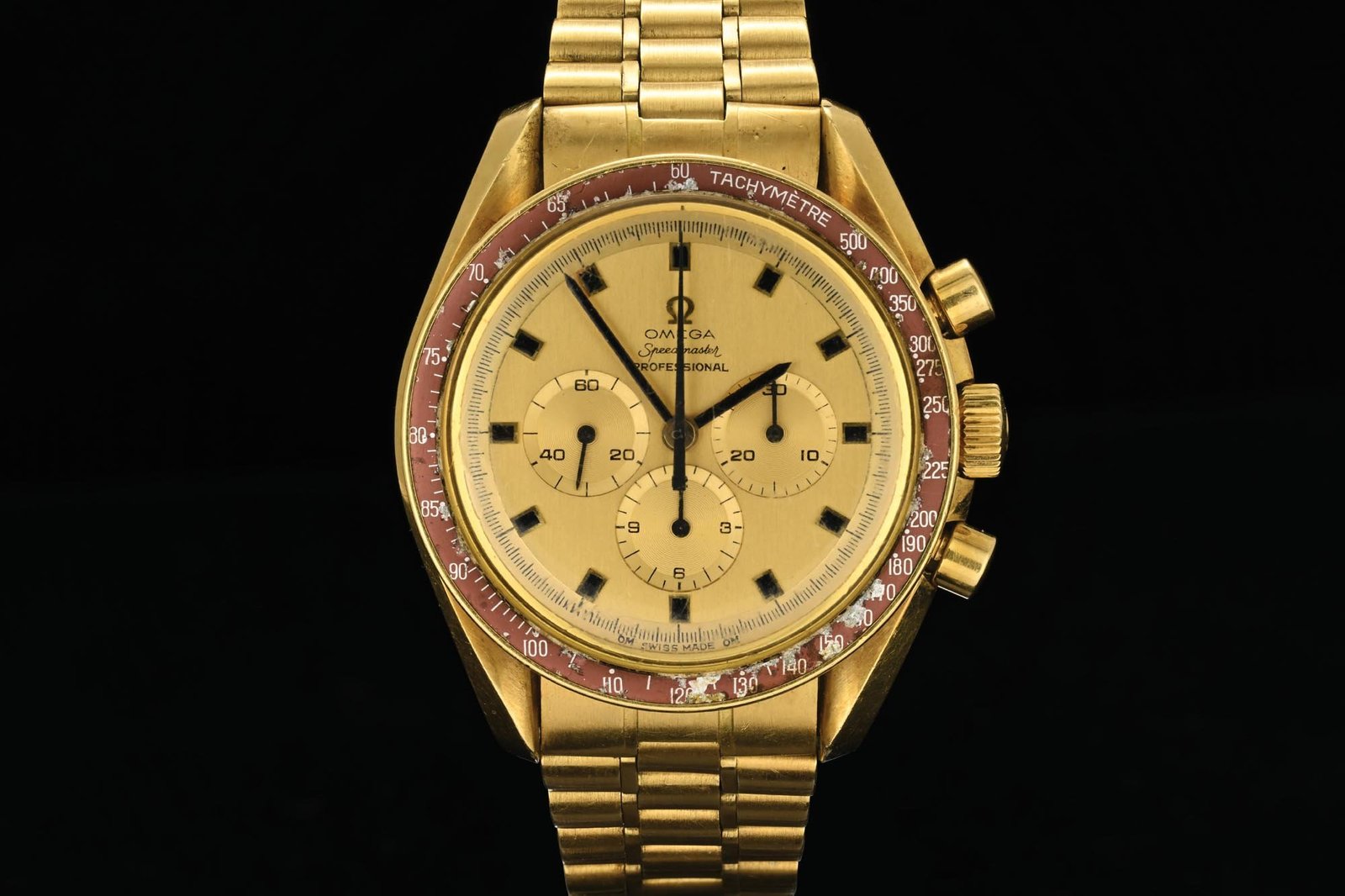
Neil Armstrong’s 18K Gold Omega Speedmaster Professional |Image: RR Auction

Crafted in 18K solid yellow gold, the 42mm watch features a rich sunburst dial, a deep burgundy tachymeter bezel with the renowned “Dot Over Ninety” (DON), and Omega’s trusted calibre 861 manually-wound chronograph movement. The black-finished sub-dials provide bold contrast and readability, while the gold Dauphine hands—coated with luminous material—glow a subtle blue in the dark. It is elegant, technical, and undeniably historic.

Set to be sold by RR Auction on April 17, 2025, the watch has already attracted significant attention. Bidding recently exceeded $1.24 million, and with pre-auction estimates between $2–3 million, Armstrong’s Speedmaster is expected to set records. For comparison, astronaut Wally Schirra’s similar gold Speedmaster sold for $1.9 million in 2022—but this is Armstrong we’re talking about. This watch is as close to the Moon landing as any collector is likely to get.

What makes this auction even more meaningful is where the money is going. A full 50% of the proceeds will be donated to charitable causes selected by Armstrong’s son, Mark, while the consignor is also pledging a portion to a scholarship fund. The winning bidder won’t just walk away with a grail-tier Omega—they’ll be supporting education and legacy in Armstrong’s name.
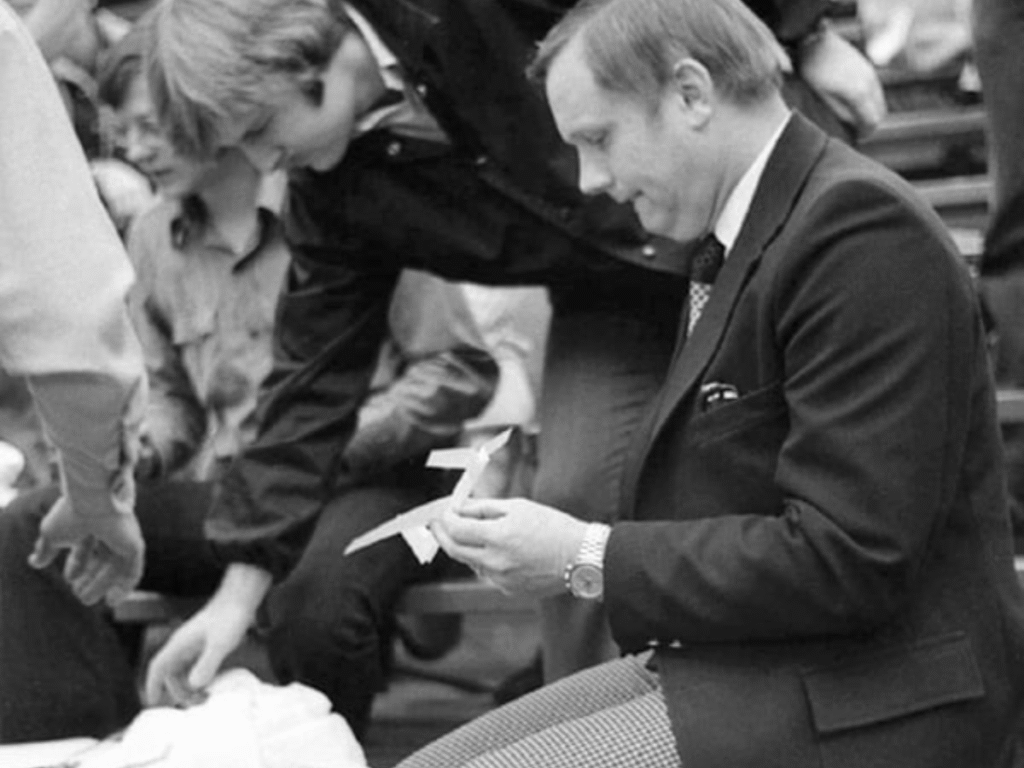
Neil Armstrong wearing his gold Speedmaster during an appearance at UC — Image: RR Auction

Collectors and space enthusiasts alike have always wondered: Who received which watch? Fortunately, Omega documented the serial numbers assigned to each astronaut. Armstrong’s is #17—but here’s the full list of those lucky enough to receive one of the most meaningful watches ever made.

  • #3 – Al Shepard (Mercury-Redstone 3, Apollo 14)
  • #4 – Gus Grissom (Mercury-Redstone 4, Gemini 3, Apollo 1)
  • #5 – John Glenn (Mercury-Atlas 6, STS-95)
  • #6 – Scott Carpenter (Mercury-Atlas 7)
  • #7 – Gordon Cooper (Mercury-Atlas 9, Gemini 5)
  • #8 – Wally Schirra (Mercury-Atlas 8, Gemini 6A, Apollo 7)
  • #9 – John Young (Gemini 3, Gemini 10, Apollo 10, Apollo 16, STS-1, STS-9)
  • #10 – Ed White (Gemini 4, Apollo 1)
  • #11 – James McDivitt (Gemini 4, Apollo 9)
  • #12 – Pete Conrad (Gemini 5, Gemini 11, Apollo 12, Skylab 2)
  • #13 – Thomas Stafford (Gemini 6A, Gemini 9A, Apollo 10, Apollo-Soyuz)
  • #14 – Jim Lovell (Gemini 7, Gemini 12, Apollo 8, Apollo 13)
  • #15 – Frank Borman (Gemini 7, Apollo 8)
  • #16 – David Scott (Gemini 8, Apollo 9, Apollo 15)
  • #17 – Neil Armstrong (Gemini 8, Apollo 11)
  • #18 – Gene Cernan (Gemini 9A, Apollo 10, Apollo 17)
  • #19 – Michael Collins (Gemini 10, Apollo 11)
  • #20 – Dick Gordon (Gemini 11, Apollo 12, Apollo 18)
  • #21 – Buzz Aldrin (Gemini 12, Apollo 11)
  • #22 – Donn Eisele (Apollo 7)
  • #23 – Walter Cunningham (Apollo 7)
  • #24 – Bill Anders (Apollo 8)
  • #25 – Rusty Schweickart (Apollo 9)
  • #26 – Alan Bean (Apollo 12, Skylab 3)
  • #27 – Deke Slayton (Apollo-Soyuz Test Project)
  • #28 – Roger Chaffee (Apollo 1)
  • #1001 – Stu Roosa (Apollo 14)
  • #1002 – Ed Mitchell (Apollo 14)
  • #1003 – Jim Irwin (Apollo 15)
  • #1004 – Al Worden (Apollo 15)
  • #1005 – Charlie Duke (Apollo 16)
  • #1006 – Ken Mattingly (Apollo 16, STS-4, STS-51-C)
  • #1007 – Ron Evans (Apollo 17)
  • #1008 – Jack Schmitt (Apollo 17)

Each of these watches has its own story, but none are quite as iconic as Armstrong’s. From the Moon landing to the auction block, this timepiece has journeyed through time in the most literal sense. And now, for one lucky collector, it’s about to begin a new chapter—on Earth, but never far from the stars.

One small step for man, one giant leap for the lucky collector who secures this golden piece of lunar history. The bidding may not need a rocket, but the numbers are already soaring into orbit. With pre-bids surpassing $1.24 million, this watch isn’t just grabbing attention — it’s making headlines. The final countdown begins at 6 PM ET on April 17 at the Royal Sonesta in Cambridge, Massachusetts.

Feel like watching the Moonwatch reach its final destination?
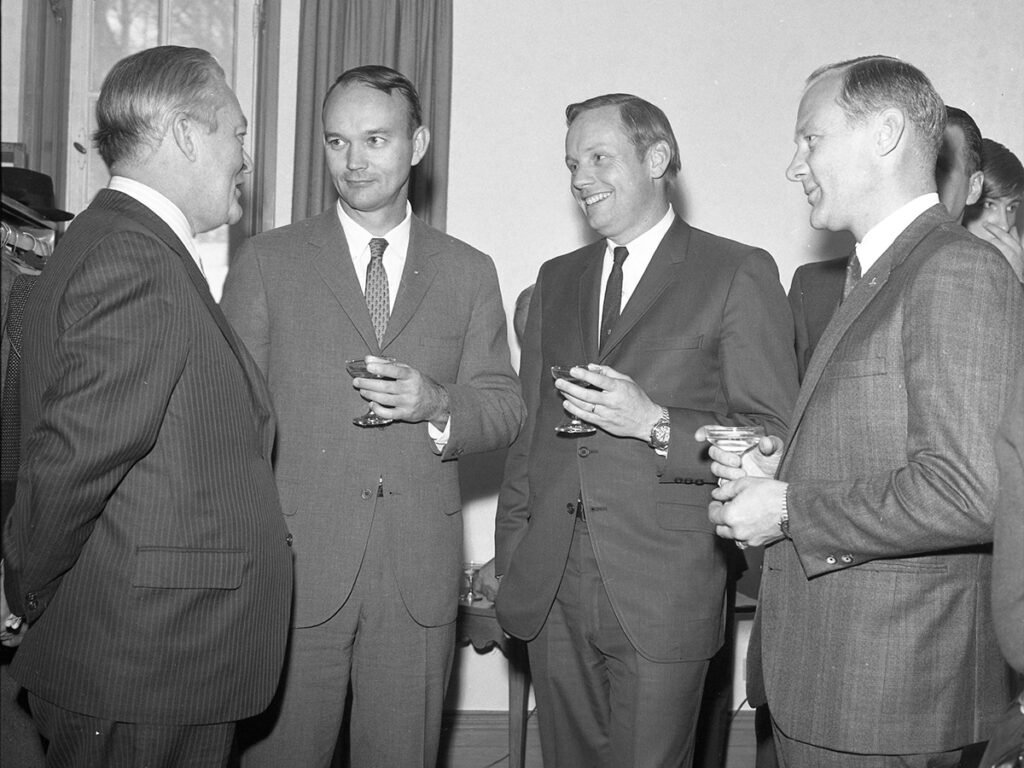
Neil Armstrong’s 18K Gold Omega Speedmaster Professional | Image: Supplied / RR Auction

Omega
About the Author
Previous Post
The New OMEGA Seamaster Diver 300M: A 007 Bond Approval
Next Post
21 Best Gifts for Foodies

Related Articles

Former F1 Boss Bernie Ecclestone’s ‘Priceless’ F1 Car Collection to Be Sold

Reading Time: 6 minutes

Our team of editors and experts thoughtfully chooses each product. If you decide to buy through one of our links, we may earn a commission. Learn more. Want to know how we test products? Click here for more details.

For most of us, collecting a few classic cars is a dream—a poster on the wall, a fantasy drive through Monaco, maybe a vintage 911 tucked away in the garage. For Bernie Ecclestone, that dream turned into a lasting legacy. Over the past 50 years, the former Formula One boss has quietly assembled what’s widely regarded as the finest collection of Grand Prix and F1 cars ever put together—a garage of 69 race-winning legends, each with its own story, victory, or scandal to tell.

Now, at 94, Ecclestone is letting go. This isn’t some billionaire’s fire sale. It’s a deeply personal decision to unload the weight of a lifetime’s racing memories—on his own terms. In a recent media statement, Ecclestone said, “After collecting and owning them for so long, I would like to know where they have gone and not leave them for my wife to deal with should I not be around.” It’s a classic Bernie move: strategic, calculated, but also—dare we say—sentimental.

Key Highlights:

  • Bernie Ecclestone, 94, is selling 69 vintage F1 cars from what’s considered the greatest race car collection ever assembled.
  • The entire collection was sold privately to Red Bull heir Mark Mateschitz to Preserve Its Integrity and Eventually Open It to the public.
  • Automotive dealer Tom Hartley Jnr is managing the sale, calling it “The most important race car collection in the world.”
  • Iconic cars include Schumacher’s Ferraris, the banned Brabham BT46B fan car, and Stirling Moss’s Vanwall VW10.
The Exclusive Bernie Ecclestone Interview | Video: YouTube – @Tom Hartley Jnr Ltd

The task of finding a suitable new home for these priceless machines has been entrusted to none other than Tom Hartley Jr., one of the most respected names in high-end automotive trading. And Hartley isn’t shy about emphasizing the importance of what he’s selling. “There has never been, and probably never will be, a collection like this ever offered for sale again,” he says. “It consists of the greatest cars of their time, many of which have not been seen for decades and are totally unique.”

These aren’t just dusty relics hidden under tarps; they are living legends—machines that once dominated Monza’s straights, glided through Spa’s curves, and ruled Monaco’s streets. From the infamous Brabham BT46B “fan car,” which won its only race before being banned, to championship-winning Ferraris driven by icons like Michael Schumacher, Niki Lauda, and Mike Hawthorn, this collection is more than just cars. It stands as motorsport’s Mount Olympus.

Also included are the Vanwall VW10, driven by Stirling Moss during Britain’s first Constructors’ Championship victory in 1958. Additionally, the Brabham BT52, a turbocharged legend that helped Nelson Piquet win the 1983 world championship. Some of these cars have not been seen in decades, let alone available for purchase.

Bernie Ecclestone F1 collection | Image: Tom Hartley Jnr

Hartley, fully aware of the responsibility, stated in his promotional video, “I feel very privileged that Bernie has entrusted the sale of his cars to my Tom Hartley Jnr business… However, there has never been a collection like this one offered for sale, and no one in the world has a race car collection that comes close to Bernie’s.”

The asking prices? Not publicly available. But as Hartley bluntly said, “Buyers shouldn’t expect any deals.” These are the kinds of cars that don’t come with price tags—they come with stories, scars, and legacies.

That legacy will now continue—thanks to Mark Mateschitz, son of the late Red Bull founder Dietrich Mateschitz. The younger Mateschitz has purchased the entire 69-car collection. No cherry-picking. No broken-up lots. Just one seamless transfer of history from one F1 titan to the heir of another.

In an interview, Ecclestone confirmed his trust in the handover: “They’ve gone to a good home… I wouldn’t have sold them unless I knew where they were going to end up.” And it will be a great home. Mateschitz has already suggested that the cars will eventually be accessible to the public—probably in a museum or exhibition in Austria. This gives fans, enthusiasts, and future drivers the opportunity to see these mechanical marvels up close, instead of them being stored away in some billionaire’s warehouse.

Bernie Ecclestone F1 collection | Image: Tom Hartley Jnr

And thank goodness for that. With the recent leaks revealing the Sultan of Brunei’s car collection languishing in storage containers, the last thing anyone wants is for these irreplaceable engineering marvels to decay in silence. These are the kinds of machines that deserve to be displayed, admired, and—if we’re fortunate—occasionally brought back to life on a proper racetrack.

This story, in many ways, closes a chapter on one of motorsport’s most influential figures. Bernie Ecclestone didn’t just collect cars—he collected moments. These weren’t investments to him; they were personal. Milestones. Markers of change, of triumph, of evolution. Now, with one sweeping move, he has passed the torch.

It’s not every day that the most important Formula 1 car collection ever assembled changes hands. It’s even rarer that it does so with such intention, grace, and respect for what these machines mean—not just to motorsport, but to those who lived and breathed it.

When the public finally gets to walk through the next iteration of this collection—wherever it ends up—it won’t feel like stepping into a museum. It’ll feel like walking through the DNA of Formula 1 itself.

Bernie Ecclestone F1 collection | Image: Tom Hartley Jnr
F1
About the Author

Related Articles

arrow_drop_up