Our team of editors and experts thoughtfully chooses each product. If you decide to buy through one of our links, we may earn a commission. Learn more. Want to know how we test products? Click here for more details.
The Pixel 9a is scheduled to launch in April 2025, with the price confirmed at USD $499.
The phone introduces the Tensor G4 processor to the mid-range market, combining flagship-level hardware with useful daily features powered by Google.
It will be available in four finishes: Obsidian, Porcelain, Iris, & Peony—Google’s versions of black, white, purple, and pink.
Google has officially announced the Pixel 9a, with a confirmed release window set for April 2025 and a starting price of USD $499. It’s a clear signal that Google is once again prioritizing the mid-range market—especially when consumers value affordability over spectacle.
The arrival itself isn’t a surprise. The Pixel 9a has been widely anticipated for months, and Google’s hardware plans rarely stay secret for long, so this release wasn’t unexpected. The budget smartphone market has become crowded and genuinely competitive, with strong recent offerings from Apple and Nothing raising the standards for what a “budget” phone should deliver. The Pixel 9a enters this space with a familiar yet refined approach by tightening it with advanced features such as Gemini integration across the system, a brighter, more capable display, a larger battery for daily reliability, and Google’s most powerful in-house processor to date.
So, let’s take a closer look at what’s new with the Pixel 9a, how it fits into Google’s current lineup, and how it compares to the strongest alternatives in the mid-range market.
Front: 13MP Rear: 48MP (wide), 13MP (ultra-wide) Can record video at 4K@60fps Can record slow motion at 1080p@240fps
Front: 13MP Rear: 64MP (wide), 13MP (ultra-wide) Can record video at 4K@60fps Can record slow motion at 1080p@240fps
Battery
5,100mAh
4,492mAh
Features
– Single USB 3.2 Type-C port – IP68 dust and water resistant – Fingerprint unlock & Face unlock – Gemini AI
– Single USB 3.2 Type-C port – IP67 dust and water resistant – Fingerprint unlock – Gemini AI
Price:
USD $499
USD $499
Google Pixel 9a | Image: Google
What’s New in Google’s Pixel 9a?
The most obvious change is the move to a 6.3-inch display, bringing Google’s most affordable Pixel into the same size category as its flagship models, like last year’s Pixel 8a, which this year focused more on reinvention and better alignment. It reflects a wider industry trend away from small phones, with most major brands now considering 6.3 inches the new standard. That won’t suit everyone—one-handed use becomes noticeably more difficult—but it does make the 9a feel more consistent with the rest of Google’s lineup.
The Pixel 9a uses the same Tensor chip as last year’s Pixel 9 and Pixel 9 Pro, reducing the performance gap between Google’s mid-range and flagship devices. While the Pixel 9 still has an advantage due to extra memory, the everyday experience on the 9a should be very similar—smooth navigation, quick app launches, and sufficient headroom for multitasking without issues. For most people, that difference will only become noticeable during heavier tasks like gaming or video editing, which put more stress on its processor.
Battery capacity has also increased, reinforcing the Pixel 9a’s focus on endurance rather than raw power. It’s a phone designed to get through a full day without attention, which matters more important now that upgrade cycles are stretching longer. Google has also introduced a new face unlock system, offering faster and more convenient authentication for the A-series for the first time—another example of flagship features quietly filtering down.
With its 13 MP Ultrawide camera, Pixel lets you fit more into a single frame. Perfect for everything from showcasing vast landscapes to adding an artistic vibe to everyday photos. | Image: Google
Google’s Pixel 9a Camera
The Pixel 9a’s camera setup doesn’t follow a simple “better than last year” story, which makes it one of the more interesting parts of the update. Up front, there’s a quiet but meaningful win with a 13MP wide-angle selfie camera, which actually has a higher resolution than the 10.5MP front camera on the Pixel 9. It’s an unexpected benefit for the more affordable model, especially for video calls and front-facing shots where clarity is more important than anything else.
Around the back, it features a dual-camera system—48MP main paired with a 13MP ultra-wide—that is understandably placed below the Pixel 9. However, it also seems to lag behind the Pixel 8a’s 64MP + 13MP setup on paper. This makes the change feel somewhat counterintuitive, especially for a generational update, and it’s one of the few areas where the numbers indicate restraint rather than progress.
That said, this is where Google is clearly relying on Gemini and its broader computational photography stack to handle the complex processing. Although the sensors themselves seem more conservative, the expectation is for better real-world results—improved HDR balance, more consistent colours, and stronger low-light performance—once again showing that, for Google, the final image is more important than what’s listed on the spec sheet.
The Pixel Camera’s innovative AI software can help fix exposure challenges, making it simple to capture beautiful shots in high-contrast situations. | Image: Supplied
Why Google Is Betting on the Pixel 9a
So, why could the Google Pixel 9a be the most significant phone this year? The Pixel 9a reflects current buying habits, as upgrade cycles lengthen, flagship prices rise, and fewer consumers want to pay extra for minor improvements. In this context, the mid-range market has become the key battleground—where Google stands to gain the most. It offers the core features that matter most to users: reliable cameras, streamlined software, and helpful AI capabilities, all at a realistic price point.
More than that, the Pixel 9a signals a shift in focus. By incorporating its newest processor, deeper Gemini integration, and long-term software support into a more affordable device, Google is betting on practicality rather than prestige. If the Pixel 9a succeeds, it won’t be because it attracts headlines—it’ll be because it becomes the phone people recommend without hesitation. And in today’s market, that kind of quiet relevance is exactly what makes it important.
What to Know About the Pixel 9a Launch
Google has announced that the Pixel 9a will be released in April 2025, although the specific date is still unknown. The device will be priced at USD $499, positioning it in the mid-range segment and highlighting Google’s emphasis on accessibility over a prolonged, hype-focused launch.
Elias Albay is the Founder and Director of Many Men Magazine, a Toronto-based digital publication dedicated to promoting modern masculinity through style, culture, and self-improvement. What started as a personal turning point became a purposeful platform. — born from Elias’ desire to create something meaningful after completing his studies and finding no career path that truly matched his ambitions. With a background in Civil Engineering from York University and experience in Commercial Flight Operations at CAE, he applied skills, and resilience from both fields to forge a new path.
Our team of editors and experts thoughtfully chooses each product. If you decide to buy through one of our links, we may earn a commission. Learn more. Want to know how we test products? Click here for more details.
This week, we’re changing the game. Rather than just one post, we’re delivering two consecutive explorations into the realm of haute horology. That’s correct—twice the watches, twice the innovation, and twice the thrill. Why the shift? Because timepieces of this caliber deserve the spotlight.
We’re venturing past the usual into a domain where innovative materials, mechanical brilliance, and bold design decisions redefine the future of watchmaking. This collection transcends mere craftsmanship, aiming to reshape expectations. Featuring the ultra-slim Richard Mille RM 16-02 Extraflat, which combines advanced engineering with a lightweight structure, alongside the mesmerizing turbine-driven skeleton of Perrelet, this week’s curated selection is both vibrant and audacious.
Moreover, we dive into David Candaux’s architectural brilliance, where each angle and finish exemplifies the pinnacle of independent watchmaking. Ulysse Nardin also impresses with the breathtaking Blast Amourex Peintre, a limited edition that merges mechanical intricacy with captivating visual storytelling, reinforcing horology as an art form. Additionally, Richard Mille introduces the RM 16-02 once more, now fashioned from Terracotta Quartz TPT®, showcasing that even among ultra-thin watches, there’s still potential for daring material innovation.
Prepare for exceptional craftsmanship, innovative design, and bold creativity—this isn’t your typical watch roundup. Welcome to L’Heure Élevée, where horology blends with artistry, and this week, we’re raising the bar. Let’s dive in.
Some watches are produced, while others are meticulously crafted with an unwavering commitment to perfection. This is where our first watch on the list comes in: The David Candaux DC6 Titanium, which belongs to the latter— a timepiece that fuses age-old Swiss craftsmanship with avant-garde modern design. Handcrafted in the Vallée De Joux, the epicentre of fine watchmaking, this remarkable piece transcends the definition of a watch; it’s an architectural masterpiece.
With a diameter of 43 mm and a thickness of just 11.29 mm, the Grade 5 titanium case offers an exceptionally lightweight feel, allowing the intricate mechanics inside to capture attention. In terms of this intricacy, the guilloché silver dial is refreshingly distinct from what you might expect in traditional haute horology. It is slightly tilted, featuring an asymmetrical design that artistically challenges conventional symmetry. Every detail is meticulously hand-finished, with each angle carefully crafted, resulting in a depth that resembles a sculptural form.
But what truly lies at the heart of this masterpiece? The D.C. 6 hand-wound tourbillon movement, entirely developed and crafted by Candaux himself. This movement is not only technically impressive—it’s a visual spectacle. The inclined flying tourbillon, set at a 3-degree tilt, enhances chronometric performance while adding an extra layer of dynamism to the design. With a 55-hour power reserve, the watch maintains peak accuracy without interruption, showcasing the meticulous engineering behind it.
More than just a feat of engineering, the DC6 Titanium embodies uniqueness. It is not a factory-made watch; rather, it represents an artisanal masterpiece crafted for collectors who genuinely appreciate the pinnacle of independent watchmaking. This piece comes in at a whopping USD 270,000; this is more than merely buying a watch—it’s an investment in the craft of horology itself.
David Candaux doesn’t create watches for the mainstream; he crafts them for individuals who value the relentless pursuit of mechanical and artistic perfection. The DC6 Titanium stands as living proof of that ethos.
Richard Mille RM 16-02 Automatic Extraflat Titanium | Image: Richard Mille
Richard Mille RM 16-02 Automatic Extra Flat Titanium
Brand: Richard Mille
Model: RM 16-02 Automatic Extraflat Titanium
Diameter: 50mm x 38mm (Tonneau-Shaped Case)
Thickness: 9.25 mm
Material: Grade 5 Titanium
Dial Color: Skeletonized Black Dial
Calibre: CRMA9(Automatic)
Power Reserve: 50 Hours
Water Resistance: 3 Bar ( 30 metres, 100 feet)
Price: Upon Request
Then we have Richard Mille, who goes beyond mere watchmaking; they create wearable marvels. With the RM 16-02 Automatic Extra Flat Titanium, they’ve redefined ultra-thin watchmaking by integrating the brand’s signature elements of high-tech and high performance. This endeavour surpasses simple size reduction; it pushes the limits of what a timepiece can accomplish while still offering the durability and striking aesthetics that are characteristic of a Richard Mille masterpiece.
Measuring 50mm x 38mm, this watch features the unmistakable tonneau-shaped case design for which Richard Mille is renowned. However, unlike its more imposing counterparts, the 9.25mm thickness makes it one of the slimmest models in the lineup—demonstrating that boldness does not have to sacrifice wearability. The Grade 5 titanium case keeps it featherlight while ensuring incredible strength, a hallmark of Richard Mille’s approach to materials.
The skeletonized dial is a mechanical marvel, exposing the inner mechanisms of the CRMA9 automatic caliber—a movement that reflects Mille’s unwavering quest for precision. With a 50-hour power reserve, this watch is built to complement an active lifestyle, whether you’re driving a supercar or managing the challenges of a busy day.
While the RM 16-02 represents a slimmer, more refined interpretation of Richard Mille’s philosophy, it retains the brand’s trademark boldness. The striking numerals, visible movement, and architectural design project high-performance luxury, indicating that this watch is meant for those who prefer to stand out rather than blend in. It’s designed for those who thrive in the fast lane. Regarding the price, it’s available upon request, highlighting the exclusivity of this exceptional timepiece. One thing is sure: the RM 16-02 Automatic Extra flat Titanium exemplifies Richard Mille’s relentless quest for innovation, making the watch progressively thinner, lighter, and even more remarkable.
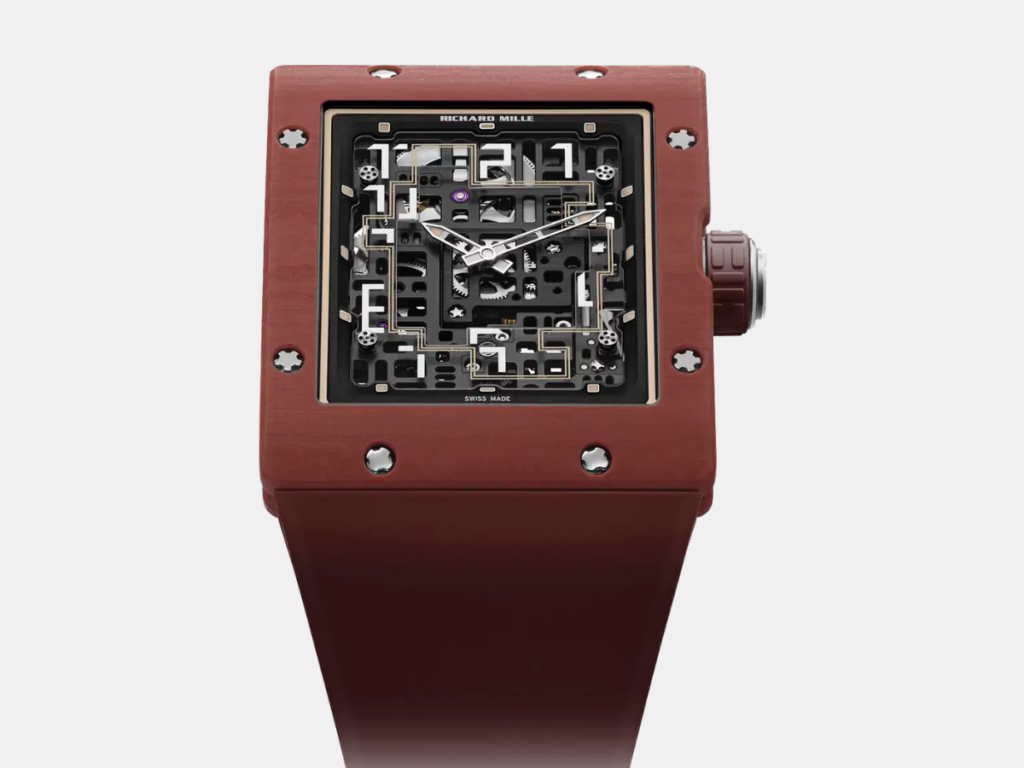
Richard Mille RM 16-02 Automatic Extraflat Terracotta Quartz TPT® | Image: Richard Mille
Richard Mille RM 16-02 Automatic Extra Flat Terracotta Quartz TPT®
Brand: Richard Mille
Model: RM 16-02 Automatic Extra Flat Terracotta Quartz TPT®
Diameter: 50mm x 38mm (Tonneau-Shaped Case)
Thickness: 9.25mm
Material: Titanium
Dial Color: Skeletonized Black Dial
Calibre: CRMA9
Power Reserve: 50 Hours
Water Resistance: 3 bar (30 metres, 100 feet)
Price: Upon Request
If the RM 16-02 Automatic Extraflat Titanium showcased ultra-thin high-performance engineering, the RM 16-02 Automatic Extraflat Terracotta Quartz TPT® emerges as its bolder, more distinctive counterpart. Both timepieces feature the same 50mm x 38mm tonneau-shaped case and 9.25mm thickness, but this edition significantly elevates material innovation. Richard Mille introduces Terracotta Quartz TPT®, a composite that is not only visually striking but also mechanically sophisticated, going beyond mere Grade 5 titanium.
Terracotta Quartz TPT® transcends mere aesthetics; it is engineered for exceptional durability. Crafted through a complex layering and heating process, this material achieves an organic, stone-like texture that remains lightweight yet remarkably robust. The distinctive finish of the RM 16-02 Terracotta sets it apart significantly from its titanium version. While the titanium variant offers a sleek and stealthy look, this one exudes a bold, earthy character that demands attention.
Even with the eye-catching new material, the skeletonized dial stays intact, showcasing the intricate mechanics of the CRMA9 calibre. This movement is crafted for lightweight strength, featuring ultra-light components that reduce energy loss while delivering peak performance. Coupled with a 50-hour power reserve, this watch not only resembles a futuristic device—it performs like one as well.
This version of the RM 16-02 blends functionality with style, demonstrating that Richard Mille’s approach goes beyond merely enhancing performance; it challenges conventional watch design. The rich, warm hues of the Terracotta Quartz TPT® stand in striking contrast to the visible mechanics, resulting in a wrist presence that is simultaneously bold and artistic. This watch is crafted not just for wearing, but for making a statement—a bold accessory for those who embrace individuality.
Besides its visual appeal, Richard Mille guarantees that this piece is sturdy. It features a water resistance of 3 bars (30 meters), which allows for everyday use while preserving its distinctive lightweight sensation. This watch appeals to collectors and individuals who appreciate horology as a blend of art and technical innovation.
Like its titanium counterpart, the RM 16-02 Automatic Extra Flat Terracotta Quartz TPT® is available at a price upon request, highlighting its exclusivity and scarcity. One fact remains clear: although both RM 16-02 versions redefine ultra-thin watchmaking, this Terracotta variant appeals to collectors who seek boldness in every facet of their collection.
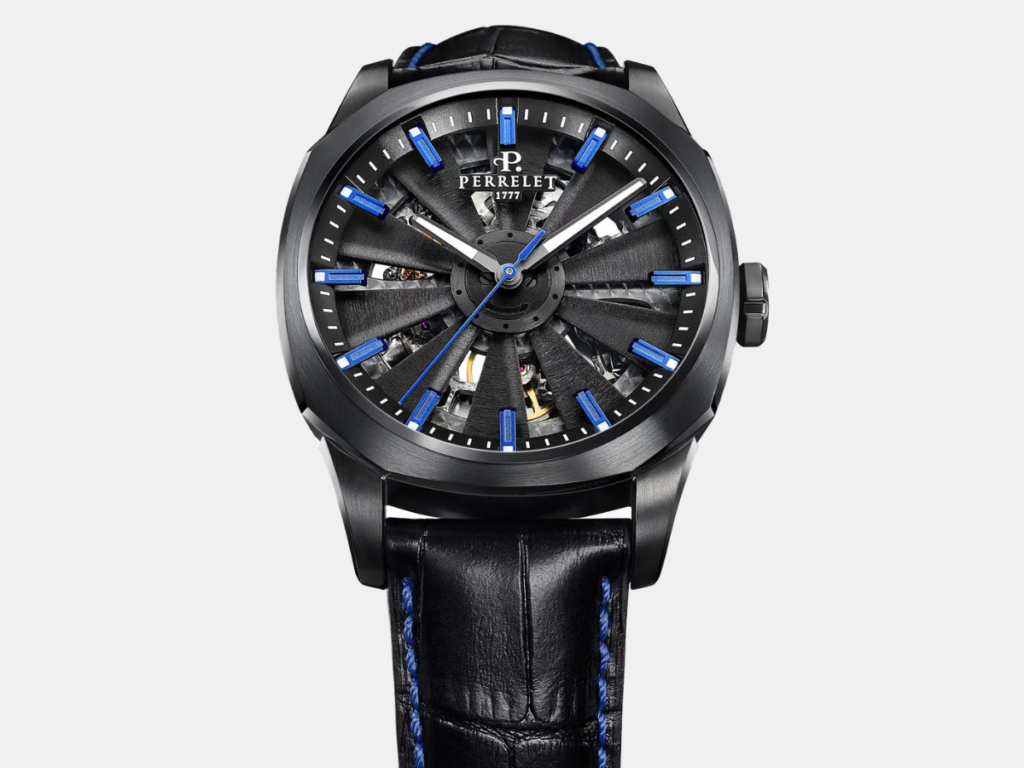
Some watches attract with intricate complications, while others shine with stunning designs; however, Perrelet’s Turbine Urban Skeleton Black PVD excels at both by incorporating continuous movement into the dial. This timepiece represents a groundbreaking reimagining of watchmaking, signifying a pivotal moment in the brand’s journey. Featuring a striking design that alternates between revealing and hiding elements, it utilizes the wearer’s kinetic energy for accurate timekeeping, all while presenting a remarkable visual impact that readily catches the eye.
With a diameter of 42mm and a thickness of 13.15mm, the cushion-shaped case in black PVD stainless steel gives the watch a robust, structured appearance. Its octagonal bezel adds to the elegant design, and the new 10-blade turbine on the dial spins with wrist movement, revealing tantalizing glimpses of the skeletonized movement beneath. Unlike conventional skeleton watches that depend entirely on transparency, this model fosters a lively contrast between visibility and concealment.
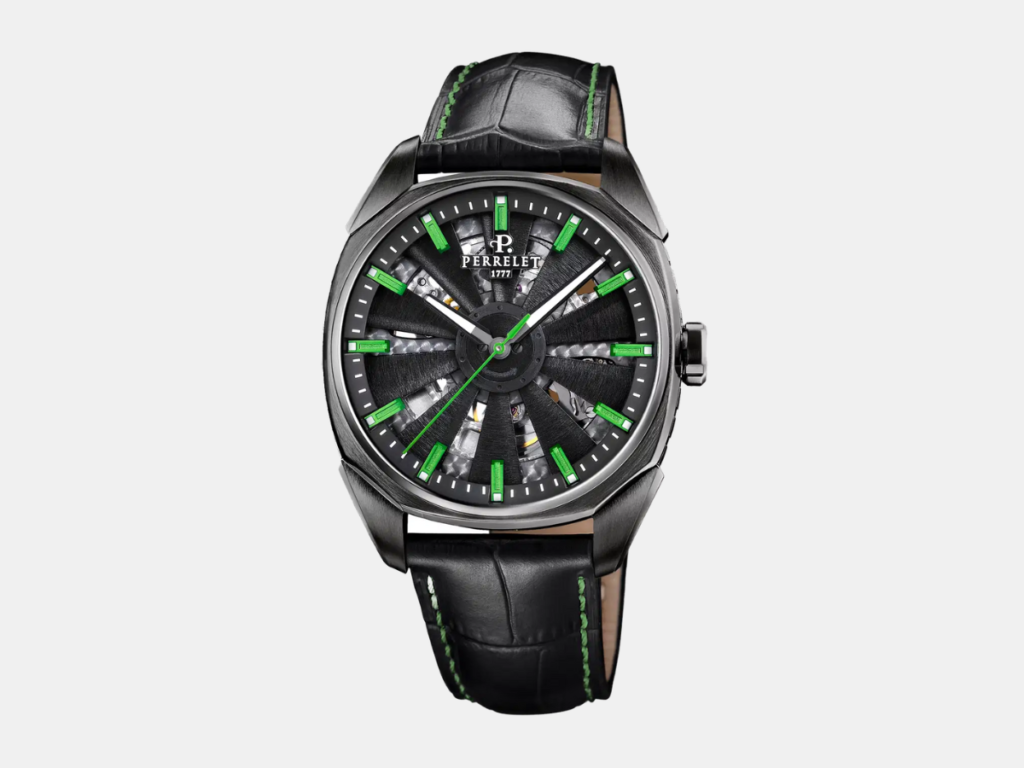
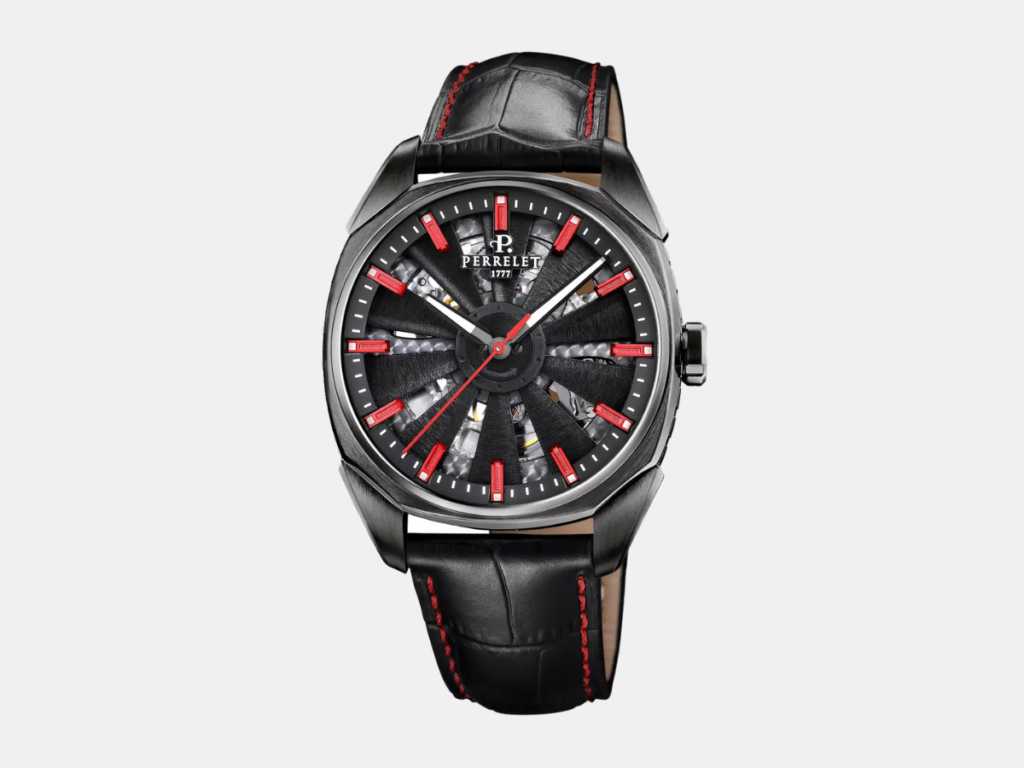
Enhancing its versatility, the Turbine Urban Skeleton Black PVD is available in three vivid colour options: Blue (A1062/2), Green (A1062/1), and Red (A1062/3). These colours are mirrored on the dial and alligator-textured calfskin straps, which beautifully complement the glowing hour markers. Secured with a folding clasp, the strap contributes sophistication while reinforcing the watch’s modern urban style.
Featuring an automatic caliber P-331-SQ, crafted by SOPROD and certified by COSC, this watch guarantees outstanding accuracy and reliability. It boasts a 42-hour power reserve, showcasing the pinnacle of watchmaking technology and reflecting Perrelet’s dedication to precision and performance. Whether worn by a collector or an enthusiast, this timepiece beautifully combines tradition with modernity, ensuring that each look at the dial is a captivating experience.
Aside from its visual appeal, the Turbine Urban Skeleton Black PVD is designed for practical use. Featuring a water resistance of 5-bar (50 meters, 165 feet), it withstands daily challenges, and the PVD-coated stainless steel case guarantees longevity. The rotating turbine blades turn timekeeping into an engaging activity, distinguishing this model from traditional skeleton watches.
Priced at $6,000 USD, the Perrelet Turbine Urban Skeleton Black PVD is more than just a watch; it’s a kinetic masterpiece. This timepiece is crafted for individuals who value the complexities of mechanical movement while seeking something extraordinary. Regardless of whether you choose the blue, green, or red version, this watch offers a unique combination of cutting-edge design, Swiss accuracy, and expert craftsmanship.
Elias Albay is the Founder and Director of Many Men Magazine, a Toronto-based digital publication dedicated to promoting modern masculinity through style, culture, and self-improvement. What started as a personal turning point became a purposeful platform. — born from Elias’ desire to create something meaningful after completing his studies and finding no career path that truly matched his ambitions. With a background in Civil Engineering from York University and experience in Commercial Flight Operations at CAE, he applied skills, and resilience from both fields to forge a new path.