








- Mike Tyson and Floyd Mayweather Jr. are reportedly set to meet in a special exhibition bout scheduled for spring 2026.
- Tyson’s last fight came against Jake Paul in November 2024, while Mayweather remains active on the exhibition circuit following his bout with John Gotti III.
- The fight is expected to feature modified exhibition rules, although the official format has yet to be announced.
- CSI Sports has teased new in-ring technology that could change how fights are presented and potentially scored.
The rumours are finally over — it’s happening. Two of boxing’s most iconic figures, Mike Tyson and Floyd Mayweather Jr., are reportedly set to step into the ring for what could be one of the most talked-about matchups the sport has ever seen. Tyson, the former undisputed heavyweight champion whose explosive knockout power helped define the late 1980s, will face off against Mayweather, the undefeated ‘Pretty Boy’ and self-proclaimed TBE (The Best Ever), whose signature Philly Shell defence helped build a reputation for impeccable timing, razor-sharp precision, and leaving even the sport’s elite fighters swinging at air.
Scheduled for spring 2026, the fight is already creating plenty of excitement across the boxing world. For years, the idea of Tyson and Mayweather sharing a ring felt more like a conversation between friends than something that could actually happen. The two legends came from different generations and fought in completely different weight classes, which made a matchup seem almost impossible. Yet here we are.
Advertisement · Continue Reading Below
There may not be a championship belt on the line, but that’s not really the point. This fight is about two of the biggest names boxing has ever produced, each with a completely different style and approach to the sport. More than anything, it’s a chance to finally see how one of boxing’s biggest “what if?” matchups might play out.
Here’s everything you need to know.
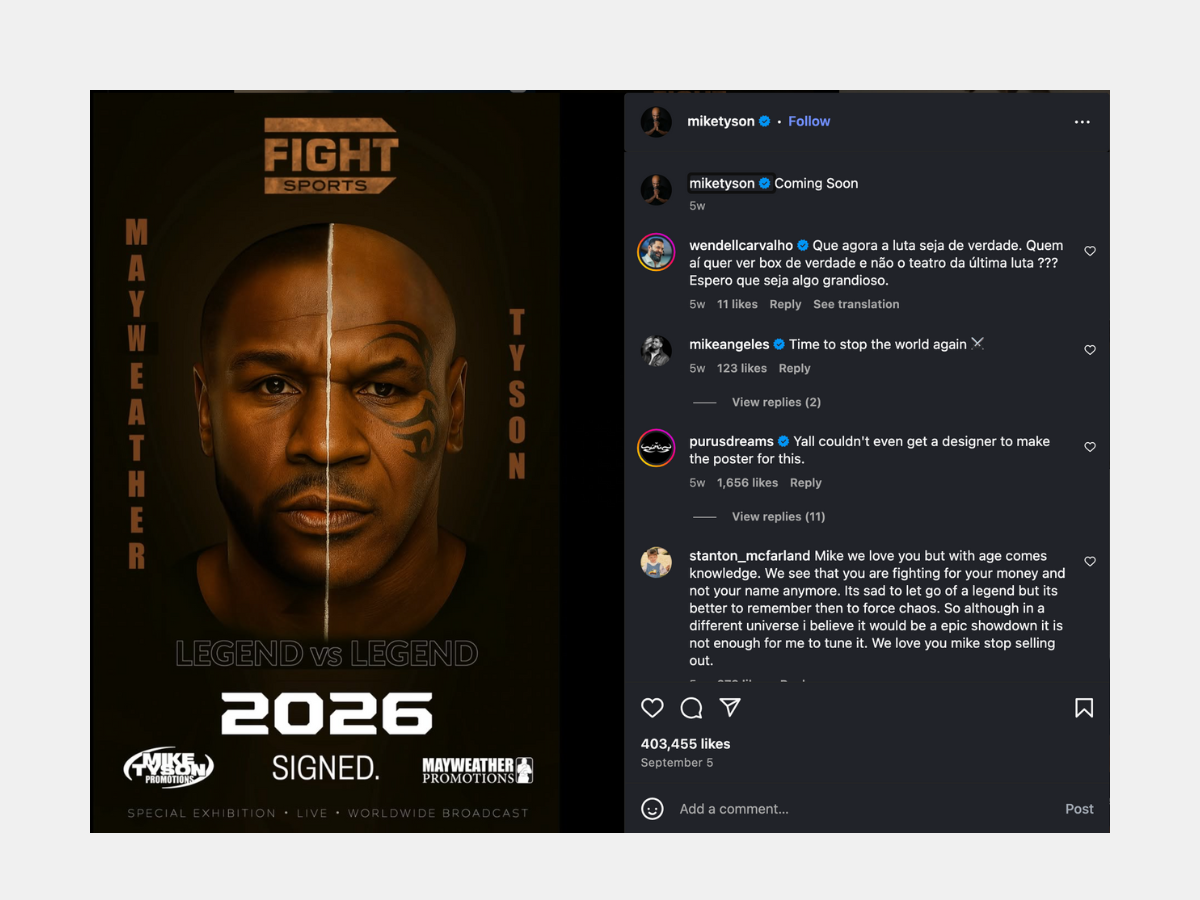
It all started with rumours. Then TMZ Sports reported that Mike Tyson and Floyd Mayweather were set to share the ring, sending the boxing world into a frenzy. Not long after, Tyson added fuel to the fire by posting the official fight poster on social media. Branded as a “Special Exhibition” and carrying the tagline “Legend vs. Legend,” the announcement quickly turned speculation into reality. While the date and venue remain under wraps, the secrecy has only added another layer of intrigue to a fight that few thought would ever happen.
“When CSI came to me about stepping in the ring with Floyd Mayweather, I thought, ‘No way this happens,’ but Floyd said yes,” Tyson admitted in a press release. “This fight is something neither the world nor I ever thought would or could happen. However, boxing has entered a new era of the unpredictable — and this fight is as unpredictable as it gets. I still can’t believe Floyd is actually going through with this. It’s going to be detrimental to his health, but he wants to do it, so it’s signed and it’s happening!”
Advertisement · Continue Reading Below
Behind the scenes, CSI Sports and Fight Sports are leading the project. The company is best known for controlling the global rights to HBO World Championship Boxing and Tuesday Night Fights, giving it extensive experience in delivering major boxing events. Rather than treating Tyson vs. Mayweather as a one-night spectacle, the goal appears to be something much larger, with plans for extensive broadcast and streaming distribution designed to reach audiences around the world.
As CSI co-founders Richard and Craig Miele explained, “Mike Tyson and Floyd Mayweather are two of the most compelling names and personalities with lasting legacies in all of sports. They are 21st-century icons. Tyson vs. Mayweather will break every broadcast, streaming and economic record set by Mike Tyson in 2024. We are planning a robust promotional campaign, complete with weekly premium storytelling and worldwide marketing reach. The event itself will be in a world-class venue and be presented to a global audience with new in-ring technology elements that will reshape how boxing is presented and scoring is achieved for years to come.”

At 59, the man once called “The Baddest Man on the Planet” is still one of boxing’s biggest names, but his November 2024 fight against Jake Paul showed a different side when faced by a younger opponent. Over eight rounds, Tyson showed moments of aggression that were used too much, which made him a heavyweight champion legend. But Paul’s youth, endurance, and stamina were too much for the former champ, and lost by unanimous decision. It wasn’t the result many fans wanted, but it reminded everyone that even legends feel the effects of getting older.
The reaction online was immediate. UFC fighter Sean Strickland labelled Paul a “clown” and went as far as calling the fight “illegal,” while KSI described the contest as “elderly abuse.” Tyson has spent much of his career proving critics wrong, and while the comments sparked plenty of debate, they also added another chapter to a story that has followed him throughout his boxing journey.
Advertisement · Continue Reading Below
Mayweather’s recent path has been very different. Officially retired since 2017, the undefeated former world champion has kept stepping into the ring for a series of well-known exhibition fights while keeping the sharp defensive skills that defined his career. His latest fight was in August 2024 against John Gotti III in Mexico City, an exhibition that lasted all 8 rounds and again showcased the speed, timing, and ring sense that have earned him a perfect 50-0 professional record.
Whether it’s a championship fight, an exhibition, or a crossover event, Mayweather rarely strays far from the style that made him one of boxing’s all-time greats. While Tyson remains the bigger puncher and one of the game’s most feared knockout artists, Mayweather enters this matchup carrying the advantages of activity, movement, and a defensive approach that has frustrated some of the best fighters of his generation. That’s what makes the tale of the tape so intriguing—both men are legends, but they arrive at this fight from very different places.
That’s what makes this matchup irresistible. Tyson is pure force, the storm that never quite fades, a man eager to prove his fists still matter. Mayweather is pure calculation, the chess master who’s never known defeat. “I’ve been doing this for 30 years and there hasn’t been a single fighter that can tarnish my legacy,” Mayweather said. “You already know that if I am going to do something, it’s going to be big and it’s going to be legendary. I’m the best in the business of boxing. This exhibition will give the fans what they want.”

So how exactly do you referee two legends like this? That’s one of the biggest questions surrounding the fight. While Tyson vs. Mayweather has been announced as a “special exhibition,” the official rules have yet to be revealed. Traditionally, exhibition bouts feature modified regulations such as shorter rounds, larger gloves, and no official judges, but with two of the biggest names in boxing history involved, it’s difficult to predict exactly what form this contest will take.
Tyson’s last outing against Jake Paul featured eight two-minute rounds, 14-ounce gloves, no headgear, and the possibility of a knockout, creating a contest that felt far more competitive than many expected. Mayweather’s recent exhibitions have followed a different path, including his bout against John Gotti III, which went the distance without an official winner being declared but still carried all the drama of a genuine fight.
Advertisement · Continue Reading Below
Adding another layer of intrigue is CSI Sports’ involvement, which has already teased the introduction of new in-ring technology for the event. As the company explained, “Mike Tyson and Floyd Mayweather are two of the most compelling names and personalities with lasting legacies in all of sports. They are 21st-century icons. Tyson vs. Mayweather will break every broadcast, streaming and economic record set by Mike Tyson in 2024. We are planning a robust promotional campaign, complete with weekly premium storytelling and worldwide marketing reach.
The event itself will be in a world-class venue and be presented to a global audience with new in-ring technology elements that will reshape how boxing is presented and scoring is achieved for years to come.” What exactly that means remains unclear, but whether it’s digital scoring, advanced punch tracking, or something entirely new, it suggests this won’t be a typical exhibition. One thing is certain: when Tyson and Mayweather finally step through the ropes, nobody will be paying attention to the rulebook.
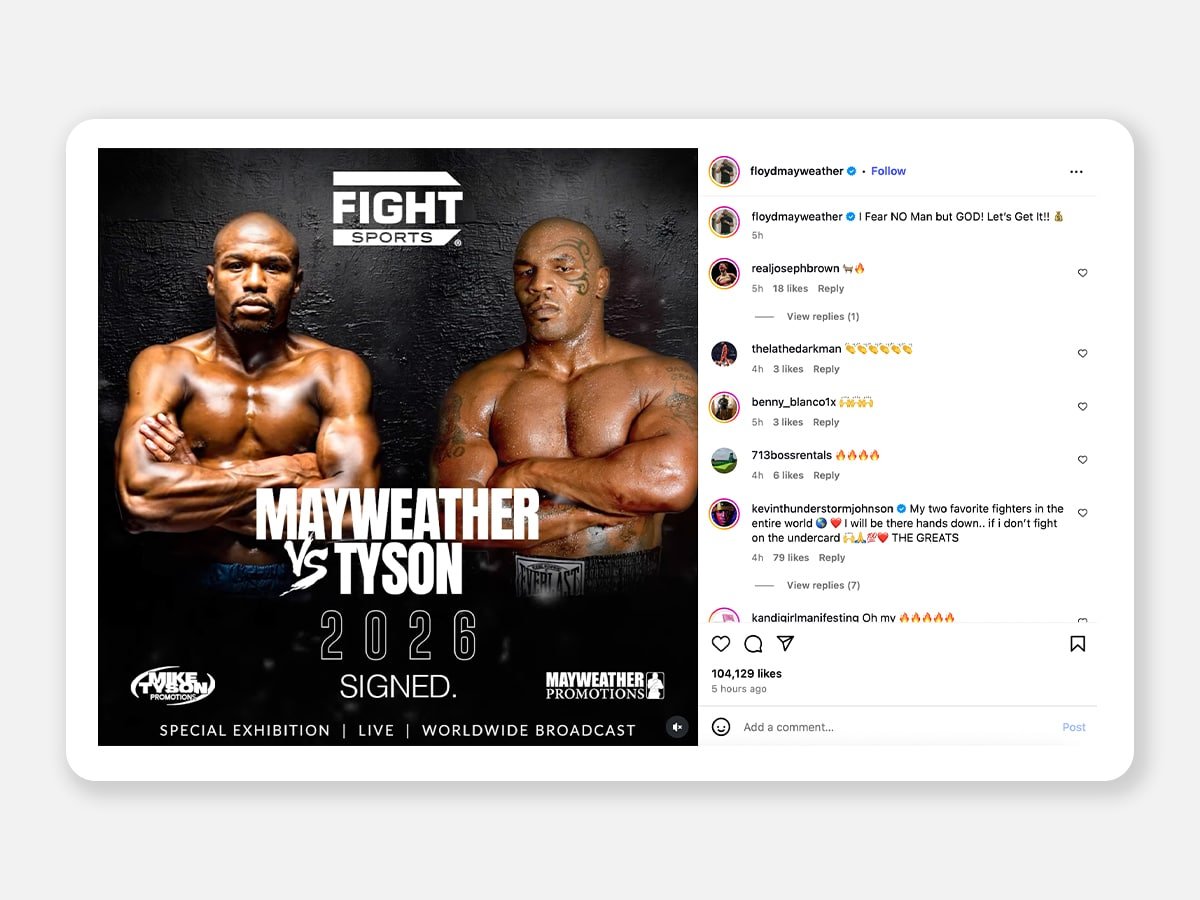
No official location has been announced, but if history offers any clues, this fight is likely to take place on a massive stage. Tyson’s last bout against Jake Paul was at AT&T Stadium in Arlington, Texas, while Mayweather’s recent exhibition against John Gotti III took place at Mexico City Arena. Both were huge events, but neither matches the scale of “Legend vs. Legend.”
The frontrunners? The Middle East. Dubai has become a luxury hotspot for combat sports, while Saudi Arabia has established itself as the epicentre of big-name fights, including the Tommy Fury vs. Jake Paul showdown. With vast resources and a passion for hosting the biggest events on the planet, don’t be surprised if Tyson and Mayweather exchange punches under Arabian lights. Wherever it takes place, one thing is for sure — it will be a global occasion filled with tourism, spectacle, and the biggest boxing legends.
Advertisement · Continue Reading Below
The fight is set for spring 2026, but promoters have not yet announced the exact date. This is classic boxing drama: keep fans guessing, build anticipation, and then make a big announcement. For now, everyone is watching the calendar.
We’ll definitely keep an eye out for you guys.