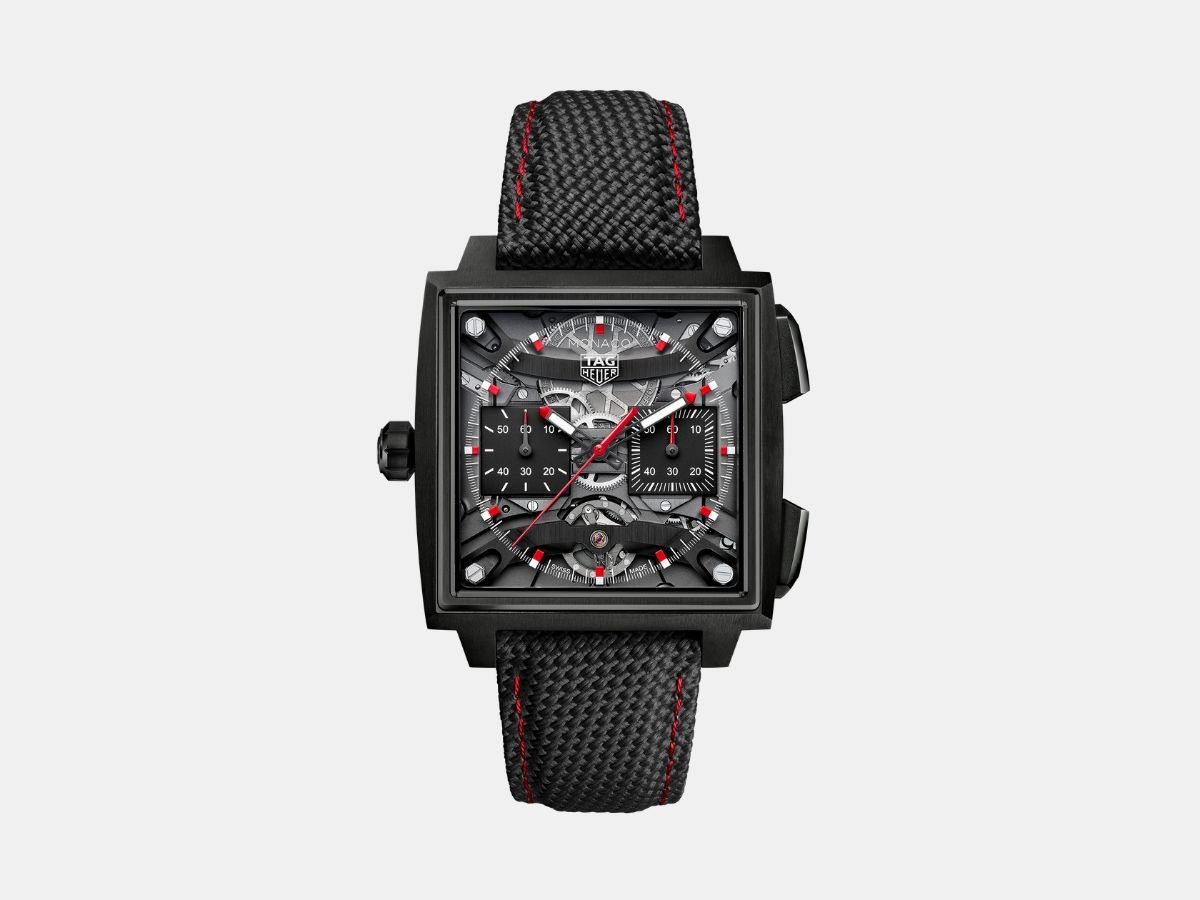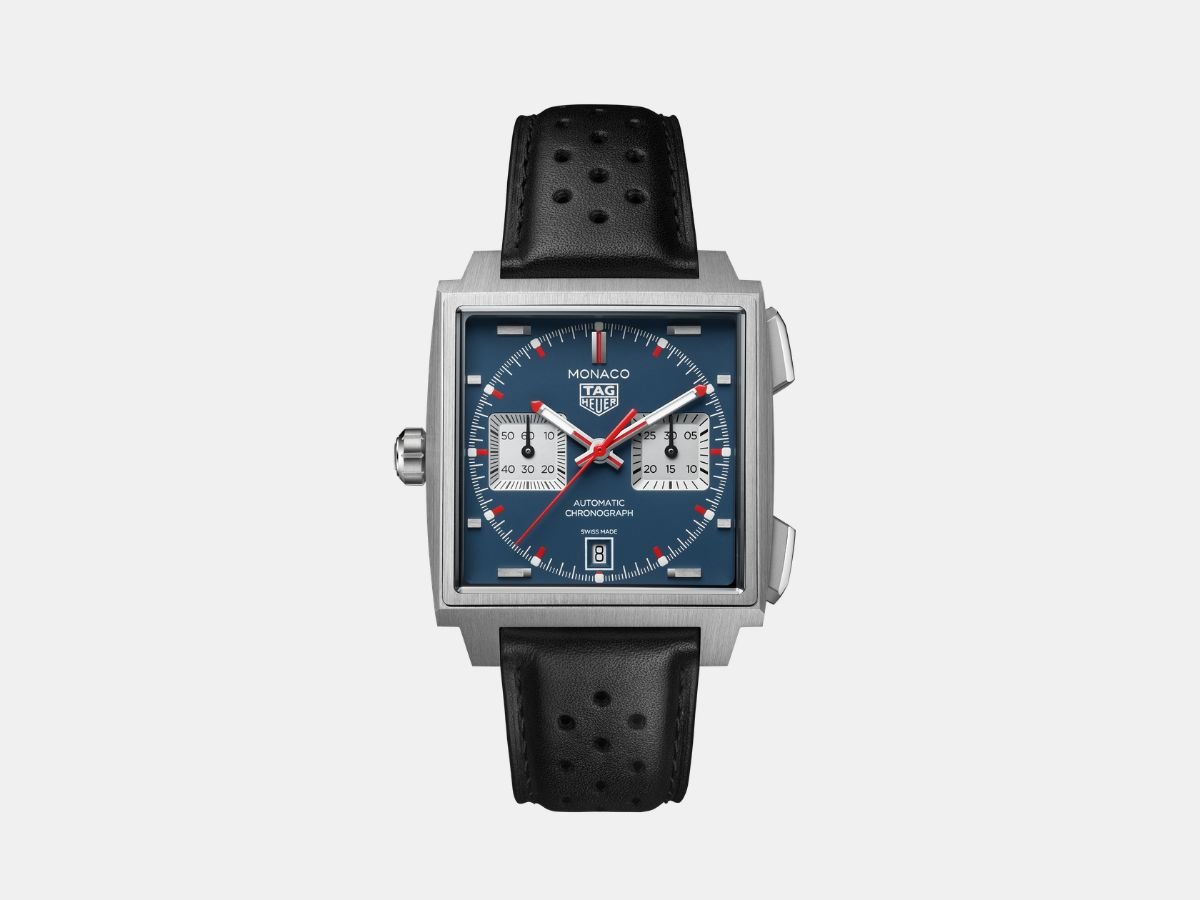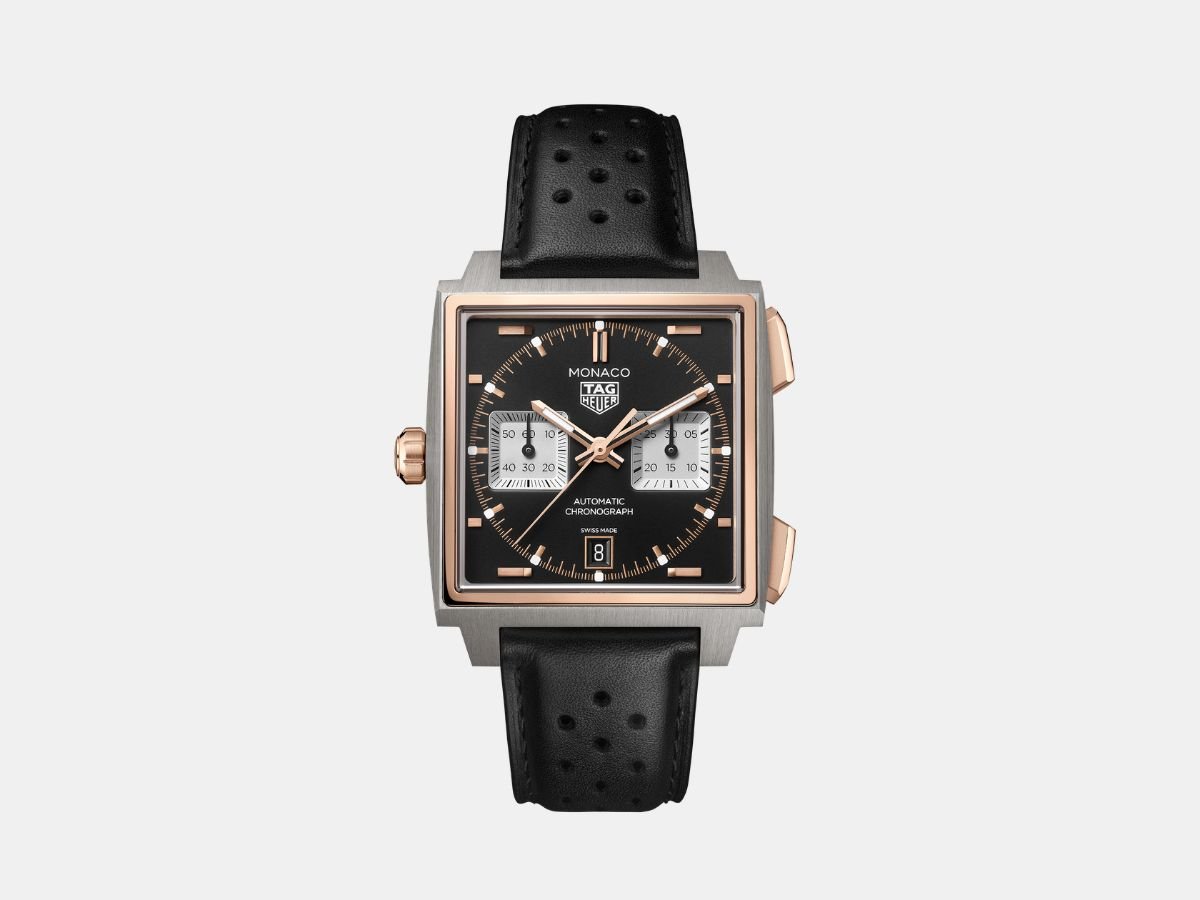




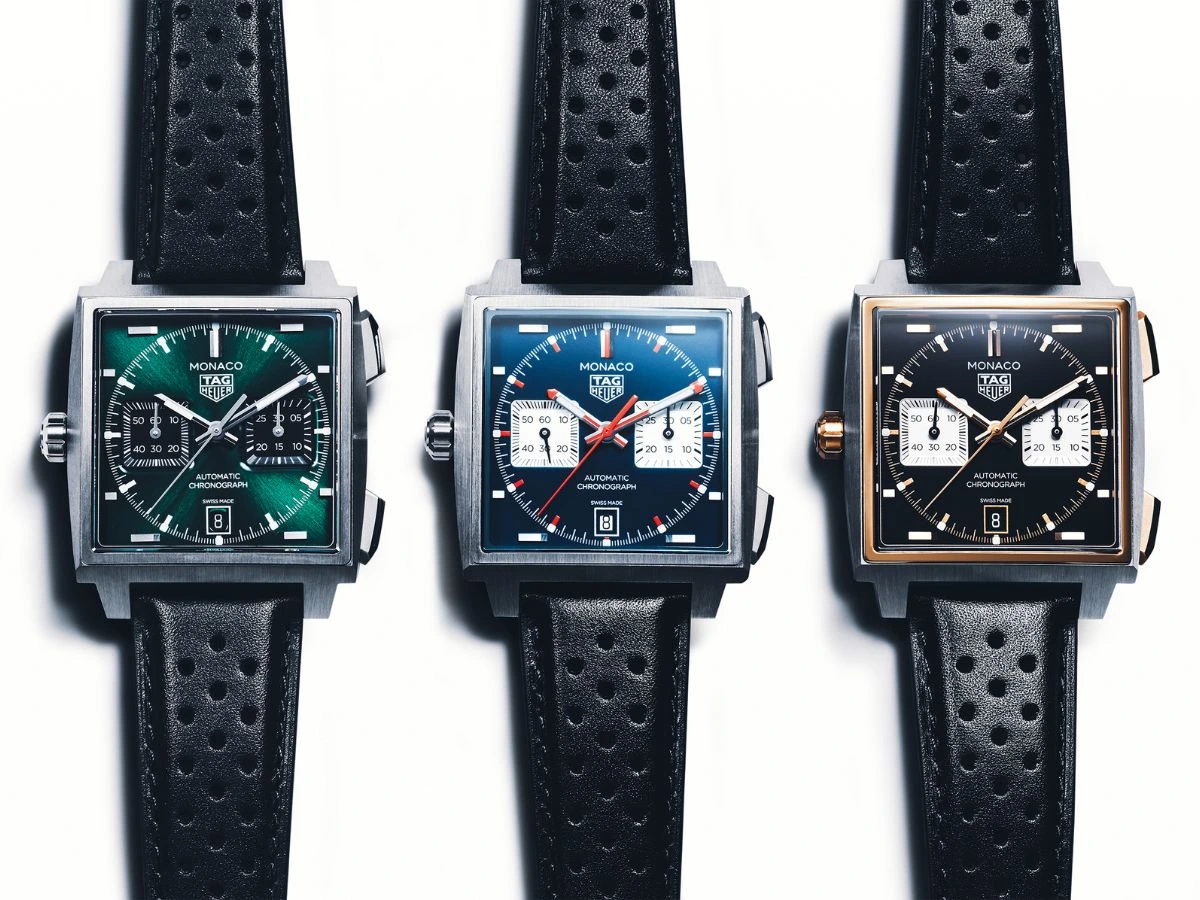
TAG Heuer Monaco Chronograph Ref. CDW2180.FC8360, CDW2181.FC8360, and CDW2150.FC8360.
Watches

TAG Heuer Doubles Down on the Monaco With Five New Watches

Reading Time: 10 minutes

Share via

Our team of editors and experts thoughtfully chooses each product. If you decide to buy through one of our links, we may earn a commission. Learn more. Want to know how we test products? Click here for more details.

  • TAG Heuer introduces five new Monaco watches, including two Monaco Evergraph models and three Monaco Chronographs.
  • The new Monaco Evergraph debuts the square Calibre TH80-00, a COSC-certified 5 Hz movement capable of timing to 1/10th of a second.
  • The 322-component TH80-00 delivers a 70-hour power reserve and is displayed through the Evergraph’s transparent dial.
  • Three new Monaco Chronographs arrive with a slimmer 13.8mm titanium case and a properly square bezel.
  • The Monaco Chronograph is powered by the Automatic Calibre TH20-11, delivering an impressive 80-hour power reserve.

The TAG Heuer Monaco has always looked like it belongs somewhere near a racetrack. The square case, rebellious attitude and decades of motorsport history have made sure of that. But with TAG Heuer back as Formula 1’s official timekeeper and chronographs firmly in the spotlight for 2026, the Swiss watchmaker appears more interested than ever in reminding us exactly where its racing roots lie.

At Watches and Wonders 2026, that means going all-in on one of its most famous creations. TAG Heuer has unveiled five new Monaco watches, split between two very different interpretations of the square icon. Two arrive under the new Monaco Evergraph name, while three new Monaco Chronographs offer a slimmer and more familiar route into the collection.

The Monaco Evergraph is undoubtedly where much of the mechanical attention will land. Crafted from titanium and powered by the new avant-garde Calibre TH80-00, the two watches push the Monaco into fresh territory. The trio of Monaco Chronographs shouldn’t be treated as supporting acts, though. Their slimmer titanium cases now house the in-house TH20-11 movement, giving the classic chronograph an important mechanical update of its own.

Five watches, two new movements and enough racing attitude to make us question the speed limit on the way home. TAG Heuer is doubling down on the Monaco for 2026, and frankly, we’re more than happy to come along for the ride. Here’s everything you need to know about the five new releases.
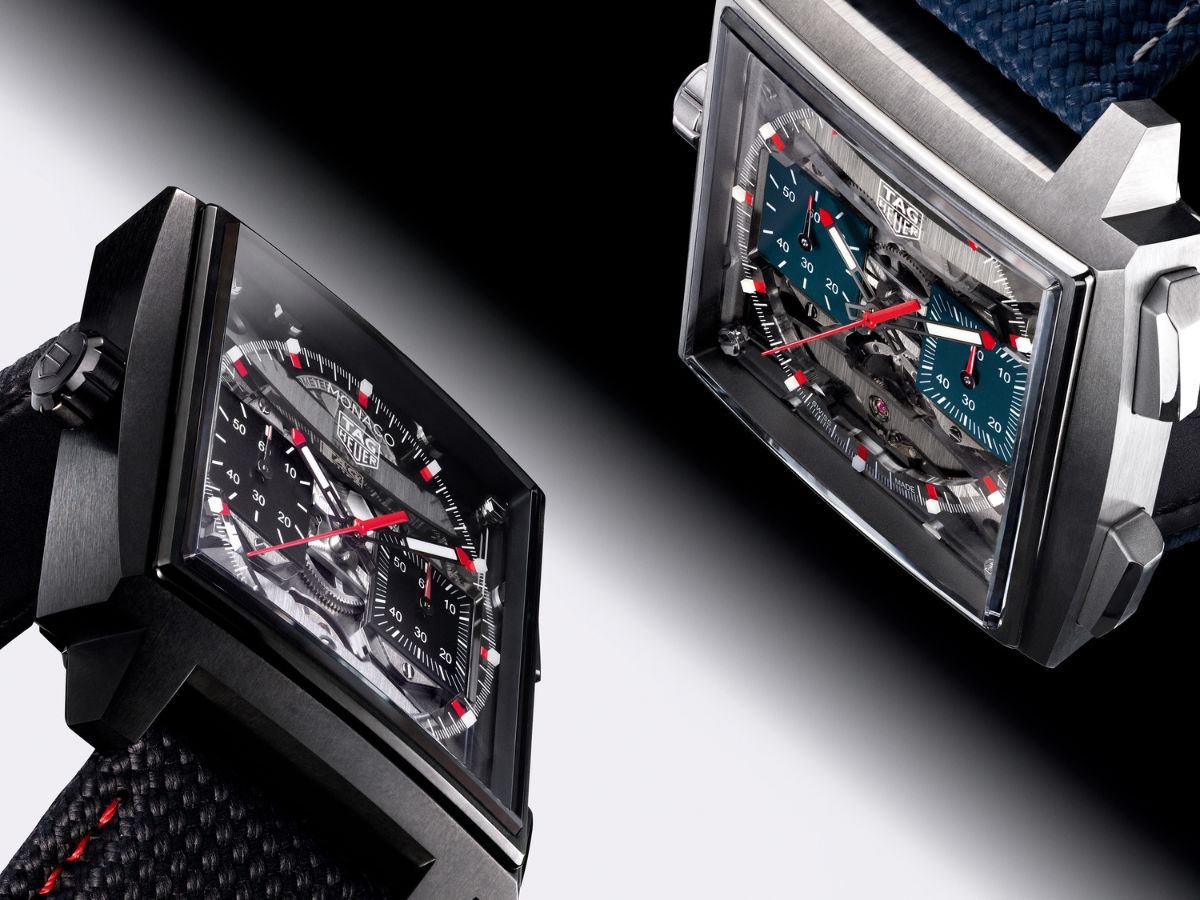
TAG Heuer Monaco Evergraph Ref. CEW5180.FT8122 & CEW5181.FT8123.

TAG Heuer Monaco Evergraph

The Monaco Evergraph is where TAG Heuer really starts pushing the technical side of its square icon. At the centre of both new references is the Calibre TH80-00, a completely square movement designed to match the architecture of the watch it surrounds. According to TAG Heuer, the more complex construction is naturally harder to produce, but the payoff comes through greater reliability — a fairly important quality when your name is once again responsible for timing the fastest cars on the planet.

And TAG Heuer certainly isn’t hiding any of the hard work. The TH80-00 features an open-worked architecture and reversed movement construction, putting its 322 components on full display through the transparent dial. Look closely, and you’ll also find bridges shaped in a clear nod to the TH81-00 movement used in the Monaco Split-Seconds Chronograph. It’s a clever link between two of TAG Heuer’s most technically ambitious modern Monacos, and one that gives the Evergraph a distinctly mechanical personality from almost every angle.

The movement itself uses a compliant mechanism, relying on flexible components to improve durability, reliability and precision. COSC-certified and beating at a high frequency of 5 Hz, the TH80-00 can measure time to 1/10th of a second while still delivering a healthy 70-hour power reserve. In other words, the Evergraph isn’t simply showing off its mechanics through a transparent dial — there is some serious timing hardware underneath all that theatre.

Both references take inspiration from the dynamic lines of the Monaco Split-Seconds Chronograph and arrive in Grade 5 titanium, with one keeping the natural metal finish and the other going darker with a black DLC coating. The familiar Monaco shape remains, but fine-brushed and polished surfaces, avant-garde horlogerie arches and elongated ergonomic pushers give the case a sharper, more technical appearance. Even the crown moves to the 9 o’clock position, adding another unusual detail to a watch that clearly has little interest in convention.

Flip the Evergraph over, and TAG Heuer gives the TH80-00 one more chance to steal the show. A large sapphire exhibition caseback uses a squared, almost hexagonal opening designed to better frame the calibre sitting inside. From the transparent dial to the exhibition back, the entire Monaco Evergraph feels built around one idea: if you’re going to create a 322-component square movement this complicated, you might as well make sure everyone can see it.
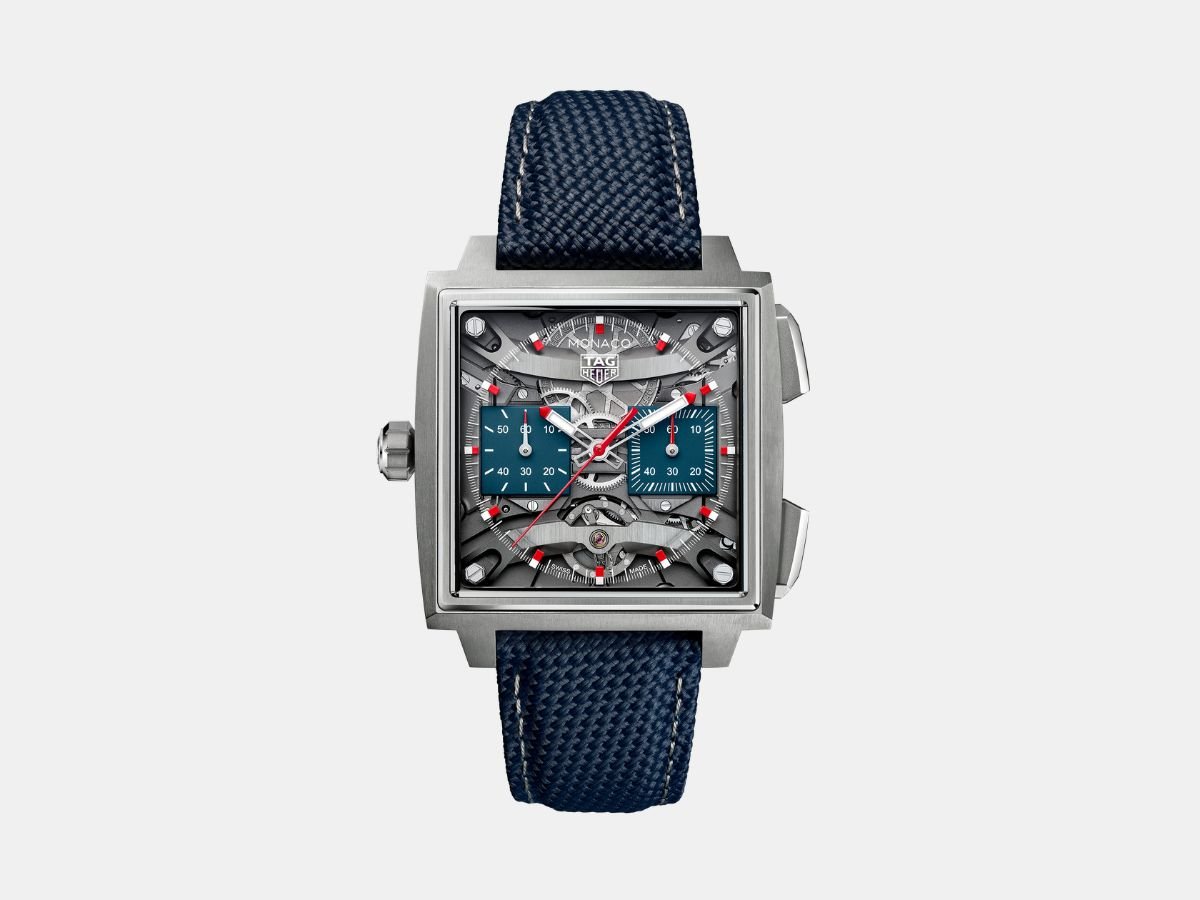
TAG Heuer Monaco Evergraph Ref. CEW5181.FT8123
TAG Heuer Monaco Evergraph Ref. CEW5181.FT8123 | Image: Supplied / TAG Heuer
  • Brand: TAG Heuer
  • Model: Monaco Evergraph
  • Reference: CEW5181.FT8123
  • Diameter: 40 mm
  • Thickness: 14.51 mm
  • Material: Titanium
  • Dial: Transparent acrylic glass with white & red markings
  • Calibre: Automatic Calibre TH80-00
  • Power Reserve: 70 Hours
  • Water-Resistance: 10 Bar (100 metres, 330 feet)
  • Price: USD $25,000
TAG Heuer Monaco Evergraph Ref. CEW5180.FT8122
TAG Heuer Monaco Evergraph Ref. CEW5180.FT8122 | Image: Supplied / TAG Heuer
  • Brand: TAG Heuer
  • Model: Monaco Evergraph
  • Reference: CEW5180.FT8122
  • Diameter: 40 mm
  • Thickness: 14.51 mm
  • Material: Titanium
  • Dial: Transparent acrylic glass with white & red markings
  • Calibre: Automatic Calibre TH80-00
  • Power Reserve: 70 Hours
  • Water-Resistance: 10 Bar (100 metres, 330 feet)
  • Price: USD $25,000
TAG Heuer Monaco Chronograph Ref. CDW2180.FC8360, CDW2181.FC8360, and CDW2150.FC8360.
TAG Heuer Monaco Chronograph | Image: Supplied / TAG Heuer

TAG Heuer Monaco Chronograph

For those who love the Monaco but don’t necessarily need the mechanical complexity of the new Evergraph, TAG Heuer has introduced three new Monaco Chronographs for 2026. The changes are more subtle here, but they reach almost every part of the watch, from the case and bezel to its dimensions and how it feels on the wrist. It is still unmistakably a Monaco, only now the famous racing chronograph has been given a more refined and wearable shape.

Although the Monaco has been recognized for more than five decades as one of watchmaking’s great square icons, earlier generations featured a rectangular bezel. TAG Heuer has finally squared things up for the new collection, introducing a properly square bezel that brings more balance to the overall design. The dimensions have changed as well, moving from 39mm x 39mm and 14.3mm thick to 39.4mm x 39.4mm and 13.8mm thick. It may have grown slightly in width and height, but the slimmer case gives the watch a noticeably neater profile.

TAG Heuer has also spent time working on how the Monaco sits on the wrist. A sloped and bevelled caseback is joined by tapered lugs and a strap that integrates higher into the caseband, while the chronograph pushers are now longer and more neatly integrated into the case. These are small changes when viewed individually, but together they make a real difference to the ergonomics of a watch that has never had the most conventional shape to begin with.

Inside all three watches is the Automatic Calibre TH20-11, an in-house chronograph movement that brings an important mechanical update to the new generation. The calibre delivers an impressive 80-hour power reserve, giving you more than three days of running time when fully wound. Paired with the lightweight Grade 5 titanium construction used across the collection, the TH20-11 gives the new Monaco Chronograph some proper substance beneath its familiar racing-inspired looks.

The three references arrive in Iconic Blue, green and black, each giving the Monaco a noticeably different personality. Blue remains closely tied to the original watch introduced in 1969 and will probably be the familiar choice for Monaco purists, while the new green version brings a fresher look to the collection. The black model leans further into luxury, pairing pink-gold details with Grade 5 titanium for a darker and richer take on the square chronograph. Each watch is finished with a perforated racing strap, keeping the Monaco’s motorsport connection right where it belongs.

Whether you’re heading to a Grand Prix or simply want one of watchmaking’s most recognizable chronographs on your wrist, the new Monaco Chronographs make a strong case for themselves. TAG Heuer hasn’t tried to turn the collection into something it isn’t; instead, the slimmer case, improved ergonomics, titanium construction and new TH20-11 movement give the Monaco a thoughtful update where it matters. More wearable, mechanically stronger and still proudly square, the Monaco continues to do things its own way.
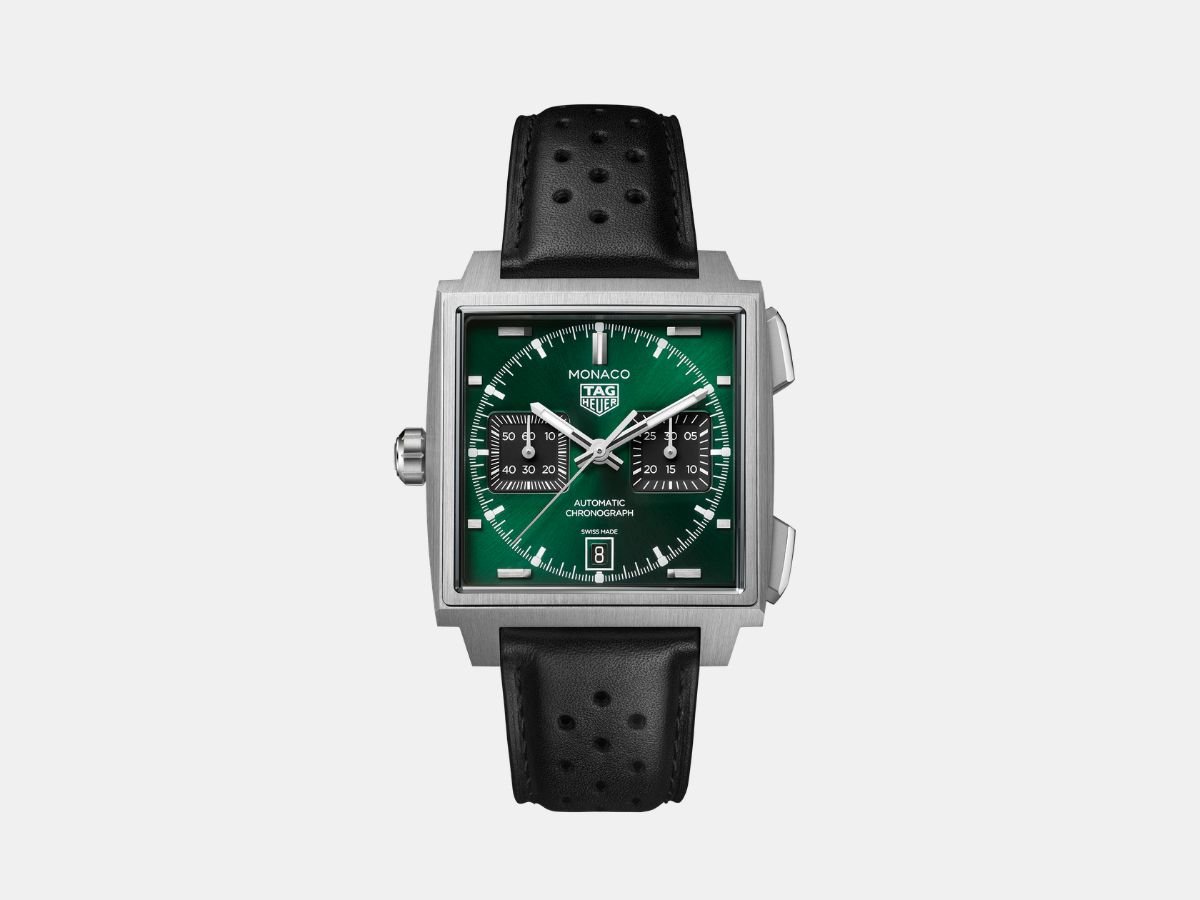
TAG Heuer Monaco Chronograph Ref.  CDW2180.FC8360
TAG Heuer Monaco Chronograph Ref. CDW2180.FC8360 | Image: Supplied / TAG Heuer
  • Brand: TAG Heuer
  • Model: Monaco Chronograph
  • Reference: CDW2180.FC8360
  • Diameter: 39 mm
  • Thickness: 13.9 mm
  • Material: Titanium
  • Dial: Green
  • Calibre: Automatic Calibre TH20-11
  • Power Reserve: 80 Hours
  • Water-Resistance: 10 Bar (100 metres, 330 feet)
  • Price: USD $9,350
TAG Heuer Monaco Chronograph Ref.  CDW2181.FC8360
TAG Heuer Monaco Chronograph Ref. CDW2181.FC8360 | Image: Supplied / TAG Heuer
  • Brand: TAG Heuer
  • Model: Monaco Chronograph
  • Reference: CDW2181.FC8360
  • Diameter: 39 mm
  • Thickness: 13.9 mm
  • Material: Titanium
  • Dial: Blue
  • Calibre: Automatic Calibre TH20-11
  • Power Reserve: 80 Hours
  • Water-Resistance: 10 Bar (100 metres, 330 feet)
  • Price: USD $9,350
TAG Heuer Monaco Chronograph Ref. CDW2150.FC8360
TAG Heuer Monaco Chronograph Ref. CDW2150.FC8360 | Image: Supplied / TAG Heuer
  • Brand: TAG Heuer
  • Model: Monaco Chronograph
  • Reference: CDW2150.FC8360
  • Diameter: 39 mm
  • Thickness: 13.9 mm
  • Material: Titanium
  • Dial: Black opalin
  • Calibre: Automatic Calibre TH20-11
  • Power Reserve: 80 Hours
  • Water-Resistance: 10 Bar (100 metres, 330 feet)
  • Price: USD $9,350

What Do We Think About TAG Heuer’s New Monaco Watches?

Five new Monaco watches in one release could easily have felt like TAG Heuer was doing too much, but we think the split between the Evergraph and the more familiar Monaco Chronograph works surprisingly well. The Evergraph is the one that grabs our attention from a technical perspective, particularly with its square TH80-00 movement and open architecture, while the slimmer titanium Monaco Chronographs are probably the watches we’d be more likely to wear every day. Our favourite? The Black opalin Chronograph has our vote. It feels fresh without messing with Monaco’s character, and with the new TH20-11 movement and 80-hour power reserve inside, there is plenty more going on than a simple colour change. Overall, TAG Heuer has given its famous square icon a proper update for 2026, and we think the Monaco is looking better than it has in years.


Watches & WondersTAG HeuerChronographs
About the Author
GamingTechnology

Here’s Everything We Know About Valve’s ‘Steam Machine’

Reading Time: 8 minutes

Our team of editors and experts thoughtfully chooses each product. If you decide to buy through one of our links, we may earn a commission. Learn more. Want to know how we test products? Click here for more details.

Whenever Valve begins discussing hardware again, it captures people’s interest. The concept of a Steam Machine is back on the table, but this time it comes with much more clarity around what Valve actually aims to create. Instead of outsourcing the experience, Valve now possesses a tested software platform in SteamOS and the assurance that comes with launching its own successful hardware.

The Steam Machine is currently designed as a small-form-factor, pre-assembled gaming PC meant to run SteamOS, Valve’s Linux-based operating system instead of Windows or macOS. It is built to fit neatly into a living room setup while offering direct access to the Steam ecosystem, similar to a console but with PC hardware underneath. Valve is targeting an early 2026 release, although specific details like availability and pricing are still to be announced.

Valve’s Steam Machine | Image: Valve

What sets this moment apart is the intentionality behind the device’s placement. Valve isn’t aiming to replace consoles or compete directly with high-end gaming PCs. Instead, it is focusing on developing a dedicated Steam device that prioritizes ease of use, a controller-first design, and smooth access to an existing game library, all without the fuss that often comes with traditional PC gaming.

That balance between familiarity and flexibility is what makes the Steam Machine worth paying attention to. It occupies a space that hasn’t been clearly defined before, somewhere between a console and a PC, and that middle ground raises just as many questions as it answers. For now, that mix of ambition and uncertainty is exactly what keeps the Steam Machine in the spotlight.

Here’s everything we know about Valve’s ‘Steam Machine’ so far.

Steam Machine Tech Specs

Tech SpecsValve’s ‘Steam Machine
OS SteamOS (Linux)
Dimensions– 156mm x 152mm x 162mm
– 2.6 kg ~ 5.72 Ibs
Storage– 512GB or 2TB M.2 Storage
– Can be upgraded
Ports
– 4x USB-A Ports
– 1x USB-C 3.2 Gen 2
– DisplayPort 1.4 (up to 4K 240Hz, 8K 60Hz)
– HDMI 2.0 (up to 4K 120Hz)
– Gigabit Ethernet
– SD Card Reader
Internals– AMD Zen 4 CPU (4.8GHz, 6 cores)
– AMD RDNA 3 (2.45GHz, 8 GB DDR6 VRAM)
– 16GB DDR5 RAM
PriceTo be confirmed

What Is Valve’s Steam Machine?

Valve’s Steam Machine is designed as a compact, living-room-friendly gaming PC that runs SteamOS out of the box, not Windows. The concept seems simple on the surface. You get something that looks and functions like a console, but beneath it’s still very much a PC, built to connect directly with your existing Steam library. Instead of focusing solely on raw power, the emphasis is on accessibility, comfort, and making PC gaming feel natural on the couch.

What makes this version feel more intentional is the software-first approach. With SteamOS at the centre of the experience, Valve is focusing on what it already excels at. The operating system is built around gaming, with controller-friendly navigation, quick resume features, and tight integration with Steam options like cloud saves. It’s not trying to replace a desktop PC or provide a full productivity setup. The aim seems to be to reduce friction, not add options.

Importantly, the Steam Machine is presented as a fully assembled, ready-to-use system rather than a DIY project. It’s not designed for those who enjoy tweaking settings, swapping parts, or troubleshooting drivers. Instead, it targets players who want the benefits of PC gaming without the typical setup frustrations. In this way, the Steam Machine feels less like a traditional gaming PC and more like Valve’s effort to establish a new middle ground between consoles and computers.

Valve’s Steam Machine | Image: Valve

PC or Console What Is This Thing?

This is where the Steam Machine really blurs the lines. While Valve clearly presents it as a gaming PC, its intended use closely resembles that of a console. The idea is to connect it directly to a TV, monitor, or projector, pick up a controller, and start playing. Features like sleep-to-wake support are designed to make jumping back into a game instant, a feature that PC gaming has traditionally struggled with, especially in a living-room setup.

Rather than functioning like a pared-down desktop operating system, it’s built to run full-screen and be easily navigated with a controller, which is all about SteamOS. This makes the Steam Machine feel much more at home under a TV than a typical Windows PC ever could. If Valve’s software runs as smoothly here as it does on the Steam Deck, the experience should feel familiar and surprisingly polished. And unlike a handheld, a permanently plugged-in box avoids issues like battery drain during sleep, which removes one of the few friction points people still run into with portable hardware.

While upgrading storage should be simple, this isn’t a system designed for frequent tinkering or future GPU replacements. You’re essentially buying a fixed setup, and there’s no expectation that you’ll upgrade graphics hardware later or connect external GPUs. That’s a conscious decision. Valve seems to be betting that many gamers prefer stability, simplicity, and access to their Steam library over cutting-edge performance.

Hardcore PC builders might find it too limiting, while console loyalists often prefer closed ecosystems. However, for players who want the freedom of PC gaming without the hassle of owning a full PC, the Steam Machine offers a balanced middle ground. It doesn’t aim to replace a desktop setup or a console entirely. Instead, it provides a third option for those who simply want to sit down, pick up a controller, and enjoy their Steam games without worrying about what’s happening inside.

Valve’s Steam Machine | Image: Valve

Who’s the Steam Machine for?

if you already own a high-end gaming PC that can push modern games at 4K with high settings, the Steam Machine probably isn’t aimed at you. In that scenario, its main appeal would be as a secondary, living-room box for streaming games from your main rig. And if you’re comfortable tinkering, you could arguably build something similar yourself by installing a Linux-based gaming OS and calling it a day. For power users, the Steam Machine is more convenience than necessity.

What becomes more interesting is for players transitioning from consoles or those wanting to try PC gaming without fully committing. Valve has claimed the Steam Machine offers around 6× the performance of the Steam Deck, which sounds impressive until you consider the context. That level of power puts it roughly on par with current entry-level console hardware, and early technical reviews suggest it could sit somewhere between the Xbox Series S and the base PlayStation 5 in terms of capability. That’s a notable position, especially for a compact, PC-based system created for the living room.

Performance expectations should be viewed realistically. While Valve has discussed aiming for 4K at 60fps, that experience will likely depend on upscaling techniques rather than native resolution throughout. At 1080p or 1440p, however, the Steam Machine should perform much more smoothly, delivering solid performance without relying on software tricks. For most players sitting a few metres from a TV, that trade-off will be quite acceptable.

Valve’s Steam Machine | Image: Valve

Release Date & Price

Valve has announced a general early 2026 timeframe for the Steam Machine’s release, but exact details remain unclear. There is no confirmed launch date, and Valve has not specified if the device will be available worldwide at launch or gradually released in phases. At this point, we simply wait, with more precise information anticipated as the launch approaches.

Pricing remains the biggest unanswered question. What Valve has made clear is that the Steam Machine won’t be priced like a traditional console. Instead, it’s expected to be closer to a mid-range PC, reflecting its hardware and the fact that it isn’t being subsidised in the same way consoles often are. That suggests it won’t be cheap, but it also means expectations should be more aligned with PC hardware than plug-and-play consoles.

Until Valve announces a specific price, any discussion about cost remains speculation. The Steam Machine appears to be designed as a dedicated Steam device for the living room, rather than an affordable console alternative. When the price is finally disclosed, it will determine whether this device remains a niche enthusiast product or establishes itself as a viable option between PCs and traditional consoles.

GearSteam
About the Author
arrow_drop_up