





StyleSports

Nike Unveils USMNT Jerseys Full of Stars, Stripes and Swagger for the 2026 World Cup

Reading Time: 7 minutes

Share via

Our team of editors and experts thoughtfully chooses each product. If you decide to buy through one of our links, we may earn a commission. Learn more. Want to know how we test products? Click here for more details.

The United States had waited more than three decades to host another men’s World Cup, so the USMNT needed jerseys worthy of the occasion—and recognizable enough to last beyond a single tournament cycle. Another plain white shirt might have been safe, but it would hardly capture the scale of playing football’s biggest competition on home soil.

Nike and U.S. Soccer responded with two contrasting designs built around the country’s most familiar symbols. The Stripes home jersey turns the American flag into a flowing red-and-white pattern, while the dark Stars away kit uses knitted graphics and chrome details to deliver the more understated swagger requested by the players during development.

Unveiled on March 16, 2026, the jerseys were created with direct input from USMNT players and supported by Nike’s new Aero-FIT cooling technology. Custom Stars and Stripes number fonts and a hidden “The Best of U.S.” message inside the collar complete an identity created specifically for a World Cup hosted across the United States, Canada and Mexico.

The designs also extend beyond the senior men’s squad and will be worn across all 27 U.S. Soccer national teams. As Dave Wright, Chief Commercial Officer of U.S. Soccer, explains, “A national team jersey represents the pride of wearing the crest, not just for players on the field, but also for the fans who support them every step of the way. With the 2026 FIFA Men’s World Cup coming to the United States, we’re excited to see players across all 27 of our National Teams and supporters across the country wearing this kit as we build toward an incredible moment for the game.”

USMNT 2026 Match Away Jersey
USMNT 2026 Match Away Jersey | Image: Nike

Stars, Stripes & Two Very Different USMNT Kits

Nike has given the USMNT two jerseys that share the same national identity without looking like simple colour swaps. The Stripes kit is the louder option, using red, white and blue to make the team immediately recognizable from the opposite side of a stadium, while the darker Stars design takes a more restrained approach that should look just as comfortable with jeans as it does with football shorts.

Development began in 2023, with Weston McKennie, Tyler Adams, Matt Turner and Ricardo Pepi among the players invited to provide feedback on the colours, fit, fabric weight and mobility. When Nike asked how the team wanted the kits to feel, the answers included “sophisticated,” “luxurious” and “swag”—which is considerably more useful than simply asking everyone whether they wanted another plain white shirt.

Ronnie J. Stewart, Global Product Director for Nike, explains, “I think between both kits there is something for everybody. If you want to be loud and proud and represent the crest, no one’s going to doubt who you’re there for in the light kit. If you’re looking for that lifestyle look that works off the field, the dark is for you.”
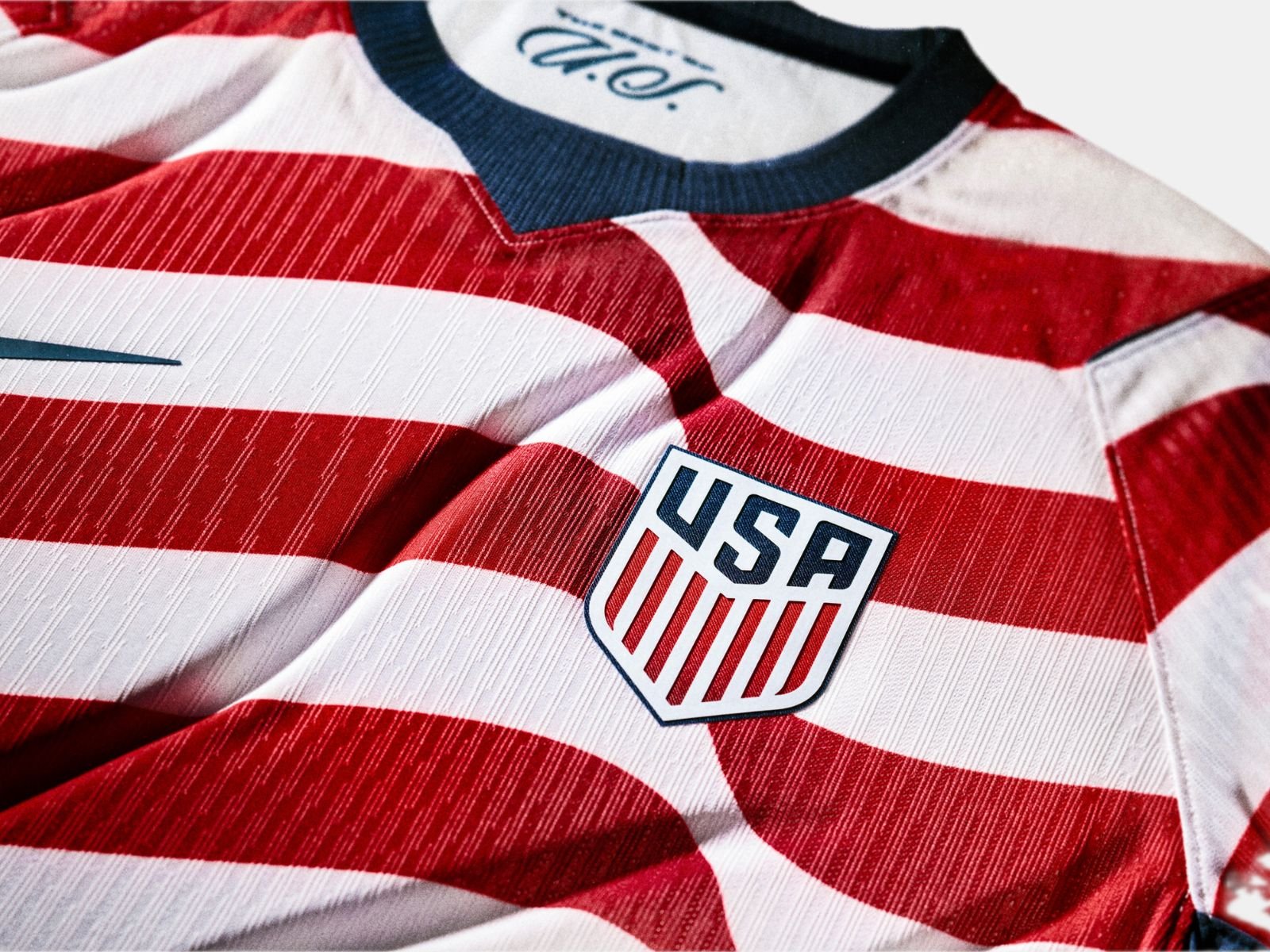
USMNT 2026 Match Home Jersey
USMNT 2026 Match Home Jersey | Image: Nike

The Stripes Home Jersey

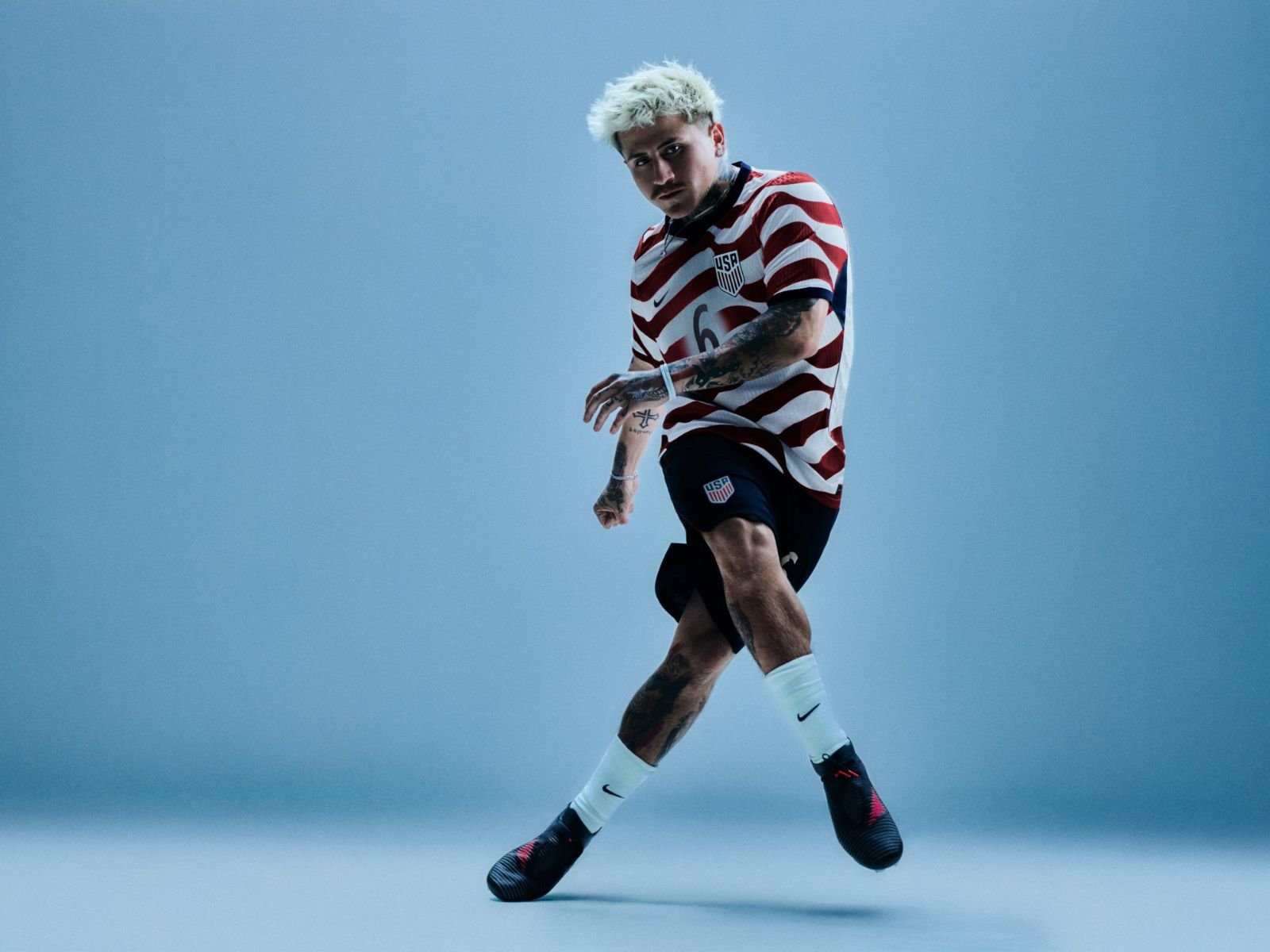
The Stripes home jersey is the more traditional of the two designs, although Nike has avoided simply placing a crest on another plain white shirt and calling it patriotic. Its sail-coloured base is crossed by curved red stripes that become progressively darker as they move down the body, creating the impression of the American flag moving in the wind rather than hanging perfectly still.

That flowing gradient continues into the U.S. Soccer crest, an element normally left untouched, while midnight-navy details around the collar and sleeves keep the red-and-white pattern from taking over completely. Nike also created a bespoke Stripes typeface for the player names and numbers, giving the entire uniform a consistent identity rather than relying on the federation’s usual graphics.

You certainly will not mistake it for another national team.

The design inevitably recalls previous USMNT favourites, particularly the horizontally striped “Waldo” jersey from 2012, but Nike says it was intended as a reinvention rather than a direct throwback. Inside the collar sits the hidden “The Best of U.S.” Inner Pride mark, completing a home jersey designed to be unmistakably American even when the crest is too far away to read.
USMNT 2026 Match Away Jersey
USMNT 2026 Match Away Jersey | Image: Nike
USMNT 2026 Match Away Jersey
USMNT 2026 Match Away Jersey | Image: Nike

The Stars Away Jersey

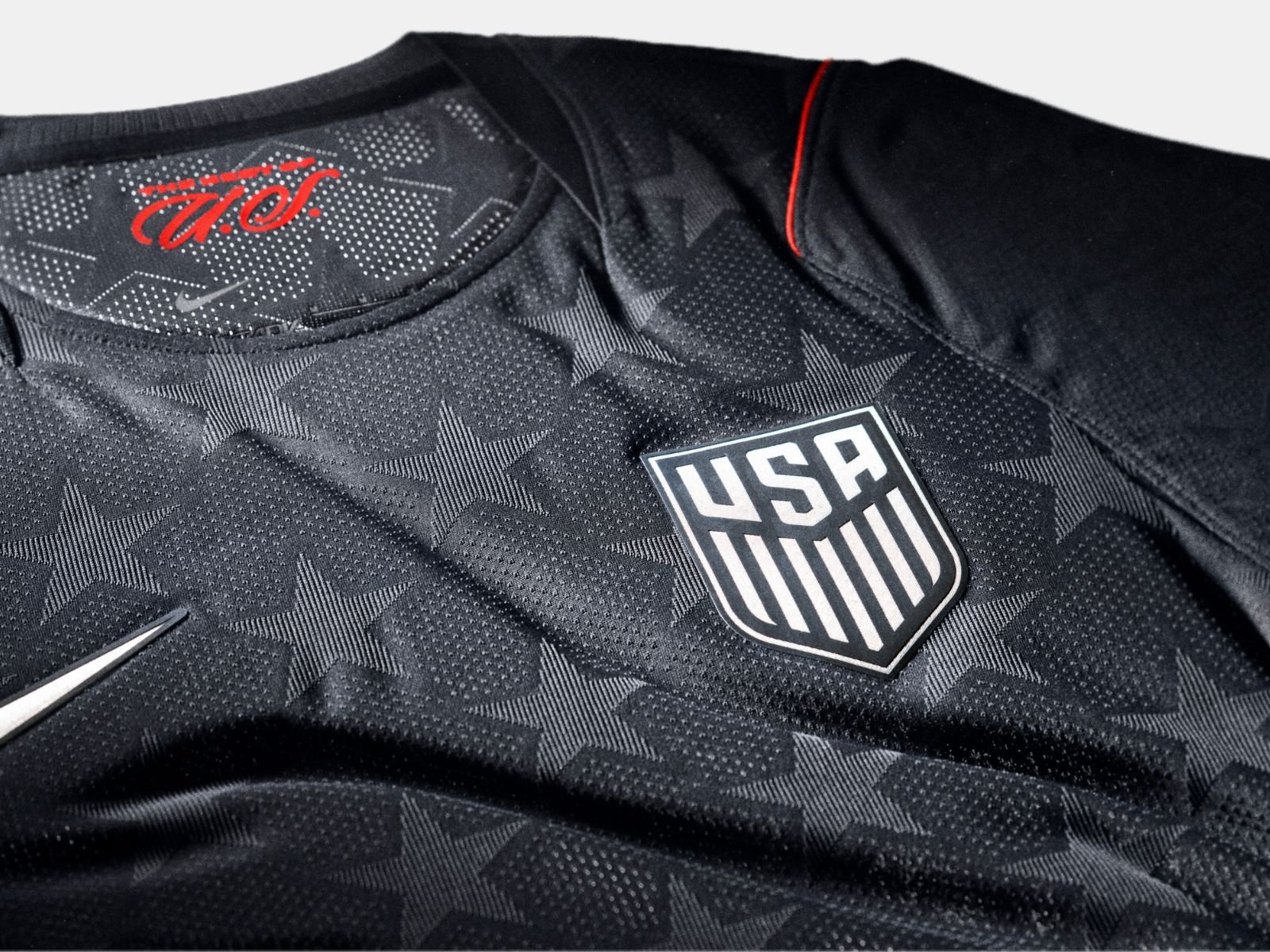
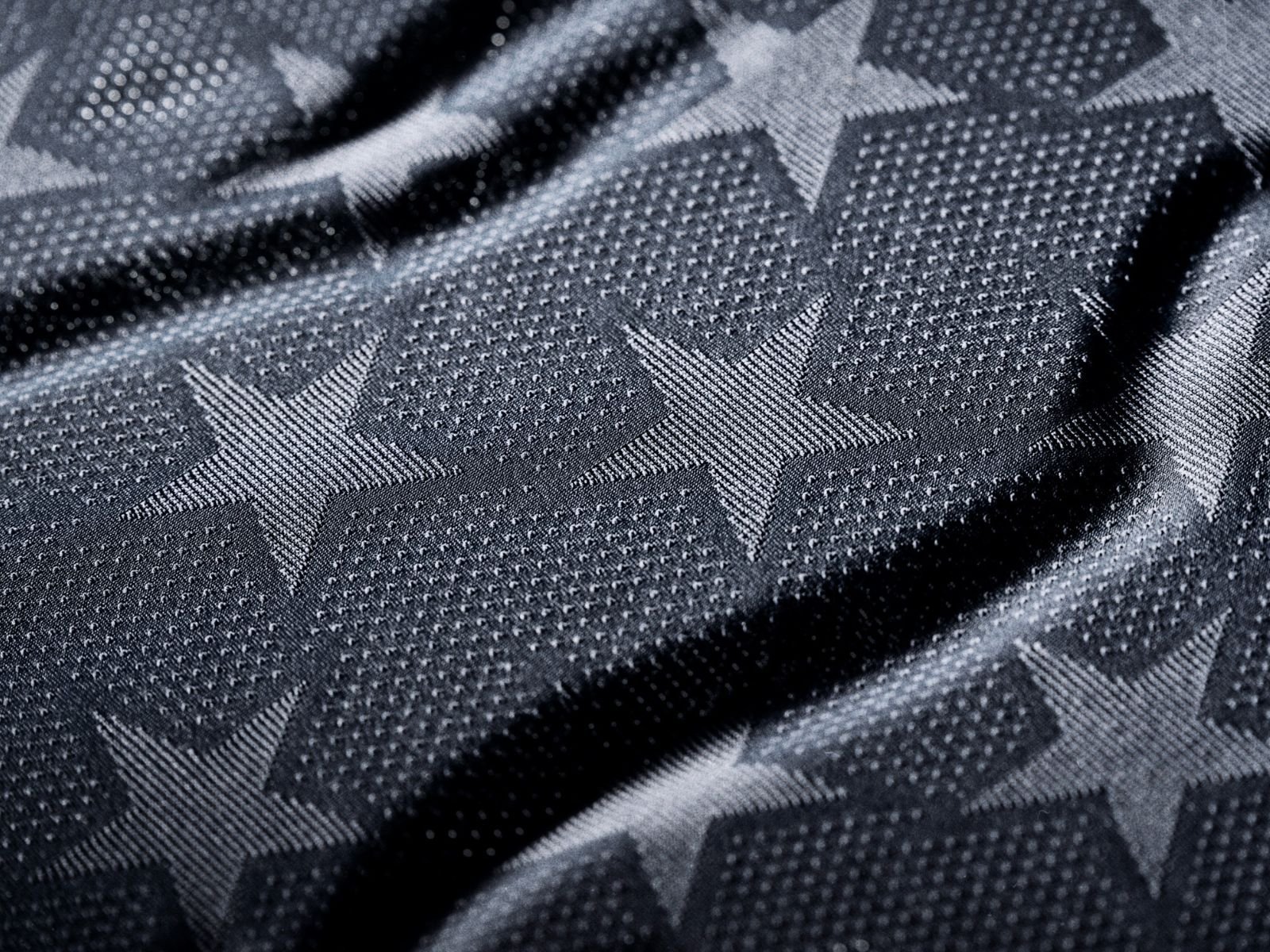
The Stars Away Jersey turns down the volume without abandoning the theme. Its deep navy base appears almost black from a distance, but closer inspection reveals stars knitted directly into the fabric, allowing the pattern to emerge as the light moves across it. Small red details keep the design connected to the wider collection without interrupting its darker appearance.

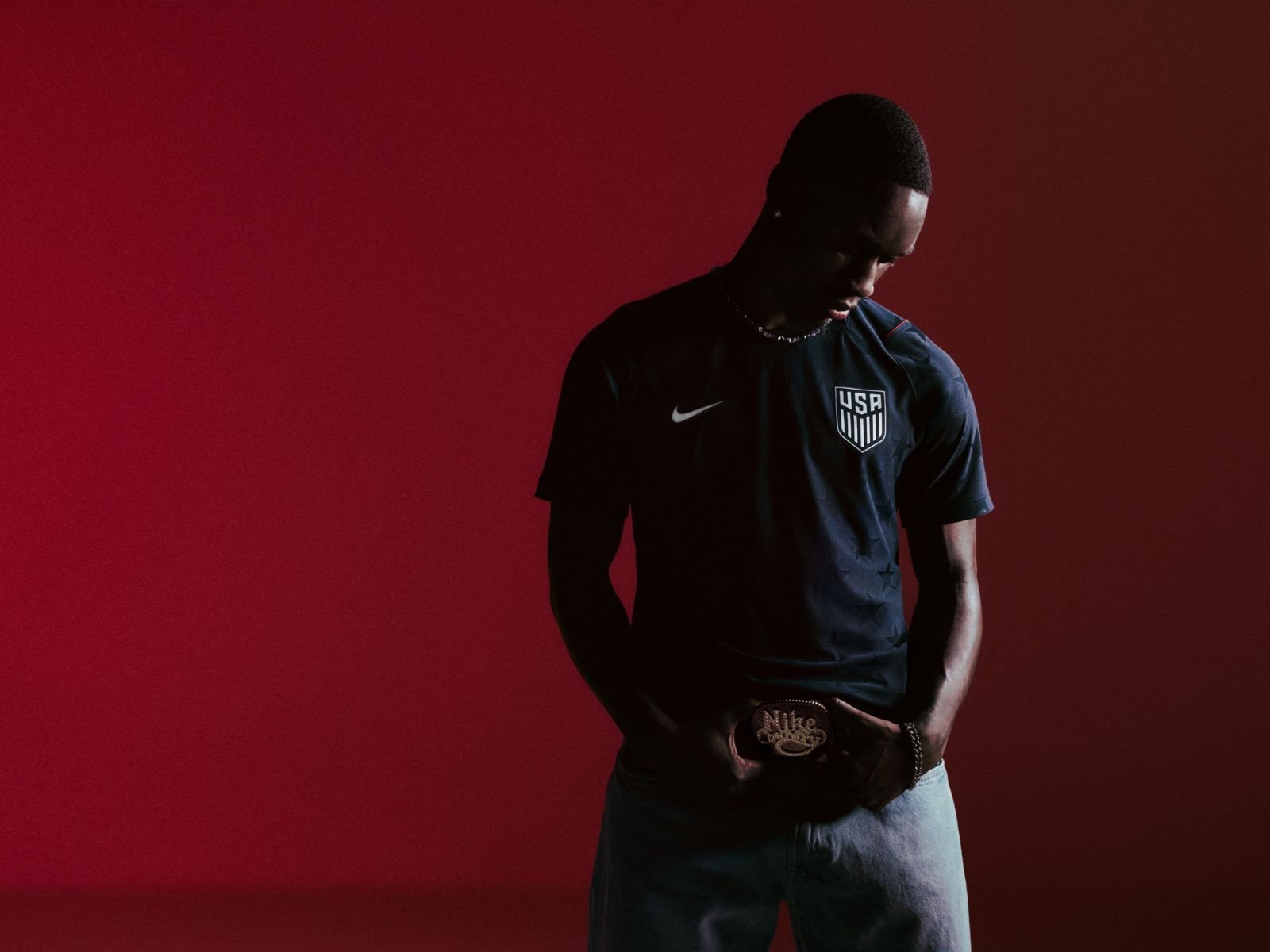
Nike finished the Swoosh and U.S. Soccer crest in chrome, drawing inspiration from the jewellery and personal style designers noticed while spending time with the players. It gives the jersey a slightly more polished look than the home kit, while the custom Stars typeface carries the same visual language into the player names and numbers.

Where the Stripes jersey is designed to stand out across a packed stadium, the Stars version makes more sense beyond matchday. It is understated enough to wear casually, but the changing knit pattern ensures it does not become another anonymous navy football shirt—which is where that requested USMNT “swagger” finally earns its place.
USMNT 2026 Match Away Jersey
USMNT 2026 Match Away Jersey | Image: Nike

USMNT 2026 Jerseys Price & Availability

The Stars and Stripes designs were offered in authentic Match and more affordable Stadium versions, with separate fits available for men, women and children. Launch pricing was as follows:

The Match editions use Nike’s lightweight Aero-FIT construction, strategically placed mesh zones and raised silicone crests, giving supporters essentially the same jersey worn on the pitch. Stadium editions switch to Dri-FIT fabric, embroidered crests and a more relaxed cut that should feel considerably more comfortable when your matchday preparation involves sitting on a sofa with snacks.

Both designs were sold through Nike, the official U.S. Soccer Store and approximately 2,500 locations across the United States, including Dick’s Sporting Goods, Rally House and Scheels. It became the widest kit release in U.S. Soccer history, ensuring the Stars and Stripes were almost as visible in the stands as they were on the pitch.

USMNT 2026 Match Home Jersey | Image: Nike
USMNT 2026 Match Away Jersey | Image: Nike

NikeFIFA
About the Author
Cars

1954 Mercedes-Benz W196R Sells for $52 Million Becoming the Second Most Expensive Car Ever

Reading Time: 6 minutes

Our team of editors and experts thoughtfully chooses each product. If you decide to buy through one of our links, we may earn a commission. Learn more. Want to know how we test products? Click here for more details.

Collectors have long been attracted to rarity, but the discovery of a vintage automotive piece after decades of concealment elevates the thrill. This was evident at RM Sotheby’s recent auction, where a 1954 Mercedes-Benz W196 R Stromlinienwagen sold for an incredible $52 million USD, ranking as the second most expensive car ever auctioned.

This wasn’t just any old Mercedes. It was chassis number 00009/54, a machine that epitomizes the golden age of Formula 1 engineering. Developed under the meticulous supervision of Rudolf Uhlenhaut, the W196 R was a technological marvel that combined performance with futuristic design. With its Stromlinienwagen (“streamliner”) bodywork, it looked like it had been from the future—a car designed to cut through the air at top speed.

Only four of these streamliner-bodied W196 R models are known to exist, and they were specifically designed for high-speed circuits. The body, constructed from Elektron magnesium alloy, weighed just 88 pounds (40 kilograms), making it lighter than aluminium while still strong enough to meet the demands of Formula 1 racing. The result was an aerodynamic masterpiece that could easily reach speeds over 186 mph (300 km/h)—staggering for the 1950s.

Key Highlights:

  • Sold at RM Sotheby’s, becoming the second most expensive car ever sold at auction.
  • 1954 Mercedes-Benz W196 R Stromlinienwagen (Chassis 00009/54)
  • Only four streamliner-bodied W196 R cars are known to still exist.
  • Released after 59 years at the Indianapolis Motor Speedway Museum, with appearances at Pebble Beach and Petersen Automotive Museum.
1954 Mercedes-Benz W 196 R Stromlinienwagen | Image: Sotheby’s

Beneath the sleek skin sat an inline eight-cylinder engine, essentially two four-cylinder units bolted together, producing between 257 and 290 horsepower depending on its race setup. Pair that with innovations like front double wishbone suspension, torsion-bar springs, Alfin drum brakes, and Uhlenhaut’s patented low-pivot swing axle rear suspension, and you had one of the most advanced racing cars of its era. This wasn’t just a car—it was a rocket ship in disguise.

The W196 R made an immediate impact on the track. When it debuted in 1954, Mercedes entered three cars into the French Grand Prix at Reims. The result? A dominant 1st, 2nd, and 7th place finish, with factory driver Juan Manuel Fangio leading the way. Fangio went on to win the 1954 Formula 1 World Championship in the W196 R, ending Ferrari’s winning streak and showing that Mercedes-Benz had built the ultimate racing machine.

The car’s legend only grew in 1955 when the streamlined W196 returned for the newly redesigned Monza circuit, which featured a dramatic high-banked section. Fangio and teammate Piero Taruffi surged to a 1-2 finish, while Stirling Moss—driving this very chassis, 00009/54—set the fastest lap with an average speed of 215.7 km/h on lap 21. These victories cemented the Stromlinienwagen’s place in motorsport history.

Italian Grand Prix in Monza, 11 September 1955 | Image: Sotheby’s

However, Mercedes’ Formula 1 dominance was brief. After the tragic 1955 Le Mans disaster, which fundamentally changed motorsport safety, Mercedes-Benz withdrew from racing completely. In October that year, the brand held a formal ceremony to retire the W196 R, relocating most examples to the Daimler-Benz Museum in Stuttgart. Four were eventually donated to other institutions worldwide—including this one.

Chassis 00009/54 was transferred to the Indianapolis Motor Speedway Museum in 1965 and stayed there for almost 59 years. Throughout this period, it became a key exhibit, appreciated by fans but not altered by collectors. Its time in the museum provided it with a pristine provenance, free from restorations or ownership changes that can lessen the value of classic race cars.

1954 Mercedes-Benz W 196 R Stromlinienwagen | Image: Sotheby’s

For collectors, the W196 R is the ultimate combination: rarity, an impeccable history, technological innovation, and a direct link to motorsport legends like Fangio and Moss. It’s the kind of car that even billionaires couldn’t previously afford, kept away in museums for decades. Now, one fortunate collector has managed to acquire it, adding a priceless piece of Formula 1 history to their collection.

The sale also sends a clear message: the desire for historically significant race cars is stronger than ever. In a world where Ferrari 250 GTOs and Aston Martins often dominate headlines, this Mercedes-Benz proves that Formula 1 machines—with their stories of speed, innovation, and championship glory—hold just as much, if not more, value in the eyes of collectors.

With only four of these streamliner-bodied W196 Rs known to exist, opportunities like this come around only once in a lifetime. And with its combination of race-winning pedigree, unbroken provenance, and stunning beauty, it’s no wonder this car commands a price tag that firmly cements its place in history.

1954 Mercedes-Benz W 196 R Stromlinienwagen | Image: Sotheby’s
1954 Mercedes-Benz W 196 R Stromlinienwagen chassis number 00009/54 | Image: Sotheby’s
1954 Mercedes-Benz W 196 R Stromlinienwagen | Image: Sotheby’s
1954 Mercedes-Benz W 196 R Stromlinienwagen chassis number 00009/54 | Image: Sotheby’s
1954 Mercedes-Benz W 196 R Stromlinienwagen | Image: Sotheby’s

Mercedes Benz
About the Author
arrow_drop_up