





Professional Boxer Manny Pacquiao celebrating with the WBO International belt after defeating Brandon Ríos in November 2013.
Movies & TV Shows

Manny Pacquiao Joins Netflix’s Physical: Asia—A New Arena for the Boxing Legend

Reading Time: 4 minutes

Share via

Our team of editors and experts thoughtfully chooses each product. If you decide to buy through one of our links, we may earn a commission. Learn more. Want to know how we test products? Click here for more details.

Manny “PacMan” Pacquiao is no stranger to high-profile stages — from crowded boxing arenas to political campaigns. But now, he’s stepping into something different. The legend has officially joined Netflix’s latest reality competition, Physical: Asia — the Asia-wide evolution of Physical: 100 — as the main figure for Team Philippines.

This isn’t a boxing match. It’s a test of endurance, strength, strategy and teamwork. Instead of punching gloves, Pacquiao will lead a squad of six Filipino athletes competing against teams from eight countries: Korea, Japan, Thailand, Mongolia, Türkiye, Indonesia, Australia and the Philippines.

Netflix Physical: Asia Team Philippines
Physical: Asia Team Philippines | Image: IMDb

Switching from the boxing ring to a reality competition show might look like a big change, but for Pacquiao, it’s just the next step in his ongoing search for new challenges and boundaries.

Pacquiao has made his mark as an athlete, senator, and brand icon, and now he’s taking on a new challenge. His role brings excitement and credibility to ‘Physical: Asia’, especially as sports, media, and entertainment converge. People will watch not only for his athletic skills, but also to see how he represents his country.

This show is driven by ambition. Earlier seasons of ‘Physical: 100’ focused on individual strength and endurance, but the Asia edition is all about teams competing for their countries. Here, one mistake can affect the whole group.


Netflix Physical: Asia Team Philippines — Manny Pacquiao
Physical: Asia Team Philippines | Image: IMDb
Netflix Physical: Asia Team Philippines — Mark Mugen
Physical: Asia Team Philippines | Image: IMDb
Netflix Physical: Asia Team Philippines — Ray Jefferson Querubin
Physical: Asia Team Philippines | Image: IMDb
Netflix Physical: Asia Team Philippines — Justin Coveney
Physical: Asia Team Philippines | Image: IMDb
Netflix Physical: Asia Team Philippines — Robyn Lauren Brown
Physical: Asia Team Philippines | Image: IMDb

Who’s on Team Philippines?

When you hear Manny Pacquiao’s name, you might think that the spotlight is only on him. However, Netflix made sure that Team Philippines is more than just one legend. The team is a carefully selected group of athletes, each providing their own strengths. Because the show is a team competition, star power alone is not enough to succeed. Teams need balance, diversity, and members who can support one another’s weaknesses. That’s where the rest of the squad steps up.

Here’s ‘Physical: Asia’ Philippines Team:

  • Mark “Mugen” Striegl — Fil-Am sambo athlete
  • Ray Jefferson Querubin — Strongman
  • Justin Coveney — National rugby player
  • Robyn Lauren Brown — Track & field hurdler
  • Lara Liwanag — CrossFit standout

It’s a mixture of speed, strength, endurance and strategic awareness. Striegl brings combat-sport grit, Querubin provides brute power, Coveney contributes teamwork and collision discipline from rugby, Brown provides explosive speed and agility, and Liwanag balances the group with exceptional conditioning and mental toughness.

What makes this lineup so compelling is how closely it reflects Pacquiao’s own story. He’s always been more than just his fists — his success came from resilience, adaptability and taking strength from those around him. Team Philippines captures this same spirit. With Pacquiao’s leadership added to this diverse group of athletes, they enter Physical: Asia as more than just underdogs. They appear like a squad built to surprise, and that is what could make them dangerous.

Boxing legend Manny Pacquiao in the ring.
Manny Pacquiao Joins Netflix’s Physical: Asia | Image: Getty Images

Why Pacquiao’s Netflix Move Matters

With Physical: Asia set to premiere in 2025, there are already some storylines to watch. Will Pacquiao face the challenges himself, or will he lead the team? How will Team Philippines react if one member starts to struggle? Can they adapt, recover, and keep going? Plus, with well-known fighters like UFC veteran Robert Whittaker and Muay Thai champion Superbon leading other teams, the competition will be tough.

But Pacquiao’s role is more than just the thrill of the matches. At 46, he has already proven his athletic skills with eight world titles in different weight classes. What matters now is his readiness to change and try new things, in sports and beyond. By joining Netflix, Pacquiao is not just competing. He is showing us that legends don’t retire—they keep growing.

For Netflix, having Pacquiao involved makes ‘Physical: Asia’ more than just another reality show. It turns the series into a cultural event where national pride, sports spirit, and entertainment come together. For Pacquiao, it is another part of a career marked not by limits, but by his will to keep moving forward.


Netflix
About the Author

Related Articles

Leica Cine Compact 1
TechAppliance & TVs

Leica Cine Compact 1 Turns Your Ceiling Into a 220-Inch 4K Cinema

Reading Time: 6 minutes

Our team of editors and experts thoughtfully chooses each product. If you decide to buy through one of our links, we may earn a commission. Learn more. Want to know how we test products? Click here for more details.

  • The Leica Cine Compact 1 projects a 4K image measuring between 60 and 220 inches using a Leica Summicron lens and Triple RGB laser.
  • Its 360-degree rotating body can project onto walls, ceilings, and outdoor surfaces, with automatic focus, zoom, keystone correction, and screen-framing setup.
  • Built-in VIDAA provides access to Netflix, Disney+, Prime Video and YouTube, while two 10W speakers handle sound without requiring additional equipment.
  • The projector launches on June 18, 2026, with US pricing set at USD $1,995.00 and availability confirmed across several international markets.

Leica is best known for making cameras that encourage people to point a lens at the world, but its latest release would rather point one at the ceiling. The Leica Cine Compact 1 is the company’s smallest home-cinema projector yet, combining a portable aluminum body with 4K resolution, Dolby Vision and enough flexibility to turn almost any suitable surface into a screen.

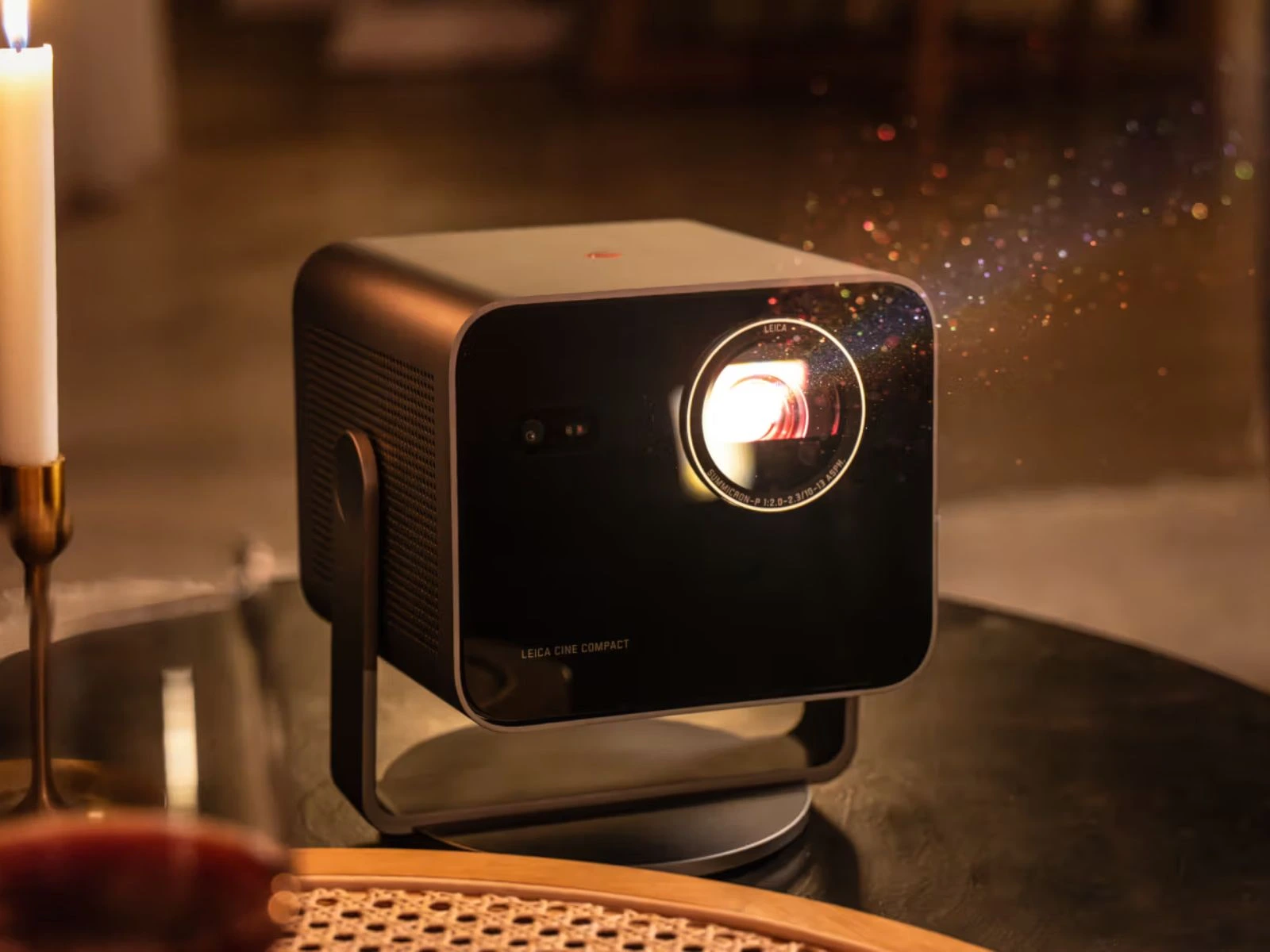
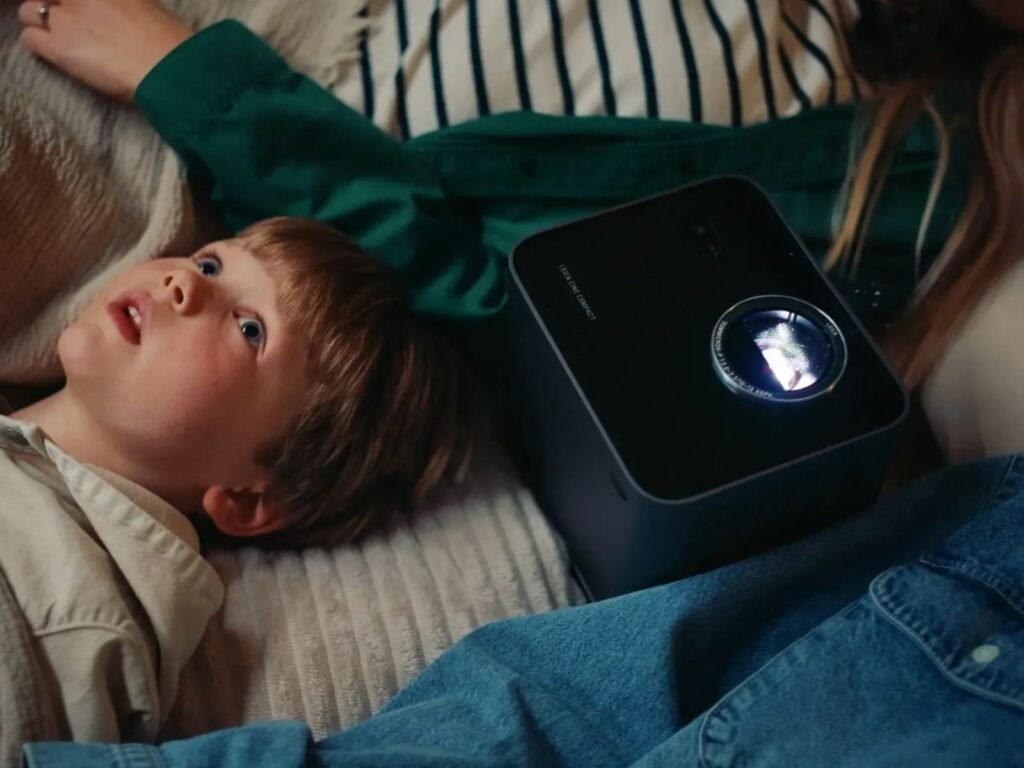
Point it at a wall, ceiling or outdoor surface, and its 360-degree rotating body allows the image to follow. The Cine Compact 1 is designed to remove most of the usual fiddling through automatic zoom, autofocus, keystone correction and intelligent screen framing, while its Leica Summicron zoom lens can produce an image measuring between 60 and 220 inches with up to 1,700 lumens of brightness. In other words, you should spend less time pushing the projector around the coffee table and more time deciding what to watch.

Leica Cine Compact 1 Makes 4K Cinema More Flexible

The Cine Compact 1 is the latest addition to Leica’s home-cinema range, bringing the company’s focus on lenses and image quality into a smaller format designed to move around the home. Instead of requiring a fixed installation or permanently mounted screen, it can travel between the living room, bedroom, backyard and anywhere else with a suitable surface and enough control over the surrounding light.

Its integrated rotation system allows the projector to rotate 360 degrees, directing the picture toward a conventional screen, blank wall, or ceiling without requiring the entire unit to be repositioned. Automatic zoom, autofocus, keystone correction and intelligent screen framing then align and resize the picture, helping users achieve a clean image without spending half the evening nudging the projector across the coffee table.

A Leica Summicron zoom lens with aspherical elements works alongside a 0.47-inch DMD imaging chip, Triple RGB laser system and Leica Image Optimization to produce a 4K picture measuring between 60 and 220 inches—roughly 152cm to 5.6 metres. Leica quotes brightness of up to 1,700 lumens, although the largest picture sizes will naturally look their best in darker surroundings. Smaller projections should be more practical in brighter living rooms, while the full 220-inch experience is better saved for movie night after sunset.

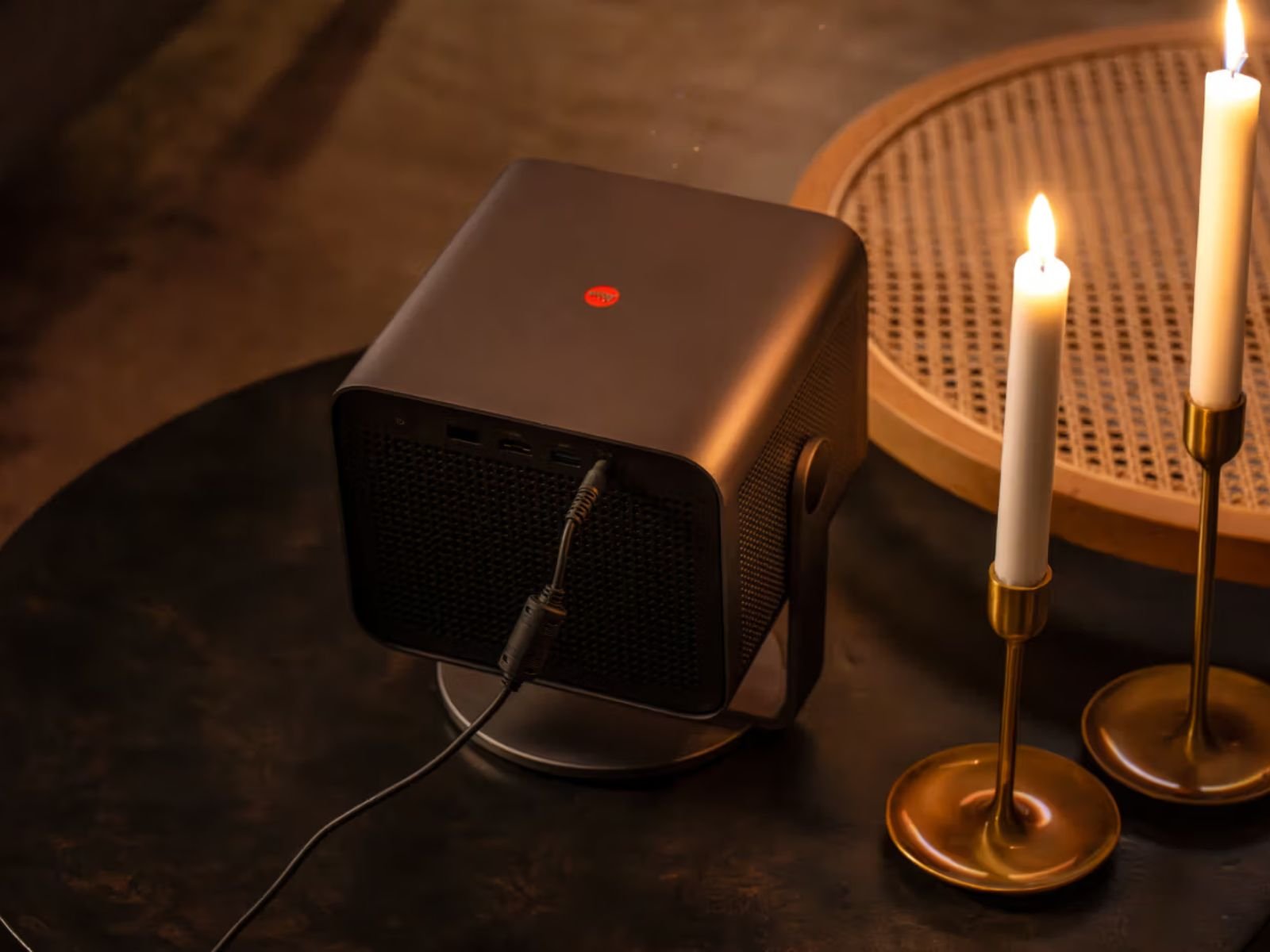
Streaming is handled through the integrated VIDAA operating system, with Netflix, Disney+, Amazon Prime Video and YouTube available through dedicated buttons on the remote. Wi-Fi 6, Bluetooth 5.4, Apple AirPlay, Apple HomeKit and screen mirroring provide additional ways to send content to the projector, while HDMI 2.1 with eARC and USB-A accommodate game consoles, media players and external storage.

Leica Cine Compact 1
Leica Cine Compact 1 | Image: Leica

Sound comes from two built-in 10W speakers housed within a 0.75-litre audio chamber, with Dolby Digital, Dolby Digital Plus and DTS Virtual:X providing a broader surround effect. External speakers can still be connected through Bluetooth or HDMI, while Game Mode reduces latency to 20 milliseconds or less and supports 2K content at up to 240Hz for players who would rather turn the ceiling into a racing circuit.

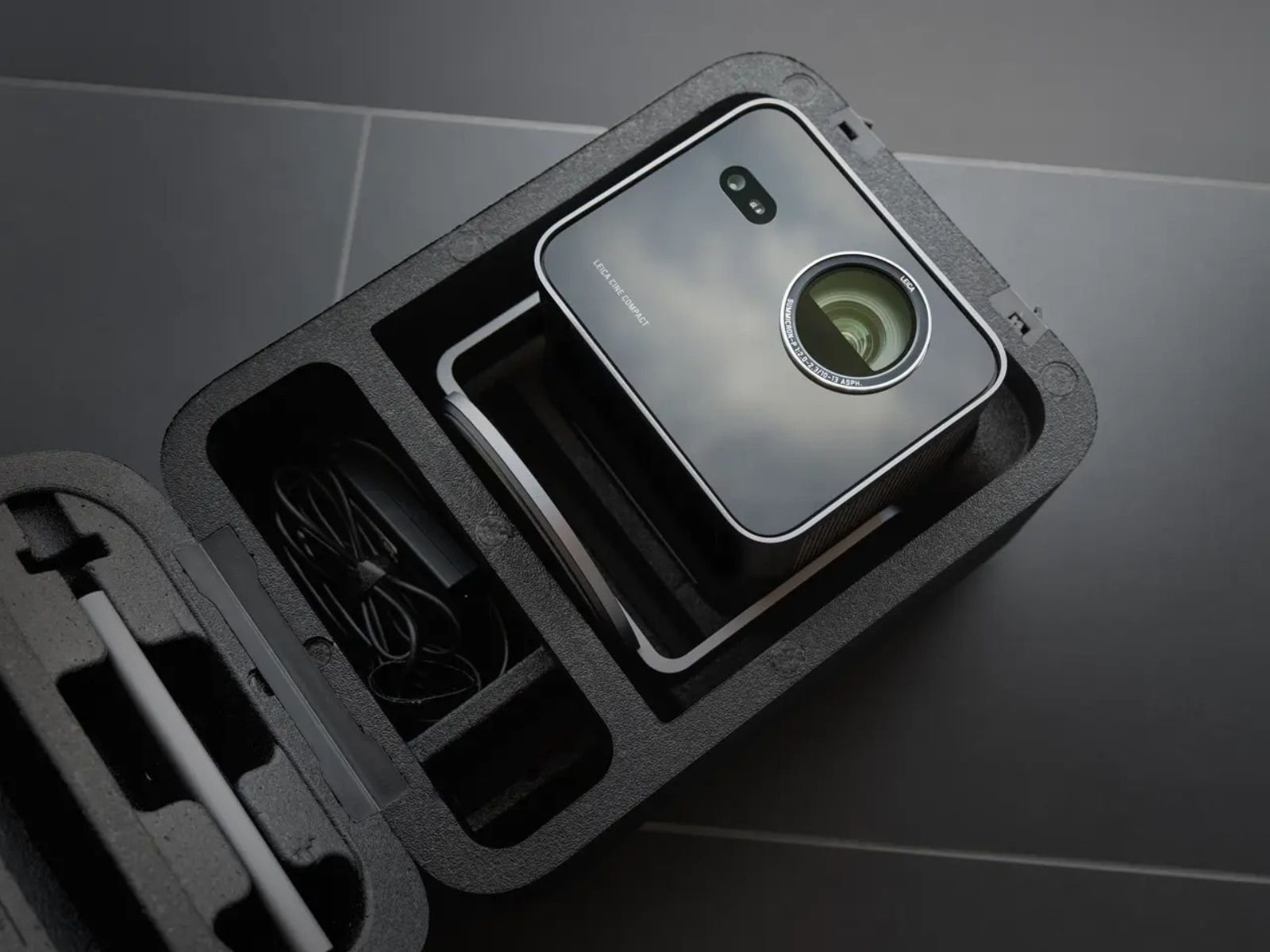
Leica has finished the Cine Compact 1 with a solid aluminum body, glass front and restrained metal-grey colour, giving it the sort of premium treatment normally associated with the company’s cameras. Its Triple RGB laser is rated to last more than 25,000 hours—equivalent to approximately 12,500 two-hour films—while an included recyclable EPP case protects it when moving between rooms or taking it away for the weekend. At approximately 4.4kg, it is portable in the “you can comfortably move it” sense rather than the “throw it into your backpack” sense.

Leica Cine Compact 1
Leica Cine Compact 1 | Image: Leica

Leica Cine Compact 1 Specifications, Price & Availability

Before we get to the release information, here is a closer look at the picture, sound, streaming and connectivity hardware packed inside Leica’s smallest home-cinema projector. Despite its compact design, the Cine Compact 1 combines a 4K Triple RGB laser system, Leica Summicron optics, built-in streaming, and integrated audio, with enough flexibility to project onto walls, ceilings, and outdoor surfaces.

That ability to move between different spaces is central to the projector’s appeal, particularly when its automatic adjustments handle most of the setup. As Icelandic adventure content creator Ása Steinars explains, “I’m so impressed by the image quality delivered by this small projector. You can use it anywhere, and it looks really good wherever you place it.”

Leica Cine Compact 1 Specifications

  • Resolution: 4K (3840 × 2160)
  • Projection Size: 60 to 220 inches
  • Brightness: Up to 1,700 lumens in Ultra Mode
  • Imaging Technology: 0.47-inch DLP DMD chip
  • Light Source: Direct Triple RGB laser
  • Lens: Leica Summicron zoom lens with aspherical elements
  • Image Processing: Leica Image Optimization
  • HDR Support: Dolby Vision, HDR10, HDR10+ and HLG
  • Contrast Ratio: Up to 1,500:1
  • Refresh Rate: 4K at 60Hz, or 2K at up to 240Hz
  • Gaming Latency: 20ms or less in Game Mode
  • Rotation: 360 degrees
  • Automatic Setup: Autofocus, zoom, keystone correction and intelligent screen framing
  • Audio: Two 10W speakers with Dolby Digital, Dolby Digital Plus and DTS Virtual:X
  • Operating System: VIDAA
  • Streaming Apps: Netflix, Disney+, Amazon Prime Video and YouTube
  • Connectivity: HDMI 2.1 with eARC, USB-A 3.0, Wi-Fi 6, Bluetooth 5.4, Apple AirPlay and Apple HomeKit
  • Dimensions: 209 × 226 × 193mm
  • Weight: Approximately 4.4kg
  • System Noise: Less than 29dB
  • Laser Lifespan: More than 25,000 hours
  • Included Accessory: Recyclable EPP transport case

The Leica Cine Compact 1 arrives on June 18, 2026, with availability confirmed for the United States, Canada, Europe, Australia, New Zealand and selected parts of Asia. Japan will follow in July, while US pricing has been set at USD $1,995.00.

Leica includes a recyclable EPP case for carrying and storing the projector, which is useful for something designed to move around the home. There is also a tripod thread if you want to mount it to the ceiling, while the optional Leica Floor Stand 1 offers a cleaner permanent setup without getting in the way of the projector’s 360-degree movement.

The Cine Compact 1 is not the cheapest alternative to buying a large television, but it is designed for people who want a bigger home-cinema experience without arranging an entire room around a fixed screen. Its Leica optics, automatic image adjustments, built-in streaming and integrated sound allow it to move from a living-room wall to a bedroom ceiling or backyard screen with most of the usual setup handled automatically—even if its 4.4kg weight means “portable” mostly applies to journeys around the house.

Leica Cine Compact 1
Leica Cine Compact 1 | Image: Leica
About the Author
arrow_drop_up