





Translating the high-octane, thrilling aerial battles of Top Gun: Maverick onto the big screen required more than just rapid maneuvers—it demanded complete authenticity. For Tom Cruise, Hollywood’s most daring action star, utilizing green screens or heavy CGI was out of the question. To truly immerse audiences in the G-forces and adrenaline of a real Navy pilot’s experience, the actors had to fly in actual fighter jets. However, this commitment to filmmaking excellence comes with its own set of challenges.
In the case of Top Gun: Maverick, the expense was staggering. Bloomberg reports that Paramount Pictures allegedly spent a shocking $11,374 per hour to rent an F/A-18 Super Hornet fighter jet for the film. Nevertheless, military sources suggest that the true operational cost is around $22,000 for each flight hour.
What was the actual production cost of Top Gun: Maverick, and did the hefty budget justify itself?

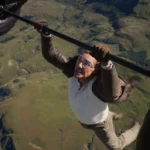
Tom Cruise is not only a Hollywood A-lister but also a perfectionist driven by a quest for authenticity. Over the years, he has consistently expanded the limits of practical effects in action films, seen in his daring act of hanging onto the side of a plane at takeoff in Mission: Impossible – Rogue Nation and executing a genuine HALO jump from 25,000 feet in Mission: Impossible – Fallout.
When it came to Top Gun: Maverick, Cruise was adamant: he wanted no green screens, no CGI for flight scenes, and no deception. In a recent interview, he stated, “I told the studio, ‘If we’re going to do this, we’re going to do it for real.’” This approach led to a filmmaking process that truly set itself apart from any previous efforts in Hollywood.
To realistically portray the thrilling action of Top Gun: Maverick, Tom Cruise created a demanding, multi-stage flight training program for his fellow actors. The objective was straightforward: to transform the actors into authentic aviators capable of executing the intense aerial stunts showcased in the film. Here’s how they evolved from beginners to skilled pilots, guaranteeing the authenticity of each breathtaking scene.
- Phase 1: Actors piloted small Cessna 172 aircraft to grasp fundamental aerodynamics and experience flying firsthand.
- Phase 2: Actors progressed to the Extra 300 aerobatic aircraft, which can perform high-G maneuvers, to prepare for the intense forces encountered in fighter jets.
- Phase 3: Actors transitioned to the L-39 Albatros, a high-performance jet trainer, to master complex aerial maneuvers.
- Phase 4: After months of training, the actors flew in actual F/A-18 Super Hornets, experiencing forces of up to 8 Gs during filming.
At the conclusion of filming, the actors had truly become Navy pilots, with their rigorous training evident in every aerial sequence. Tom Cruise’s dedication to realism brought Top Gun: Maverick to unprecedented levels, providing audiences with an exhilarating, realistic experience.

The stated cost for Top Gun: Maverick to operate an F/A-18 Super Hornet was $11,374 per flight hour. However, the military publication SOFREP reported that the true operational cost is much higher, approximately $22,000 per hour. This discrepancy arises because the Department of Defense’s official rates often fail to account for crucial expenses related to aircraft operations.
Brett Odom, a former F/A-18 Hornet pilot and Harvard Business School alumnus, provides an in-depth analysis of the actual expenses associated with operating these fighter jets. The aircraft consumes approximately 1,100 gallons of fuel each hour, which, at a rate of $3 per gallon, results in fuel costs amounting to $3,300 per hour.
Pilot salaries, benefits, and taxes amount to approximately $1,250 for every flight hour per crew member. With two crew members, this totals $2,500 for both the pilot and the weapons officer. Additionally, maintenance expenses for the aircraft—taking into account parts with defined service lives—are significant. For the F/A-18, Odom estimates maintenance costs to be $3,500 per hour, factoring in engine wear and the routine replacement of various components.
Considering all factors—fuel, salaries, and maintenance—the true operating cost of an F/A-18 Super Hornet is $22,000 per flight hour, which is double the amount previously mentioned for the film.

Using real jets and skilled actors, the next hurdle was to film high-speed, high-G dogfights like never before. To accomplish this, the filmmakers utilized groundbreaking cockpit-mounted IMAX cameras. Each Super Hornet was equipped with six advanced cameras, enabling the actors to capture their own performances in real-time while experiencing intense maneuvers. There were no camera crews and no retakes—every facial expression from the actors was completely genuine.
As director Joseph Kosinski stated, “Every time you see someone straining, their face distorted under G-forces—it’s because they’re truly experiencing it.” Jon Hamm, who portrays Vice Admiral Beau “Cyclone” Simpson, captured it perfectly when he said, “Tom Cruise is one of the last true movie stars. They don’t make them like that anymore.”

In one word? Definitely. Top Gun: Maverick was not only a critical and commercial triumph—it became a worldwide sensation. Upon its North American release, the film earned $151 million in its opening weekend, achieving a global debut of $260 million. By the end of its theatrical run, it had amassed an astonishing $1.4 billion, making it the highest-grossing film in Tom Cruise’s career.
Beyond the box office figures, the film garnered six Academy Award nominations, including Best Picture. Critics and audiences alike praised the movie’s practical effects, stunning cinematography, and unparalleled realism. Additionally, the film had an unexpected outcome: it triggered a significant increase in U.S. Navy recruitment, with numerous young individuals eager to emulate Maverick’s journey.
As Hollywood leans more towards CGI-dominated projects, Top Gun: Maverick demonstrated that viewers still desire authenticity. Its success conveyed a strong message: practical effects, real stunts, and authentic experiences aren’t just engaging—they are exactly what audiences seek.
With Tom Cruise gearing up for his next breathtaking stunt—a genuine spacewalk outside the International Space Station for an upcoming project—one thing is clear: the best is still ahead.