






Bang & Olufsen x Fragment Design Collection
TechAudio

Hiroshi Fujiwara Brings Fragment Design’s ‘Liquid Black’ Treatment to Four Bang & Olufsen Icons

Reading Time: 10 minutes

Share via

Our team of editors and experts thoughtfully chooses each product. If you decide to buy through one of our links, we may earn a commission. Learn more. Want to know how we test products? Click here for more details.

  • Bang & Olufsen has partnered with Hiroshi Fujiwara’s Fragment Design on a four-piece limited-edition audio collection.
  • The collaboration covers the Beoplay H100, Beosound A1, Beosound Shape and Beosystem 9000c.
  • Specialized anodizing and hand polishing create the collection’s liquid-like black aluminium finish.
  • The Beoplay H100, Beosound A1 and Beosound Shape launched internationally on June 3, 2026.
  • The USD $69,650 Beosystem 9000c is made to order and sold exclusively in Japan.

Bang & Olufsen has teamed up with Hiroshi Fujiwara’s Fragment Design to rework four of its most recognizable audio products. Rather than introduce an entirely new speaker or pair of headphones, the collaboration takes familiar Bang & Olufsen hardware and gives it the monochrome treatment that has become inseparable from the Japanese design studio.

Fujiwara comes to the partnership as a longtime customer rather than a designer who discovered the brand last week. Bang & Olufsen says he has spent around 35 years listening to its products, making the collaboration feel more considered than the usual limited edition built around a new colour and an extra logo.

Everything has gone black—although not just any black.

The collection stretches from personal audio to a full home-listening system, with each product receiving its own interpretation of Fragment’s stripped-back visual style. Some of the changes are subtle, while others turn already distinctive Bang & Olufsen designs into serious collector pieces. Either way, there is considerably more happening here than simply reaching for a can of black paint.

Bang & Olufsen x Fragment Design Collection | Image: Bang & Olufsen

Four Bang & Olufsen Icons Get the Fragment Treatment

The four products may come from very different corners of Bang & Olufsen’s catalogue, but the thinking behind them is consistent. Fragment Design has not attempted to disguise the original forms or make them look like entirely new devices. Instead, the collaboration builds on the Danish brand’s century-long approach to precision, longevity and recognizable industrial design, then filters it through Hiroshi Fujiwara’s considerably darker visual language.

Fujiwara’s connection with Bang & Olufsen stretches back more than three decades, beginning with the Beocenter 2300 and eventually becoming serious enough for him to design his home around the company’s integrated audio system.

As Hiroshi Fujiwara explains it — “This collaboration has been a long-time dream of mine. Since building my home around Bang & Olufsen’s integrated home sound system in the 1990s, the brand has been my first choice for audio. This collaboration feels like a meaningful continuation for our journey together,” says Hiroshi Fujiwara, founder of Fragment Design.

The finish is where the collection becomes more interesting than four existing products painted black. Bang & Olufsen developed a specialized anodization process for selected aluminum surfaces before polishing them by hand, producing a deep, reflective appearance that looks almost liquid under the light. It remains unmistakably Fragment, but the way it has been applied relies heavily on Bang & Olufsen’s experience working with precision-milled aluminum.

“We applied a highly artisanal anodization and polishing process for the first time on our portable products as part of the Fragment Design collaboration,” says Kresten Bjørn Krab-Bjerre, Bang & Olufsen’s senior director of design. “This meticulous approach brings Fragment’s signature black to life through a finish only achievable by hand.”

Fragment’s double-lightning symbol and wordmark appear throughout the collection, although the branding has been kept restrained enough to let the original designs remain recognizable. The result is one shade of black expressed across four very different objects, ranging from something you can carry in one hand to a home-audio system that may require considerably more space—and an equally substantial bank balance.

The Beoplay H100 Fragment Edition
Bang & Olufsen x Fragment Design Collection | Image: Bang & Olufsen

The Beoplay H100 Fragment Edition

  • Product type: Premium over-ear wireless headphones
  • Design details: High-gloss black anodized aluminum, black leather headband and cushions, & contrasting white logos
  • Fragment branding: Double-lightning emblem on the left ear cup and a co-branded leather pouch
  • Features:
    • Titanium drivers
    • Dolby Atmos
    • Spatial audio
    • Adaptive noise cancellation
    • 32 hours battery life
  • Availability: Globally, available from June 3, 2026
  • Price: USD $2,400 (Limited Edition)

Starting with the Beoplay H100 Fragment Edition, Bang & Olufsen’s flagship headphones trade their usual mix of colours and exposed metal for high-gloss black anodized surfaces, contrasting white logos and black leather across the headband and ear cushions. They remain unmistakably H100s, only now wrapped almost entirely in Fragment’s signature monochrome aesthetic.

The headphones retain their glass touch surfaces, physical control dials and automatic wear detection, while the magnetically attached ear cushions and inner headband can be removed and replaced when worn. That matters on a limited edition this expensive, because “collectible” sounds considerably better when the parts touching your head are not expected to last forever.

Beosound A1 3rd Gen Fragment Edition
Bang & Olufsen x Fragment Design Collection | Image: Bang & Olufsen

Beosound A1 3rd Gen Fragment Edition

  • Product type: Portable Bluetooth speaker
  • Design details: High-gloss black anodized aluminum, monochrome body & matching black carrying strap
  • Fragment branding: Double-lightning emblem integrated beneath the speaker grille
  • Features:
    • 360-degree sound
    • Upgraded bass performance
    • IP67 dust & water resistance
    • 24 hours of battery life
  • Availability: globally available from June 3, 2026
  • Price: USD $475 (Limited Edition)

Next is the Beosound A1 3rd Gen Fragment Edition, which brings the same high-gloss black treatment to Bang & Olufsen’s portable speaker. Fragment’s double-lightning emblem sits beneath the aluminum grille, giving the smallest piece in the collection a recognizable stamp without making it look like branded keychain merch. It remains practical enough for everyday use, with IP67 dust and water resistance, 360-degree sound and the ability to pair with another compatible A1 for stereo playback—although the reflective finish may encourage you to handle this limited edition rather more carefully than the average Bluetooth speaker.

Beosound Shape Fragment Configuration
Bang & Olufsen x Fragment Design Collection | Image: Bang & Olufsen

Beosound Shape Fragment Configuration

  • Beosound Shape Fragment Configuration
  • Product type: Modular wall-mounted speaker system
  • Design details: Seven-tile flower configuration with black & grey fabric covers
  • Fragment branding: Aluminium tag carrying the Bang & Olufsen and Fragment Design logos
  • Features:
    • Modular wall-mounted construction
    • Room-filling sound
    • Integrated acoustic-dampening tiles
    • Wireless music streaming
    • Bang & Olufsen app control
  • Availability: Globally available through selected Bang & Olufsen stores
  • Price: USD $7,100

Moving onto the most spatial piece in the collection, the Beosound Shape Fragment Configuration turns Bang & Olufsen’s modular wall-mounted speaker into something closer to installation art. After seeing Beosound Shape at the company’s headquarters in Struer, Hiroshi Fujiwara reportedly returned to his hotel room and sketched the seven-tile flower arrangement, which was later completed with monochrome black-and-grey fabric covers and a discreet aluminum logo tag. This comes with a combination of room-filling audio and acoustic treatment, with a design intended to become part of the wall, with a price tag of USD $7,100.
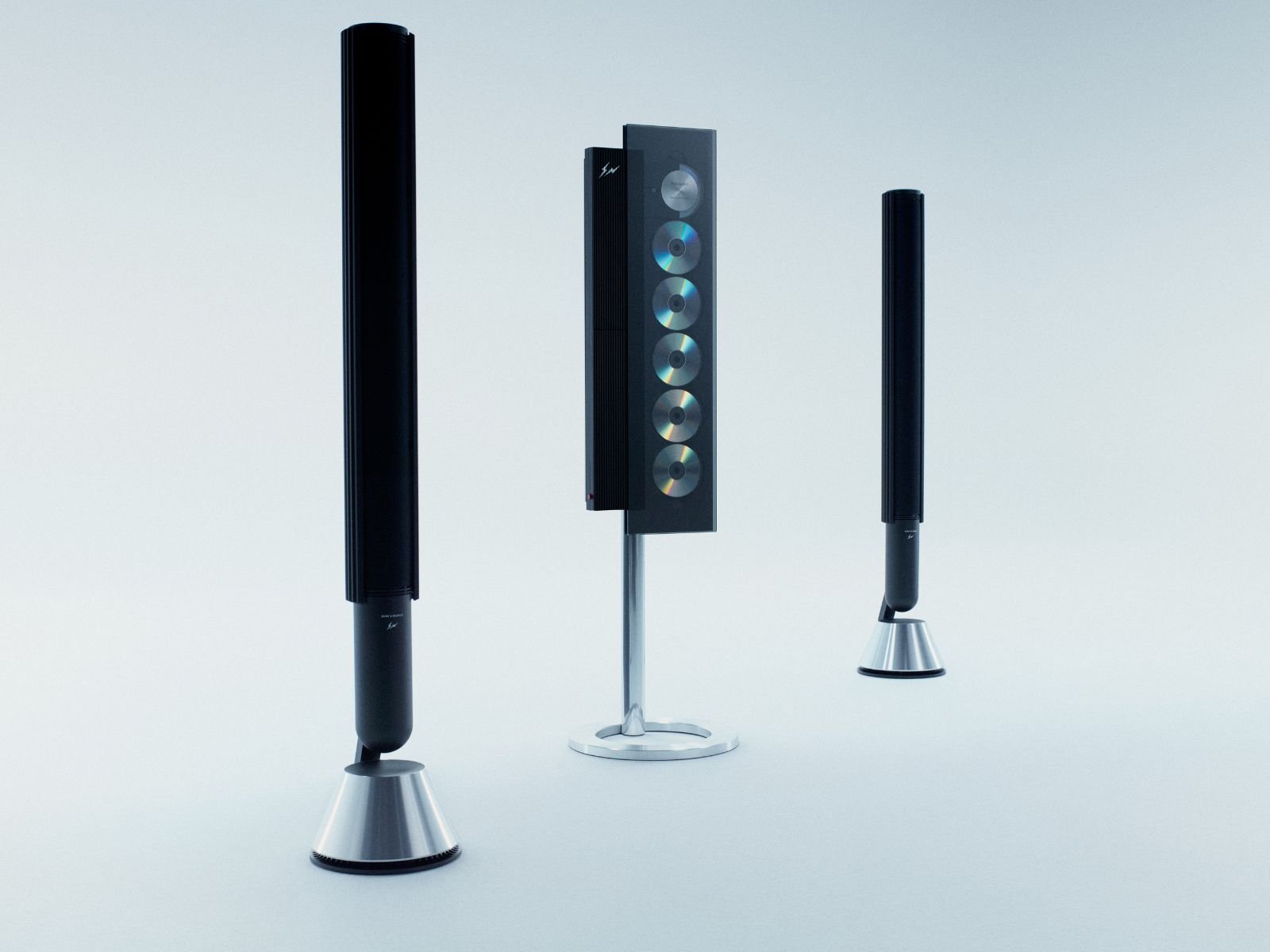
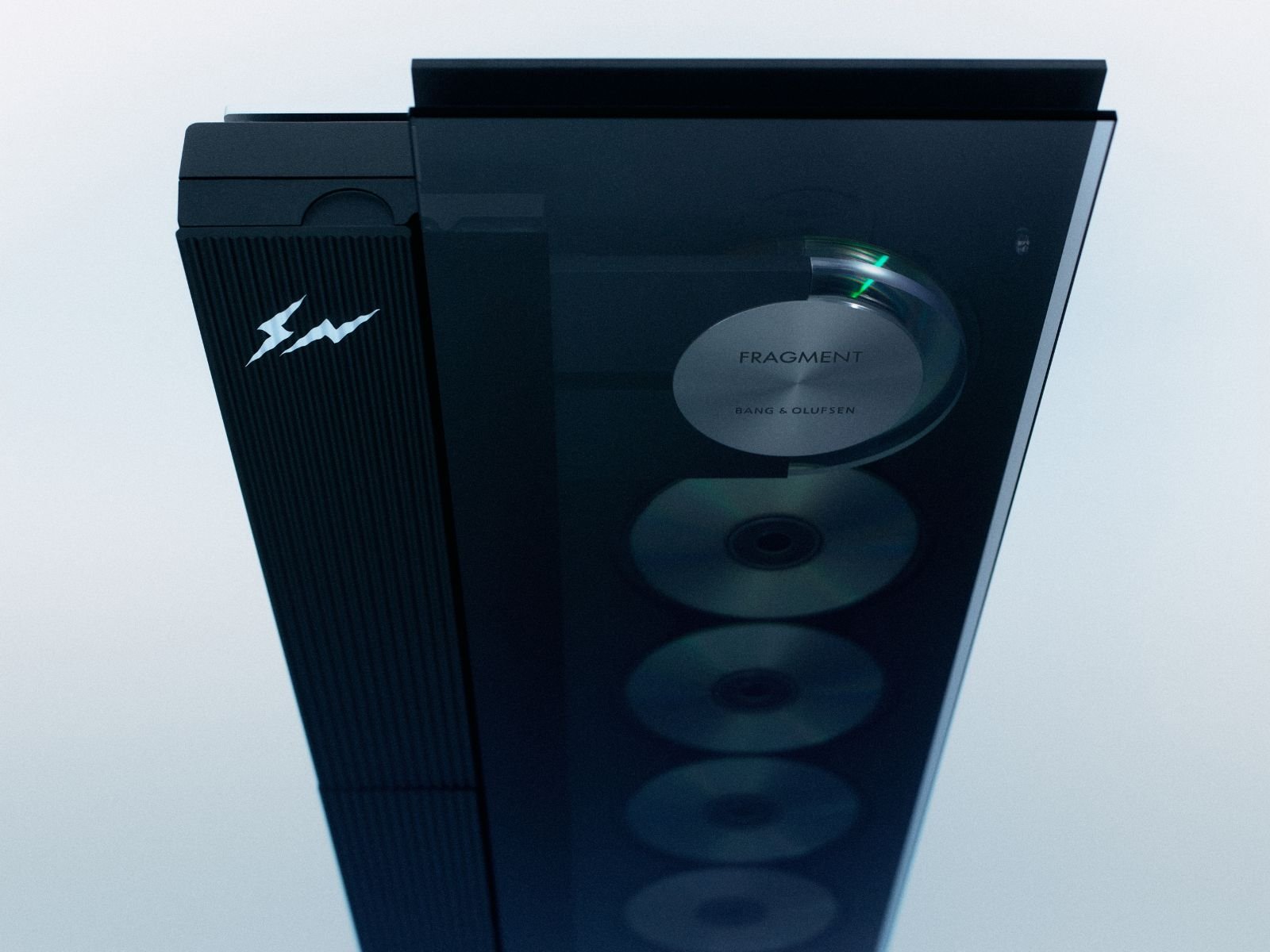
Beosystem 9000c Fragment Edition
Bang & Olufsen x Fragment Design Collection | Image: Bang & Olufsen

Beosystem 9000c Fragment Edition

  • Product type: Made-to-order six-disc CD audio system
  • Included: Beosystem 9000c CD player, pair of Beolab 28 wireless speakers & Beoremote One
  • Design details: Matte-black anodized surfaces contrasted by glossy natural aluminium
  • Fragment branding: Co-branded CD clamper & Beolab 28 speaker stands
  • Features:
    • Vertical six-disc CD mechanism
    • Automatic disc changing & return system
    • High-resolution wireless stereo speakers
    • Adjustable Beolab 28 sound beams
    • Music streaming through the Beolab 28 speakers
  • Availability: Japan exclusive
  • Price: USD $69,650 (Limited Edition)

Finishing the collection is the Beosystem 9000c Fragment Edition, a made-to-order setup pairing Bang & Olufsen’s restored six-disc CD player with two Beolab 28 wireless speakers and a Beoremote One. Fragment applies matte-black anodized surfaces across the system while retaining sections of glossy natural aluminum, with both brands represented on the CD clamper and speaker stands. It is the largest, rarest and comfortably most expensive piece in the collaboration—the sort of audio system that makes displaying six CDs feel like an architectural decision.

The original Beosound 9000 was designed by David Lewis and introduced in 1996, with a mechanism that rapidly moves between six vertically displayed discs before returning each one to its original position after playback. That mechanical theatre particularly appealed to Hiroshi Fujiwara, and it remains at the centre of this modernized version, now supported by the wireless capabilities and high-resolution sound of the Beolab 28 speakers. Limited to made-to-order purchases in Japan only and priced at USD $69,650, this is less an impulsive return to physical media and more a collector’s monument to the compact disc.

Beosystem 9000c Fragment Edition
Bang & Olufsen x Fragment Design Collection | Image: Bang & Olufsen

price & Availability

The Bang & Olufsen x Fragment Design collection made its first appearance at a temporary Isetan Shinjuku installation in Tokyo, held from May 20–26, 2026. The Japanese release followed on May 27, with the Beoplay H100, Beosound A1 and Beosound Shape reaching selected international stores and online markets from June 3.

Prices begin at USD $475 for the portable Beosound A1, rising to USD $2,400 for the Beoplay H100 and USD $7,100 for the Beosound Shape. Sitting in an entirely different financial neighbourhood is the USD $69,650 Beosystem 9000c, a made-to-order setup reserved exclusively for customers in Japan.

Most of us will probably admire these pieces through a screen and leave our bank accounts undisturbed. Still, Bang & Olufsen and Fragment Design clearly understand their audience — collectors who see the material, finish and cultural story surrounding an audio product as part of its value—and who are unlikely to lose much sleep over the extra cost of making everything liquid black.
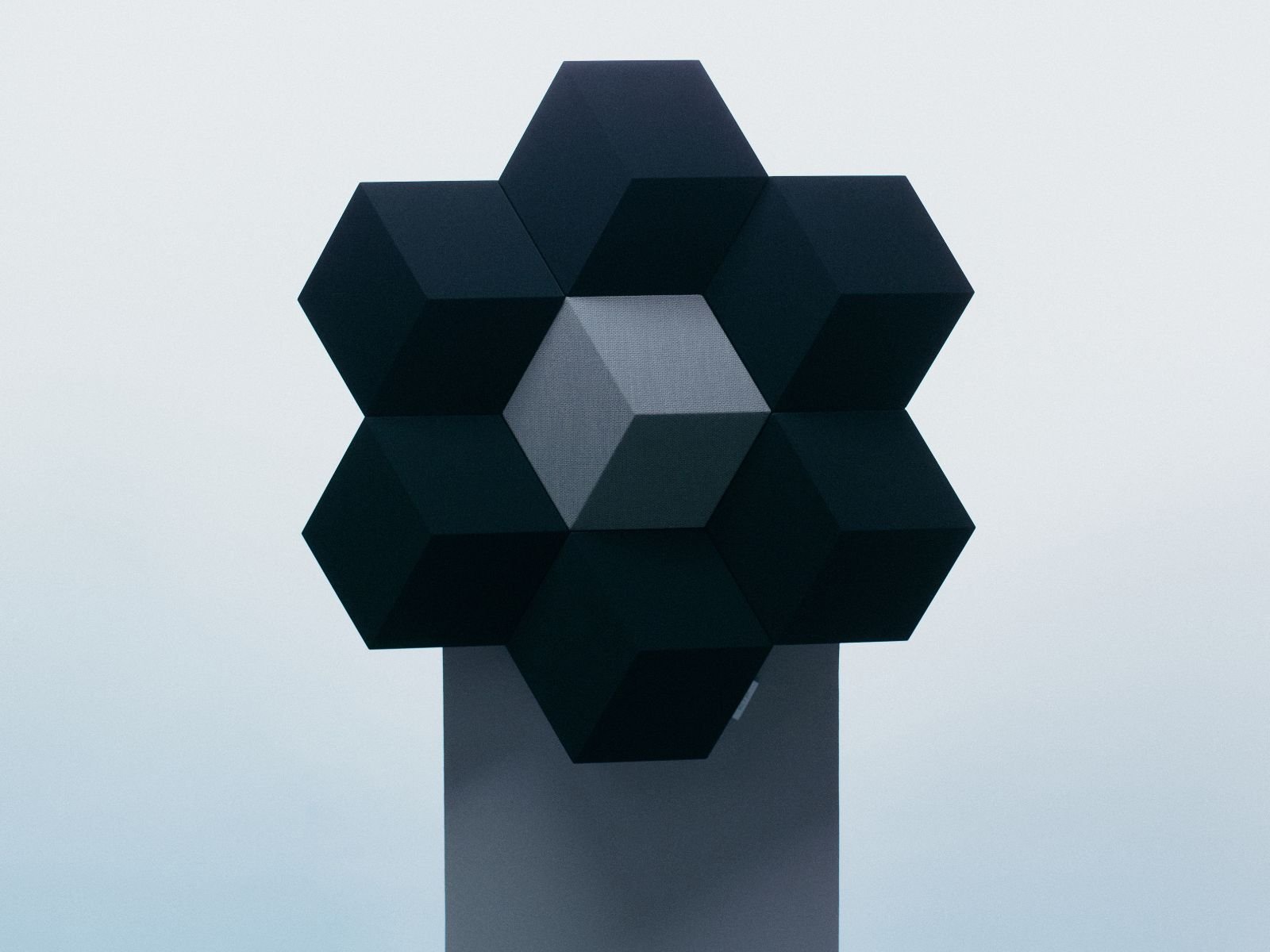
Beosound Shape Fragment Configuration
Bang & Olufsen x Fragment Design Collection | Image: Bang & Olufsen
Beosystem 9000c Fragment Edition
Bang & Olufsen x Fragment Design Collection | Image: Bang & Olufsen
The Beoplay H100 Fragment Edition, and Beosound A1 3rd Gen Fragment Edition
Bang & Olufsen x Fragment Design Collection | Image: Bang & Olufsen
CollaborationsSpeakersHeadphonesBang & Olufsen
About the Author
Entertainment

10 Of The Most Expensive Materials On Earth

Reading Time: 10 minutes

Our team of editors and experts thoughtfully chooses each product. If you decide to buy through one of our links, we may earn a commission. Learn more. Want to know how we test products? Click here for more details.

From the hidden depths of the Earth to the laboratories where science expands the boundaries of imagination, some materials are worth far more than gold. Their prices soar not just because they’re rare, but because of the incredible power, beauty, or potential they possess. Diamonds and platinum have long been associated with wealth and prestige, while futuristic wonders like antimatter and californium sit at the forefront of discovery, promising to change how we think about energy and space travel.

These aren’t just commodities — they’re the world’s most sought-after treasures. Some shine brighter than any jewel, others can fuel spacecraft or transform entire industries. So, buckle up as we explore the 10 most expensive materials on Earth and discover what makes them so remarkably valuable.

AntiMatter | Image: Supplied

1. AntiMatter – $62.5 Trillion Per Gram

When it comes to value, nothing on Earth—or in the universe, for that matter—can match antimatter. This mysterious substance is essentially the mirror opposite of normal matter, and when the two meet, they annihilate each other in a burst of pure energy. That makes antimatter not only rare but also incredibly powerful. Scientists believe it could one day be the ultimate fuel source, capable of powering spacecraft at unimaginable speeds or even revolutionizing energy production here on Earth.

The catch? Producing it is incredibly challenging. Currently, antimatter can only be generated in highly advanced particle accelerators, and even then, we’re dealing with fractions of a gram at astronomical costs. With a single gram valued at an astonishing $62.5 trillion, antimatter is the most expensive material in existence — and perhaps the most futuristic.

Californium | Image: Supplied

2. Californium $27 Million Per Gram

First synthesized in the 1950s, californium is one of the rarest and most valuable man-made elements on Earth. It doesn’t occur naturally in usable quantities and must be painstakingly produced in nuclear reactors, a process that explains its astronomical price of $27 million per gram. Despite the cost, californium has life-saving applications in cancer treatments, plays a crucial role in starting nuclear reactors, and is even used in devices that detect valuable resources like gold and oil, making it a material as powerful as it is scarce.

Diamonds | Image: Supplied

3. Diamond – $55,000 Per Gram

Long celebrated as symbols of wealth, beauty, and power, diamonds are among the most sought-after gemstones in history. Formed under intense pressure deep within the Earth over billions of years, these sparkling crystals are admired not only for their brilliance but also for their durability — making them essential in both luxury jewellery and high-precision industrial tools. With a value of approximately $55,000 per gram, diamonds continue to rank as one of the most expensive natural materials on Earth, blending timeless appeal with practical strength.

Tritium | Image: Supplied

4. Tritium – $30,000 Per Gram

Tritium is a rare radioactive isotope of hydrogen that’s unlike anything you’ll find in a glass of water. What makes it special is its ability to glow when combined with phosphors, which is why it’s often used in self-powered lighting for items like wristwatches, emergency exit signs, and even aircraft instruments. That soft glow doesn’t require an external power source, making it invaluable in situations where reliability is essential.

But its true potential lies in the future. Scientists see tritium as a possible game-changer for nuclear fusion — the clean energy solution that could one day replace fossil fuels. Since tritium doesn’t occur in large quantities naturally, it must be painstakingly produced in nuclear reactors, pushing its value to around $30,000 per gram. Rare, functional, and potentially revolutionary, tritium sits at the crossroads of science and industry.

Taaffeite | Image: Supplied

5. Taaffeite – $20,000 Per Gram

First identified in 1945 by gemologist Richard Taaffe, taaffeite is one of the rarest gemstones on Earth, often mistaken for spinel due to its similar appearance. Found only in small deposits in Sri Lanka, Tanzania, and Myanmar, this gem shines in delicate shades of violet, pink, and red, with optical qualities that make it stand out even among prized stones. Valued at around $20,000 per gram, taaffeite’s scarcity makes it more exclusive than most diamonds, turning every fragment into a collector’s treasure.

Painite | Image: Supplied

6. Painite – $9,000 Per Gram

Once thought to be the rarest mineral in the world, painite is a deep brownish-red gemstone that puzzled scientists when it was first found in Myanmar in the 1950s. For many years, only a few crystals existed, making it practically priceless. Although more deposits have since been discovered, painite remains extremely rare, and its vibrant colours and unique crystal structure continue to attract collectors. With a value of around $9,000 per gram, this gem remains one of the most sought-after minerals for both scientists and jewellery lovers.

Plutonium |Image: Supplied

7. Plutonium – $4,000 Per Gram

Plutonium is one of the most notorious substances on Earth, often associated with nuclear weapons and the Cold War period. Silvery in appearance but highly radioactive, it was first produced in the 1940s and rapidly became central to military arsenals and nuclear energy initiatives. Its capacity to release enormous amounts of energy makes it one of the most powerful and debated materials ever created.

But plutonium isn’t just about destruction; it also powers spacecraft through radioisotope thermoelectric generators, enabling missions that go far beyond the reach of solar energy. Since its production is heavily restricted and handling requires extreme precautions, every gram is extremely costly. Valued at about $4,000 per gram, plutonium’s price reflects both its rarity and the significant effort needed to produce, contain, and safely utilise it.

Rhino Horn | Image: Supplied

8. Rhino Horn- $110 Per Gram

Rhino horn is one of the most controversial and tragic entries on this list, valued at around $110 per gram. Unlike gemstones or metals, it isn’t a mineral at all but is made of keratin — the same protein found in human hair and nails. Its high price comes from black market demand, driven by myths in traditional medicine and its use as a status symbol in some cultures. Sadly, this demand has fuelled rampant poaching, pushing several rhino species to the brink of extinction. While conservation efforts and strict international bans are fighting to curb the trade, the staggering value of rhino horn continues to make it one of the most costly — and heartbreaking — materials in the world.

Platinum | Image: Supplied

9. Platinum – $60 Per Gram

This lustrous white metal has a reputation for being as tough as it is beautiful. Highly resistant to corrosion and tarnish, platinum has become a staple in industries that require strength, from catalytic converters in vehicles to precise medical instruments. At the same time, it remains a symbol of status in jewellery and luxury watches, often regarded as more exclusive than gold. With a value of around $60 per gram, platinum successfully combines luxury with technology, proving to be both practical and prestigious.

Rhodium | Image: Supplied

10. Rhodium – $58 Per Gram

Shiny, silvery, and exceptionally rare, rhodium is one of the least abundant precious metals on Earth, which explains its high price of around $58 per gram. It’s highly resistant to corrosion and has a reflective brilliance that makes it ideal for use in jewellery, often as a finishing layer on white gold and platinum pieces. Beyond luxury, rhodium is vital in automotive catalytic converters, where it helps reduce harmful emissions. Its combination of scarcity, beauty, and industrial importance makes rhodium one of the most valuable metals in the modern world.

What Makes These Materials So Expensive?

The world’s most expensive materials share three common traits: rarity, demand, and the difficulty of obtaining or producing them. Some, like diamonds and taaffeite, are formed over millions of years under extraordinary geological conditions, making each carat extremely rare. Others, like californium or antimatter, do not occur naturally in usable quantities at all — they must be synthesised in nuclear reactors or particle accelerators, which demand enormous amounts of energy, time, and resources. When supply is scarce and production is nearly impossible, the price naturally skyrockets.

On top of scarcity, demand plays a significant role. Platinum and rhodium are essential in modern industries like automotive manufacturing and medicine, while tritium and plutonium are crucial for energy and technology. Even rhino horn, despite being made of keratin, skyrockets in value because of illegal markets driven by cultural beliefs and status symbols. The more society needs or desires a material, the higher its value climbs, especially when alternatives are scarce.

Will We Ever Find or Create Materials Even More Valuable?

It’s very likely. As science and technology continue to progress, new discoveries could push the boundaries of what we consider valuable today. Just as antimatter and californium arose from cutting-edge research rather than natural deposits, future breakthroughs in quantum computing, nanotechnology, or space exploration may introduce materials with properties we can barely imagine — and price tags to match. Whether mined from distant asteroids or manufactured in labs, the next “most expensive material” might not even exist yet, waiting for us to find it.

General FAQ’s

Have more questions you’d like to ask? Don’t worry, we’ve got you covered.

Which Material Is The Most Expensive In The World Right Now?

Antimatter ranks at the top by a significant margin, with an estimated cost of $62.5 trillion per gram. It’s so scarce and hard to produce that only small amounts have ever been created in labs, but its potential as a future energy source makes it invaluable in scientific terms.

Are All Expensive Materials Used In Luxury Products?

Not at all. While diamonds, platinum, and taaffeite dominate the world of jewellery and prestige, many of the most expensive materials serve scientific or industrial purposes. Tritium, californium, and plutonium, for example, are linked to energy, medicine, and research rather than luxury.

Could Prices Drop If More Of These Materials Are Discovered Or Produced?

Yes. History has shown that rarity often boosts price — painite was once nearly impossible to find, but as more deposits were discovered, its cost became a bit more accessible. Similarly, advances in technology could make producing or synthesizing some of these materials cheaper in the future, which would lower their market value.

Finances
About the Author
arrow_drop_up