





Watches

Rolex Land-Dweller Unveiled: Price, Specs, and Everything You Need to Know

Share via

Our team of editors and experts thoughtfully chooses each product. If you decide to buy through one of our links, we may earn a commission. Learn more. Want to know how we test products? Click here for more details.

If Rolex were to release a new model in 2025 that wasn’t a Submariner, Daytona, or GMT-Master II, the watch world would likely raise a collective eyebrow and then rush to their nearest authorized dealer. Enter the Rolex Land-Dweller — a name that sounds like it’s been hiding in plain sight, just waiting to be summoned into existence.

In a move that’s equal parts a nod to heritage and a forward-thinking flex, the Land-Dweller stands as the rugged, land-based sibling to the legendary Sea-Dweller. It’s not here to dive deep or fly high; it’s built to conquer terrain, elevate adventure, and sit boldly on the wrist of the modern explorer who prefers mountains over oceans, altitude over depth. Think of it as the Explorer’s brawnier cousin—with some serious technical chops to back it up.

So, what exactly is the Land-Dweller bringing to the table (and your wrist)? We’ve broken down all the essential specs, discussed design, examined pricing, and determined whether this new tool-watch earns its place in the Rolex pantheon or serves as hype bait for collectors. Shall we start with it?

Highlights:

  • Rolex introduces the Land-Dweller, available in two case sizes, featuring a new Flat Jubilee bracelet and the innovative Calibre 7135.
  • Features a honeycomb dial, open 6 and 9 numerals, and enhanced Chroma-light lume for maximum legibility.
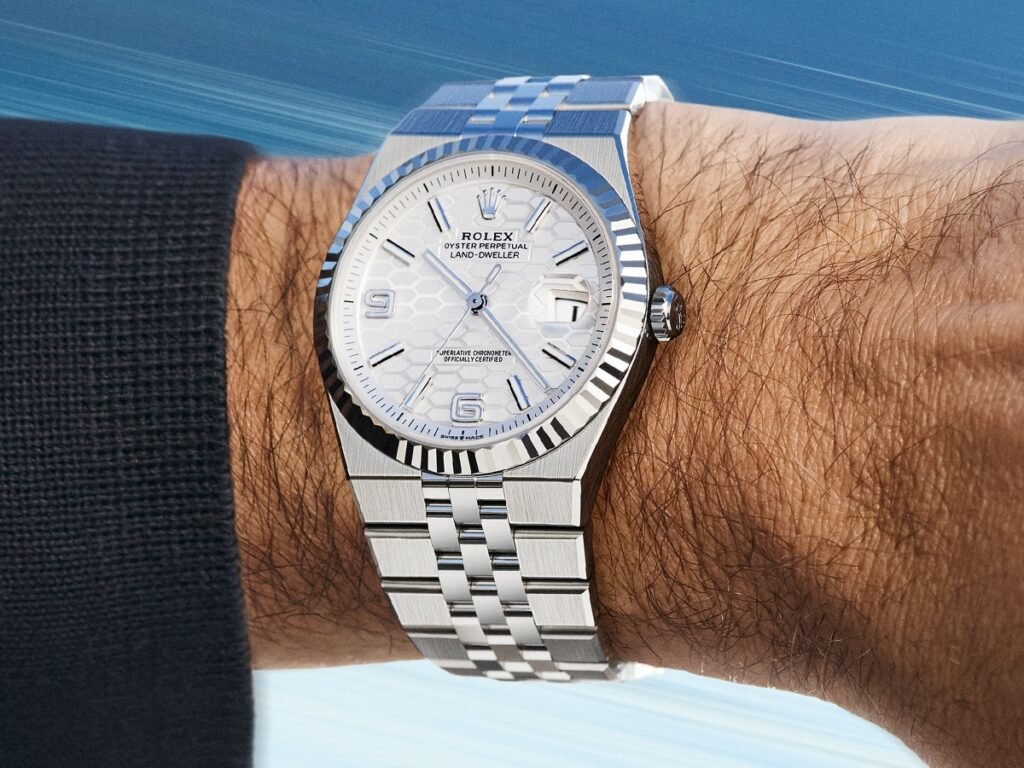
Rolex Oyster Perpetual Land-Dweller 40 in White Rolesor | Image: Rolex

How Much Does The Rolex Land-Dweller Cost?

The Land-Dweller is available in ten distinct variants, divided between 36mm and 40mm case sizes, with pricing heavily influenced by your material of choice. From White Rolesor steel-and-white-gold hybrids to solid Everose and platinum gem-set references, this collection encompasses various styles and investment levels, each tailored to various tastes and occasions. Here’s a full breakdown of each:

Rolex Land-Dweller 36mm:

  • Rolex Land-Dweller Ref. 127234 (36 mm, White Rolesor) – USD $14,000
  • Rolex Land-Dweller Ref. 127235 (35 mm, Everose gold) – USD $42,100
  • Rolex Land-Dweller Ref.127285TBR (36 mm, Everose gold & Diamonds ) – USD $93,200
  • Rolex Land-Dweller Ref.127236 (36 mm, platinum) – USD $59,200
  • Rolex Land-Dweller Ref. 127236TBR (36 mm, 950 Platinum & Diamonds) – USD $98,400

Rolex Land-Dweller 40mm:

  • Rolex Land-Dweller Ref.127234 (40 mm, White Rolesor) – USD $14,900
  • Rolex Land-Dweller Ref.127235 (40 mm, Everose Gold) – USD $46,100
  • Rolex Land-Dweller Ref.127285TBR (40 mm, Everose Gold & Diamonds ) – USD $109,000
  • Rolex Land-Dweller Ref.127236 (40mm, Platinum) – USD $63,500
  • Rolex Land-Dweller Ref.127236TBR (40 mm, 950 Platinum & Diamonds) – USD $121,000

From the understated elegance of White Rolesor to the full-throttle flash of a gem-set platinum showpiece, the Land-Dweller lineup covers the entire spectrum. There’s something here for both the seasoned collector and the bold first-time buyer. Just don’t expect to walk into a boutique and grab one off the shelf—Rolex’s prestige and limited availability mean these models will be incredibly difficult to find. Sure, the price tags climb quickly—but so does the craftsmanship, the presence, and let’s be honest, the bragging rights.
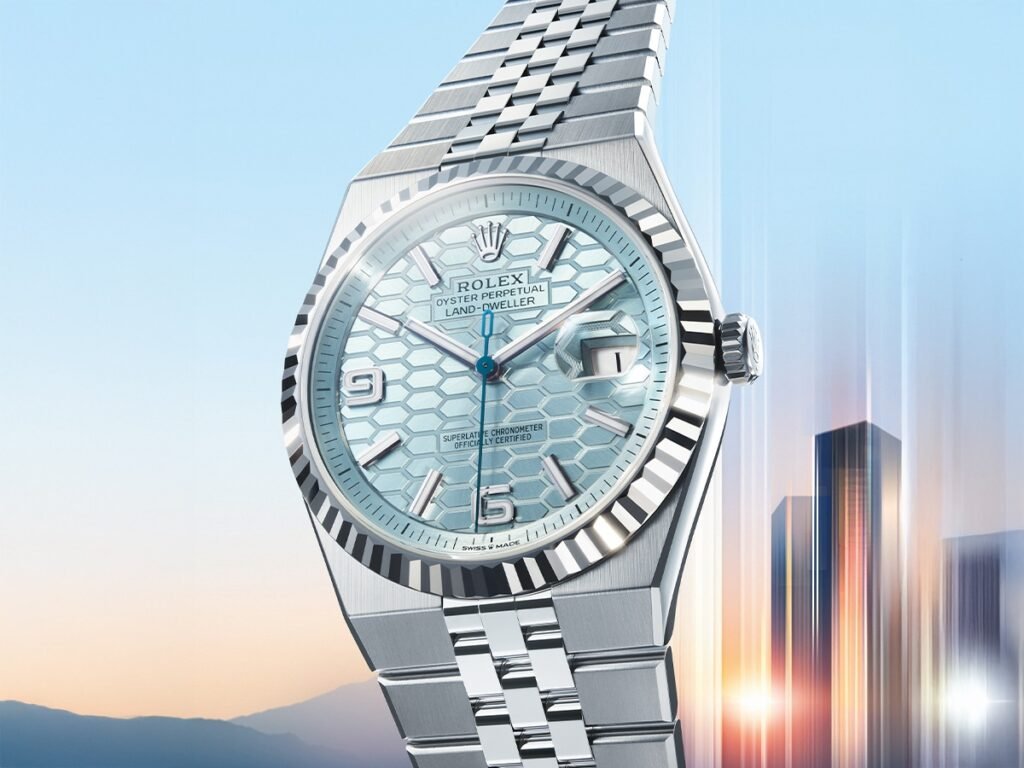
Rolex Oyster Perpetual Land-Dweller White Rolesor 40 mm | Image: Rolex

Every Rolex Land-Dweller Model You Need to Know

Rolex has launched the Land-Dweller in two models: Rolex Land-Dweller 36 mm (Women) and Rolex Land-Dweller 40 mm (Men).

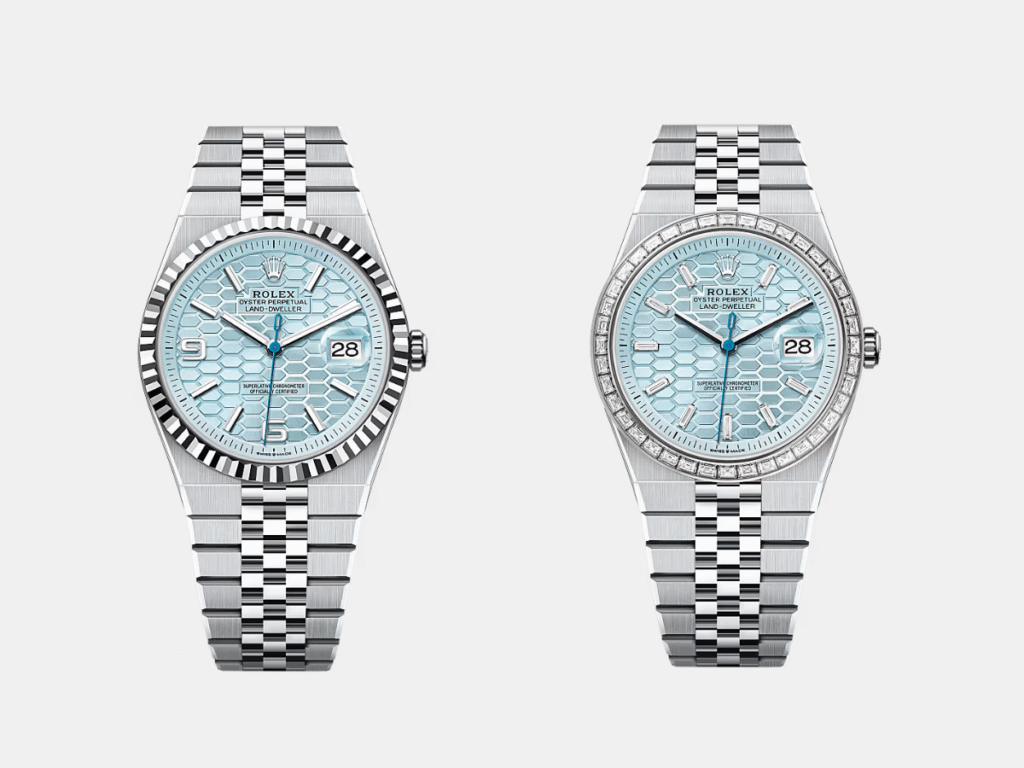
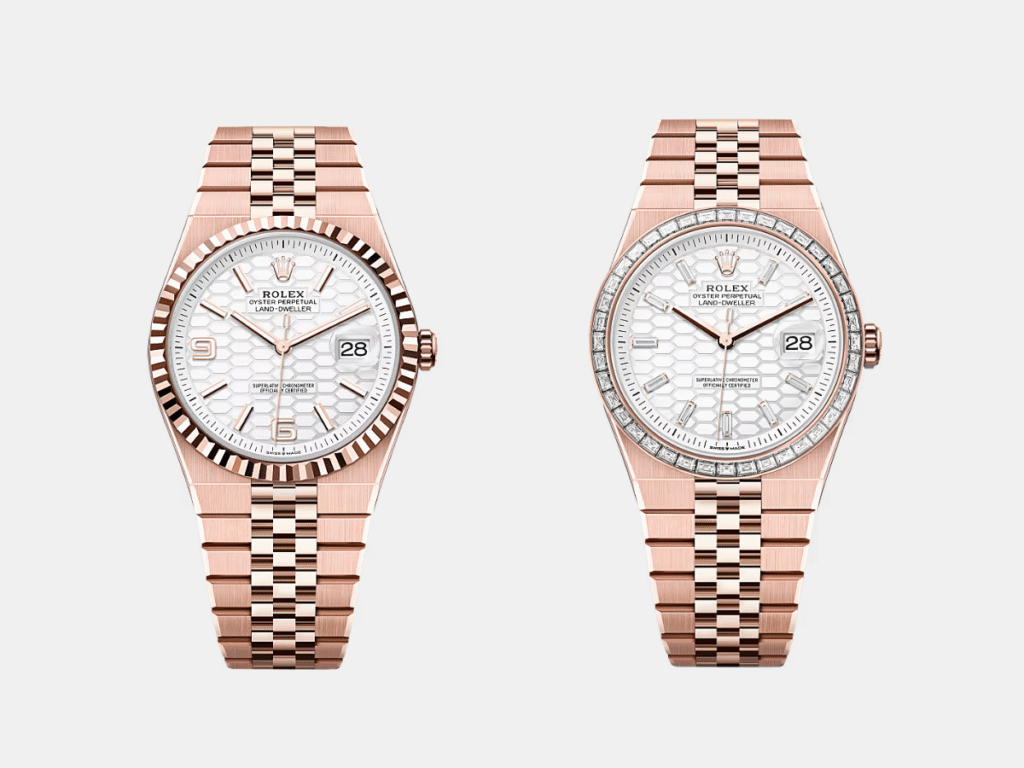
Although they appear differently on the wrist, both versions are identical in every aspect. Each model is powered by the same movement, crafted with equal precision, and offered in three premium case materials: (White Rolesor, Everose Gold, and 950 Platinum). You can also select between a fluted bezel or a gem-set bezel, depending on your desired level of boldness. Visually, there’s a slight distinction—White Rolesor and Everose Gold models feature a striking white honeycomb dial, while the platinum versions display a unique ice-blue honeycomb dial.

That’s where the exterior similarities end. So, why don’t we take a closer look at the full technical lineup of the Rolex Land-Dweller?
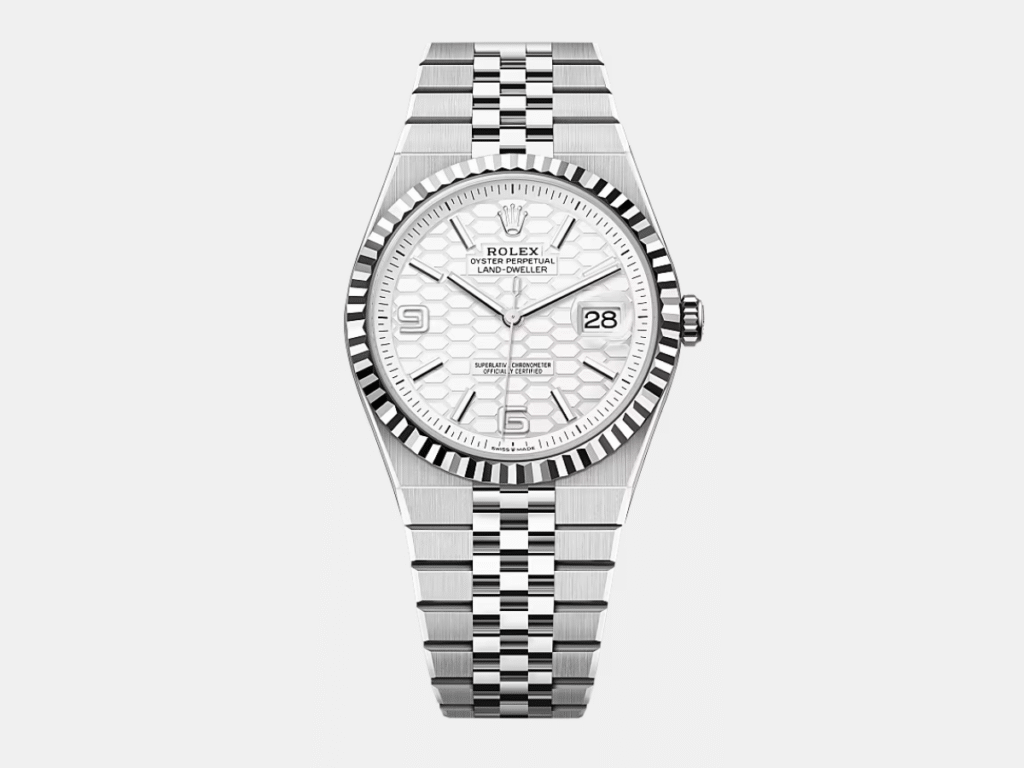
Rolex Oyster Perpetual Land-Dweller White Rolesor 40 mm | Image: Rolex
  • Brand: Rolex
  • Model: Oyster Perpetual Land-Dweller White Rolesor
  • Reference: 127334
  • Diameter: 40 mm
  • Material: White Rolesor
  • Dial: DialIntense White, Honeycomb Motif
  • Bezel: Fluted
  • Bracelet: Oystersteel Flat Jubilee
  • Calibre: 7135 Manufacture Rolex
  • Power Reserve: 66 Hours
  • Water Resistance: 10 Bar (100 metres, 330 feet)
  • Certification: Superlative Chronometer (COSC + Rolex certification)
  • Price: USD $14,900
Rolex Oyster Perpetual Land-Dweller Platinum | Image: Supplied
  • Brand: Rolex
  • Model: Oyster Perpetual Land-Dweller
  • Reference: 127336 / 127386TBR
  • Diameter: 40 mm
  • Material: Platinum
  • Dial: Ice blue, Honeycomb Motif / Set Diamonds
  • Bezel: Fluted / Set Diamonds
  • Bracelet: Oystersteel Flat Jubilee
  • Calibre: 7135 Manufacture Rolex
  • Power Reserve: 66 Hours
  • Water Resistance: 10 Bar (100 metres, 330 feet)
  • Certification: Superlative Chronometer (COSC + Rolex certification)
  • Price: USD $63,500 / USD $121,000
Rolex Oyster Perpetual Land-Dweller 18-KT Everose Gold | Image: Supplied
  • Brand: Rolex
  • Model: Oyster Perpetual Land-Dweller
  • Reference: 127335 / 127385TBR
  • Diameter: 40 mm
  • Material: 18-KT Everose Gold
  • Dial: Intense White, Honeycomb Motif / Set Diamonds
  • Bezel: Fluted / Set Diamonds
  • Bracelet: Oystersteel Flat Jubilee
  • Calibre: 7135 Manufacture Rolex
  • Power Reserve: 66 Hours
  • Water Resistance: 10 Bar (100 metres, 330 feet)
  • Certification: Superlative Chronometer (COSC + Rolex certification)
  • Price: USD $46,100 / USD $109,000

What is the Rolex Land-Dweller?

The Rolex Land-Dweller is the brand’s boldest new release, designed not for the ocean’s depths or the skies above, but for solid ground. Think of it as a tribute to earthbound exploration, combining the muscular build of a professional tool watch with the refined aesthetics for which Rolex is known.

Unlike the Sea-Dweller, which was engineered for saturation divers, and the GMT-Master, which caters to frequent flyers, the Land-Dweller is grounded—literally. It’s designed for everyday adventurers: those who climb, hike, explore, and appreciate a watch that can handle rugged outdoor conditions while still looking sharp in the city.
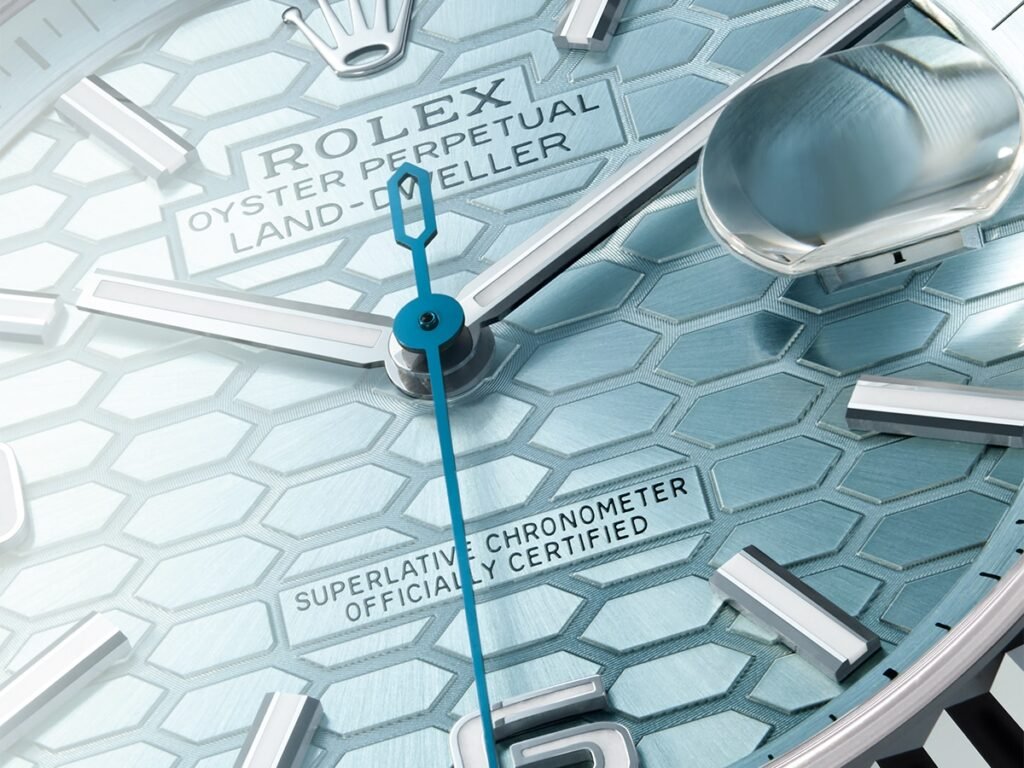
Rolex Oyster Perpetual Land-Dweller Platinum Dial | Image: Rolex

Dial Details

One of the most distinctive features of the Rolex Land-Dweller is its honeycomb-patterned dial—a subtle yet striking detail that sets it apart from anything else in the brand’s current lineup. It is textured, refined, and just bold enough to catch the light without screaming for attention.

Depending on the case material, you’ll find one of two dial colorways: a clean white honeycomb dial on the White Rolesor and Everose Gold models, and a cool, luxurious ice-blue honeycomb dial on the 950 Platinum variants. That ice-blue tone, exclusive to platinum in Rolex’s catalog, adds a layer of quiet sophistication that only seasoned collectors will immediately recognize.

The hour markers and numerals are where things become even more intriguing. The open 6 and 9 numerals are directly inspired by the Explorer and Air-King models—a nod to Rolex’s adventure-driven heritage. All hour markers are coated with Chroma-light luminescent material extending each index’s full length, offering excellent nighttime visibility. But here’s the kicker: Rolex claims the luminescent compound used here is harder and more durable than materials typically used, maintaining the same colour, glow, and hue in daylight across the entire dial.
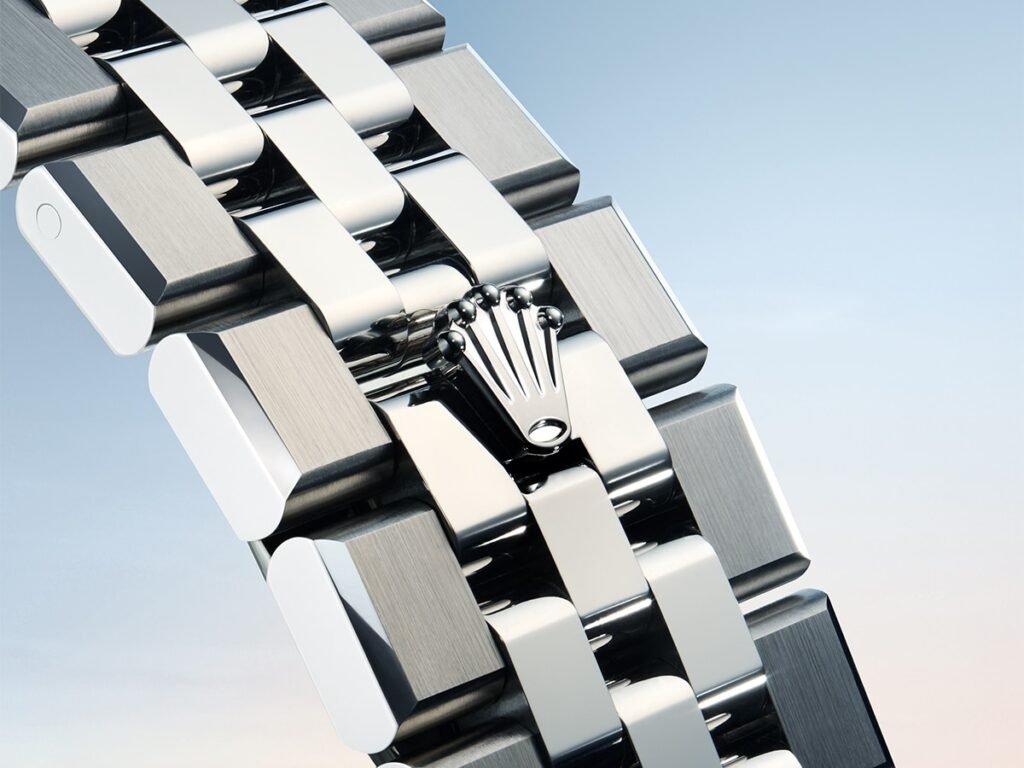
Rolex Oyster Perpetual Land-Dweller Bracelet | Image: Rolex

Bracelet

The Rolex Land-Dweller debuts with a brand-new Flat Jubilee bracelet, a fresh interpretation of one of Rolex’s most recognizable designs. Flatter and sharper than the traditional Jubilee, this updated bracelet provides the watch with a more structured, contemporary feel while retaining the comfort Rolex is known for. Designed to match the case materials—White Rolesor, Everose Gold, or 950 Platinum—the Flat Jubilee combines brushed and polished finishes for a refined look that wears comfortably all day. It features the reliable Oysterlock safety clasp and Easylink extension system, enabling quick 5mm adjustments as needed. The Flat Jubilee not only enhances the Land-Dweller’s contemporary character but also provides a dynamic, adaptable presence on the wrist.

Movement

Inside the Rolex Land-Dweller ticks the all-new Calibre 7135, a movement that marks a significant advancement in the brand’s mechanical evolution. Beating at a high frequency of 5 Hz (36,000 vibrations per hour, it is built for precision and long-term reliability. It meets Rolex’s Superlative Chronometer certification, performing within -2/+2 seconds per day after casing—a tighter tolerance than standard chronometer ratings.

Winding is managed by the brand’s reliable Perpetual rotor, providing bidirectional self-winding for effective energy capture through natural wrist movement. The 66-hour power reserve guarantees that the Land-Dweller continues to tick even after a long weekend without being worn.

One of the biggest innovations here is the Dynapulse escapement, which ditches the traditional Swiss lever in favor of a rolling energy transmission system. The result is improved efficiency, reduced friction, and enhanced mechanical longevity—ideal for those who wear their Rolex as much as admire it.

Completing the movement’s technical package is a Syloxi hairspring for increased magnetic resistance and Paraflex shock absorbers for enhanced toughness under active conditions. Supported by 16 patents, the Calibre 7135 isn’t merely a movement—it’s Rolex redefining mechanical timekeeping from the inside out.

Rolex Oyster Perpetual Land-Dweller 40 in White Rolesor | Image: Rolex

What Do We Think About The Rolex Land-Dweller?

The Rolex Land-Dweller isn’t just another watch—it’s a confident step into new territory for the Crown. Every detail, from the case dimensions to the newly developed Calibre 7135, feels thoughtfully crafted, true to Rolex’s reputation for precision and restraint.

The choice between 36mm and 40mm sizes offers versatility without sacrificing presence. Both models wear beautifully, but it’s the debut of the brand-new Flat Jubilee bracelet that truly marks a turning point. It’s sleeker, more angular, and feels more contemporary compared to the traditional Jubilee design. Early impressions suggest it provides excellent comfort, though time will tell if it lives up to the durability Rolex bracelets are known for.

Dial options are strong across the board. The white honeycomb dial is crisp, clean, and infinitely wearable, while the ice-blue honeycomb dial, reserved for platinum models, is simply stunning—elegant without being over the top. Still, there’s a small part of us that wonders if more dial colours might eventually roll out; Rolex tends to play the long game. But for now, the two options feel carefully chosen.

Securing a Land-Dweller will be a challenge, no question. But perhaps that’s part of the appeal. The Land-Dweller isn’t trying to be everything to everyone. It’s crafted for those who appreciate the subtle art of Rolex’s slow yet deliberate innovation. If you’re fortunate enough to own one, you’re not just purchasing a timepiece—you’re owning a moment where Rolex once again expanded its world without ever losing its identity.
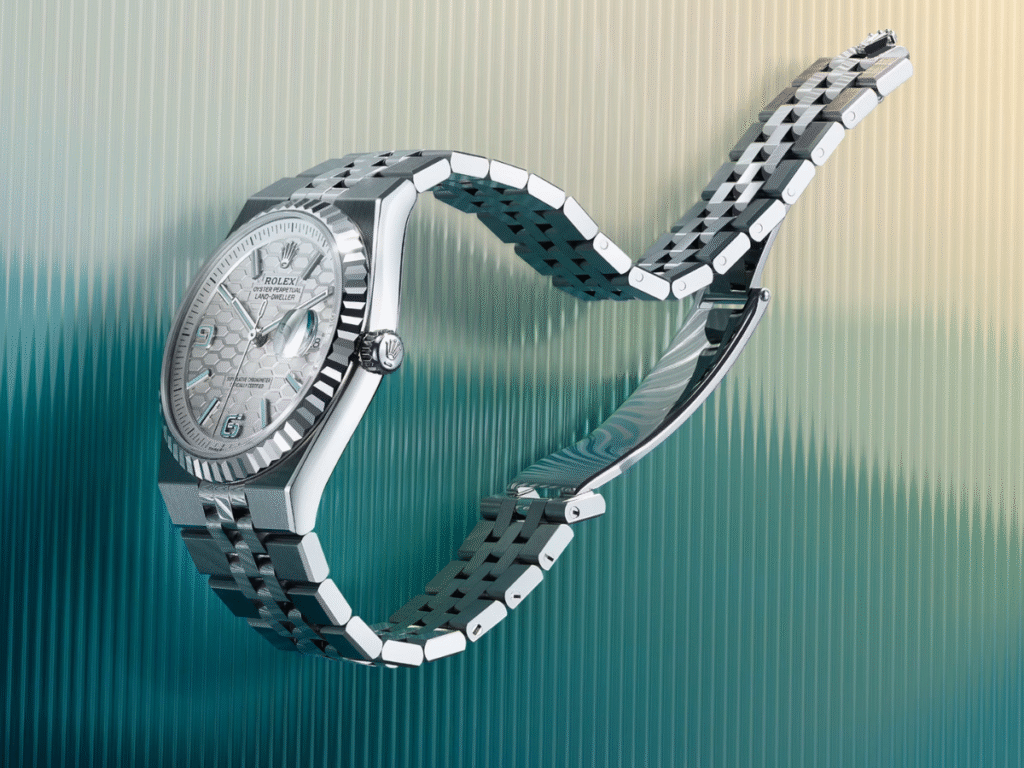
Rolex Oyster Perpetual Sea-Dweller Bracelet | Image: Rolex
Watches And WondersRolex
About the Author
Previous Post
Grand Seiko Presents a New Calibre at Watches and Wonders 2025
Next Post
10 Best Steakhouses in New York for Serious Meat Lovers

Related Articles

Everything You Need to Know About Hairline Tattoos

Reading Time: 9 minutes

Our team of editors and experts thoughtfully chooses each product. If you decide to buy through one of our links, we may earn a commission. Learn more. Want to know how we test products? Click here for more details.

It usually starts small — a little more forehead than usual, your barber subtly adjusting your fade higher each visit, or that sinking feeling when your selfie angles mysteriously seem higher. Hair loss sneaks in like a bad habit. One day, you’re sporting a sharp lineup; the next, you’re googling “best hats for receding hairlines.”

But before you go for a full buzzcut or spend thousands on a transplant, there’s a modern option that’s been gaining serious popularity in the grooming scene: hairline tattoos — also called scalp micropigmentation (SMP). Sound intense? Maybe. But trust us, this isn’t your cousin’s regrettable neck tattoo.

Hairline tattoos focus on precision and illusion. Tiny pigment deposits are applied on your scalp to resemble real hair follicles, giving the appearance of a fuller, sharper hairline — no surgery, no downtime, no daily upkeep. It’s like having a permanent, barber-fresh fade…minus the small talk.

In this guide, we’re covering everything you need to know: what SMP actually is, how it works, who it’s for, how long it lasts, and what the process looks like from beginning to end. If your hairline’s been playing hide-and-seek lately, this might be the comeback it needs.

What Is a Hairline Tattoo?

Let’s clear something up — a hairline tattoo isn’t about getting barbed wire or script inked across your forehead. What we’re really talking about is something much more refined: scalp micropigmentation, or SMP for short. It’s a non-surgical treatment where a trained specialist uses microneedles to deposit tiny dots of pigment into your scalp. These dots are designed to mimic real hair follicles, creating the illusion of a fuller, sharper hairline. Think of it as hyper-detailed dotwork — only instead of a canvas, the art happens right where your hairline used to be.

The magic is in the realism. When done properly, SMP resembles natural stubble or a clean, freshly buzzed head. It can rebuild a receding hairline, fill in thinning areas, or simply enhance what’s already present. Whether you have a widow’s peak advancing or your corners are beginning to retreat like a bad haircut, a hairline tattoo provides the appearance of density and definition — without surgery, creams, or questionable powders.

Now, let’s talk about pain — because we know you’re wondering. The idea of tattooing your scalp might sound intense, but most guys say it’s not nearly as bad as it sounds. The sensation is more like a series of light taps or a rubber band snapping, not some medieval torture device. It’s tolerable, especially when you remember the end result: a clean, confident look that doesn’t wash off, fade overnight, or require constant maintenance. Just one more tool in the modern grooming kit — and a very effective one at that.

How does it work?

Getting a hairline tattoo isn’t a quick buzz and go — it’s a carefully planned, multi-session process designed to deliver the most natural and personalised result possible. It begins with a consultation and ends with you walking out with a sharper, more confident look. No plugs, no pills, and definitely no combovers.

What to Expect During the Process:

  • The process starts with a thorough consultation, where a trained practitioner assesses your scalp, discusses your goals, and works with you to create a natural-looking hairline that suits your facial structure and current hair pattern.
  • The first treatment session focuses on establishing a solid foundation. Using micro-needles, the technician deposits the initial layer of pigment in small, precise spots to outline the hairline and start creating the illusion of hair density.
  • The second session builds on this foundation by adding more pigment for greater depth, texture, and a more natural-looking finish. This stage improves the natural appearance of the hairline, carefully blending the pigment with your existing hair or skin tone.
  • In some cases, a third session might be recommended, especially for clients who want a darker finish, more density, or further refinements to enhance the overall look.
  • After the final session, it’s common to notice temporary darkness in the pigment or mild scabbing. As the scalp heals, the excess pigment gradually diminishes, revealing a softer and more natural appearance.
  • Once fully healed, the treatment offers a durable, low-maintenance hairline that requires no daily styling or upkeep — providing a consistently fresh, barber-like finish with minimal effort.

If you’re seeking something permanent, sharp, and effortlessly stylish, a hairline tattoo might be just what you’ve been searching for. It’s subtle, clever, and designed to suit your lifestyle.

Who Is It For?

Hairline tattoos are ideal for men who want a sharp, low-maintenance look without surgery or gimmicks. Here’s who it’s perfect for:

  • Receding hairlines
  • Thinning or patchy spots
  • Buzz-cut styles
  • Post-transplant
  • Tired of hair loss products
  • Low-maintenance grooming

How Long It Lasts

One of the main benefits of scalp micropigmentation is its durability. A typical hairline tattoo can last between 4 to 6 years before requiring a touch-up, making it one of the most low-maintenance grooming choices. The pigment is intended to fade gradually over time, not all at once, so your hairline remains natural-looking — never patchy or overly intense.

How long it lasts depends on factors like sun exposure, skin type, and how well you care for your scalp. Oily skin, excessive sweating, or skipping aftercare can cause faster fading, while staying properly hydrated and protecting from the sun can help maintain the look longer. When the time comes, a quick refresh session is all it takes to restore that sharp, defined hairline — no fuss, no downtime.

Cost Breakdown

Let’s talk numbers. Hairline tattoos — or scalp micropigmentation — aren’t exactly cheap, but when you compare them to the cost of endless hair loss treatments or surgical transplants, they start to make a lot more sense.

On average, SMP can cost between $1,500 and $4,000, depending on factors such as your location, the technician’s experience, the size of the treatment area, and how many sessions you require. Smaller touch-ups or partial work (like just the temples) will be priced on the lower end, while full scalp treatments or more intensive density blending can reach the higher range.

Here’s a rough overview:

  • Small areas (like corners or a mild recession) – $1,000 to $2,000
  • Full hairline restoration – $2,000 to $3,000
  • Top of scalp or full crown work – $3,000 to $4,000+
  • Touch-up (after 3–5 years) – Typically $500 to $1,000.

Keep in mind — this isn’t just a one-time aesthetic upgrade. It’s a long-term investment in how you look, feel, and carry yourself. No daily maintenance, no recurring product costs, no awkward “in-between” phases. Just one upfront cost for years of peace of mind.

Fade Less, Flex More

Hairline tattoos aren’t just about appearance — they’re about owning your image and regaining control without surgery, snake oil, or high-maintenance routines. Scalp micropigmentation provides a sharp, natural-looking hairline that stays in place, doesn’t fade unevenly, or require a drawer full of styling products. It’s a wake-up-and-go kind of confidence — and honestly, who doesn’t want that?

From your initial consultation to that final mirror check, the process is simple and tailored to your features, goals, and lifestyle. Unlike trends that fade away, a well-executed hairline tattoo remains timeless — because a sharp hairline never goes out of style. Whether you’re aiming to rewind the clock, improve your self-image, or stay ahead of trends, SMP is a modern grooming choice that truly provides results.

So if your hairline’s been messing around, maybe it’s time to stop hunting for quick fixes and start making bold statements. Fade less. Flex more. Your future self will thank you.

General FAQ’S

Does a Hairline Tattoo Look Real?

Yes — when performed by a skilled practitioner, a hairline tattoo (scalp micropigmentation) can appear extremely realistic. The technique uses microdots of pigment to imitate the look of natural hair follicles. The final result resembles a freshly buzzed haircut or a naturally dense hairline. People won’t realize it’s a tattoo unless you tell them — even barbers are often impressed by how seamlessly it blends.

Is the Procedure Painful?

It’s not entirely pain-free, but most clients report minimal discomfort. Imagine it as a series of light pricks or a rubber band snapping against your scalp — mildly irritating yet very tolerable. The good news is that it’s much less intense than a traditional tattoo, and there’s no cutting, stitching, or significant recovery time involved.

How Long Does the Treatment Take?

Scalp micropigmentation usually takes 2 to 4 sessions, depending on your desired look and coverage needs. Each session generally lasts 2 to 3 hours, with about 7 to 14 days between sessions to allow your scalp to heal and the pigment to settle. By the final session, your hairline will appear fuller, sharper, and fully refined.

Will the Pigment Fade or Change Color Over Time?

The pigment is formulated to fade gradually and naturally over 4 to 6 years. It won’t turn green, blue, or become blotchy like traditional tattoo ink sometimes does. Instead, the colour softens evenly. To keep your hairline looking fresh, a simple touch-up every few years generally suffices.

Can I Still Grow My Hair Out After Getting SMP?

Yes, but it depends on your hair goals. SMP looks best when combined with short or buzzed hairstyles, as it creates the illusion of hair density at the scalp. If you grow your hair out too long, especially in areas with little natural hair, it may disrupt the visual harmony. Many men opt to keep their hair cropped close to maintain a clean, consistent appearance.

About the Author

Related Articles

arrow_drop_up