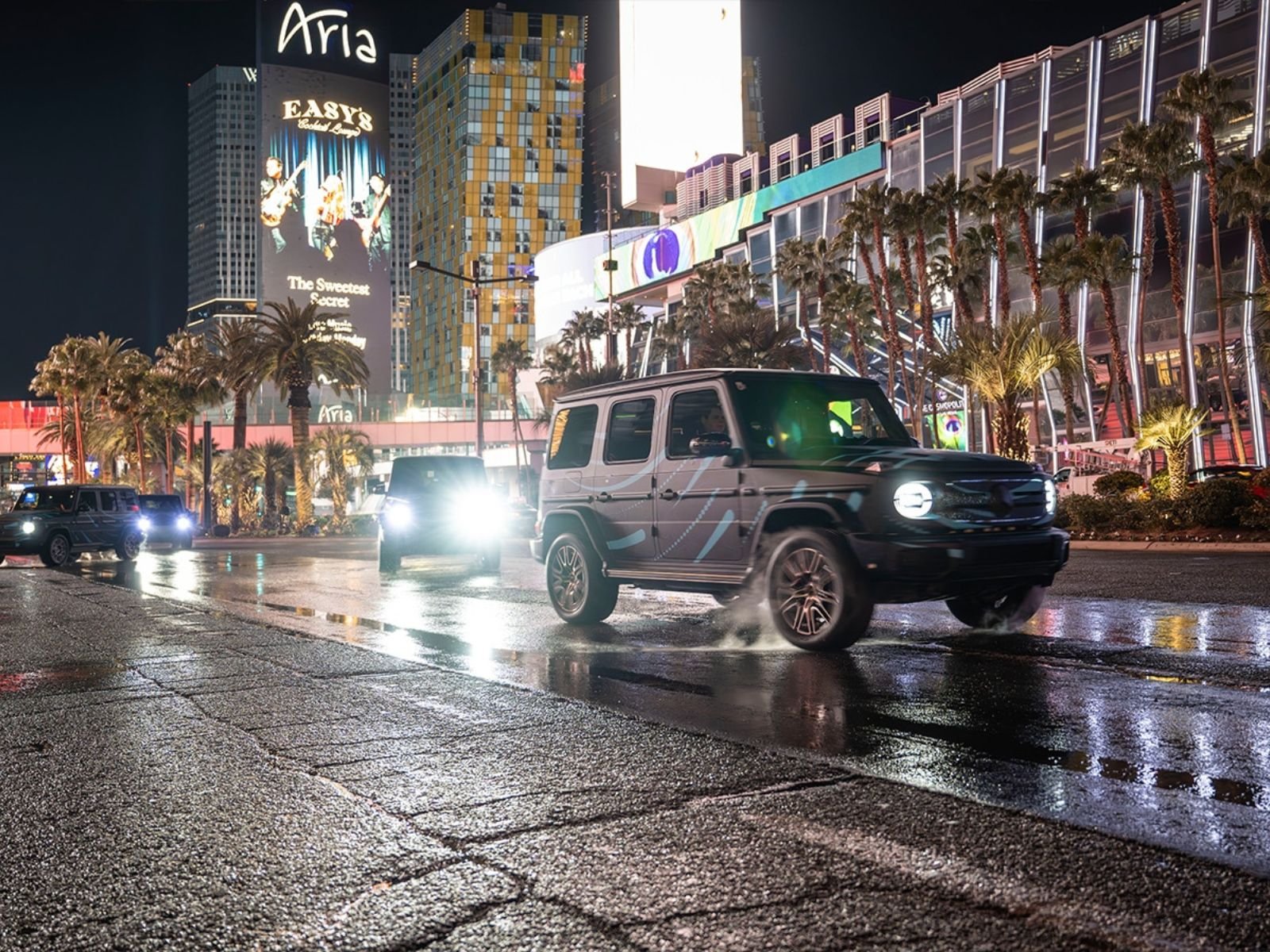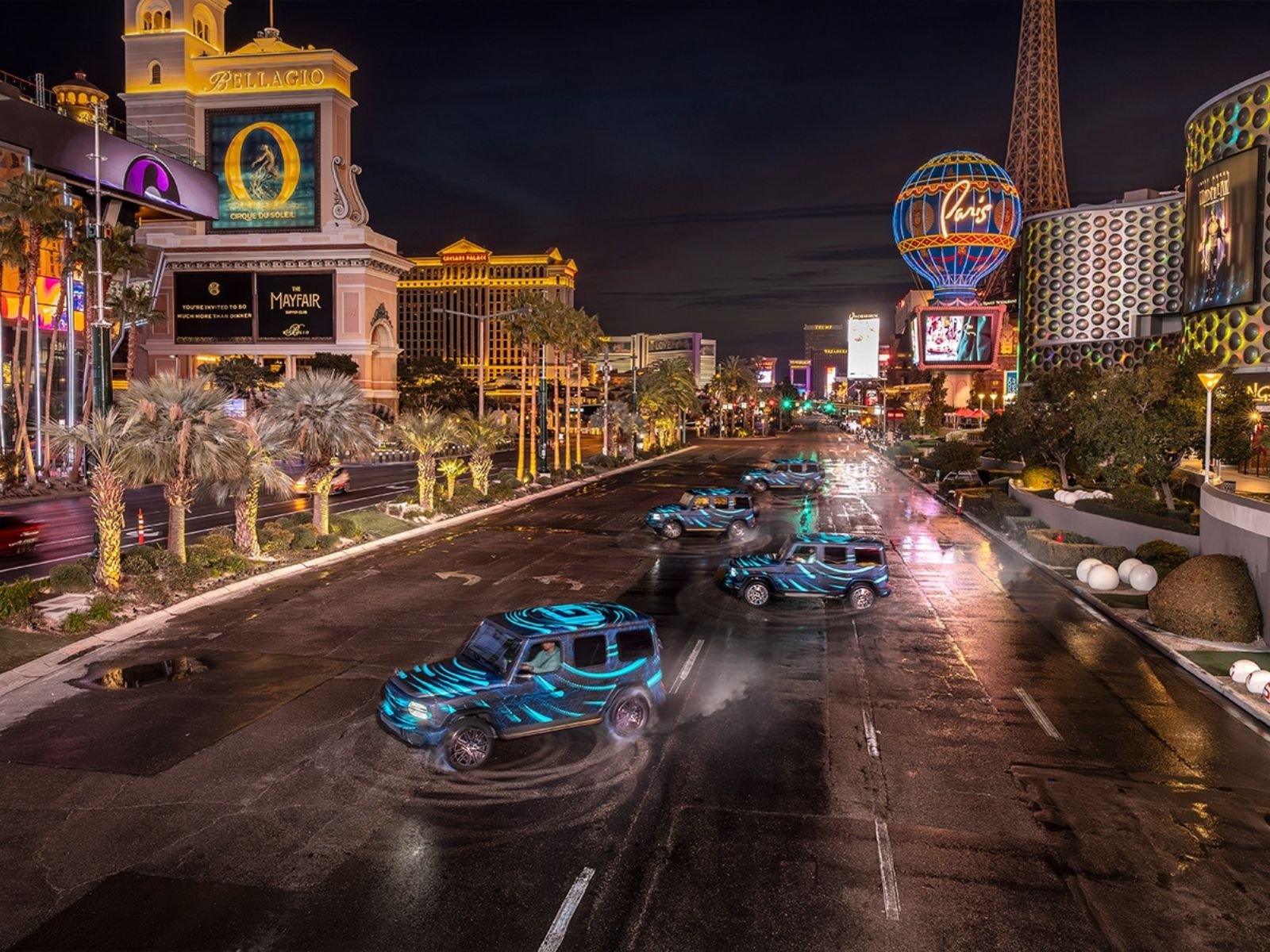








Las Vegas is no stranger to over-the-top performances, but even the Strip had to make room when Mercedes-Benz arrived with four camouflaged EQG prototypes during CES 2024. With the electric G-Class still approaching production at the time, the automaker closed a section of the famous boulevard and turned its latest off-roader into the star of a synchronized spin show. Each prototype completed a 720-degree G-Turn, using four individually controlled electric motors to send the wheels on either side in opposite directions and rotate the SUV almost entirely on the spot.
Practical? Perhaps off-road. Completely unnecessary on the Las Vegas Strip? Absolutely—but that is precisely what made it so entertaining.
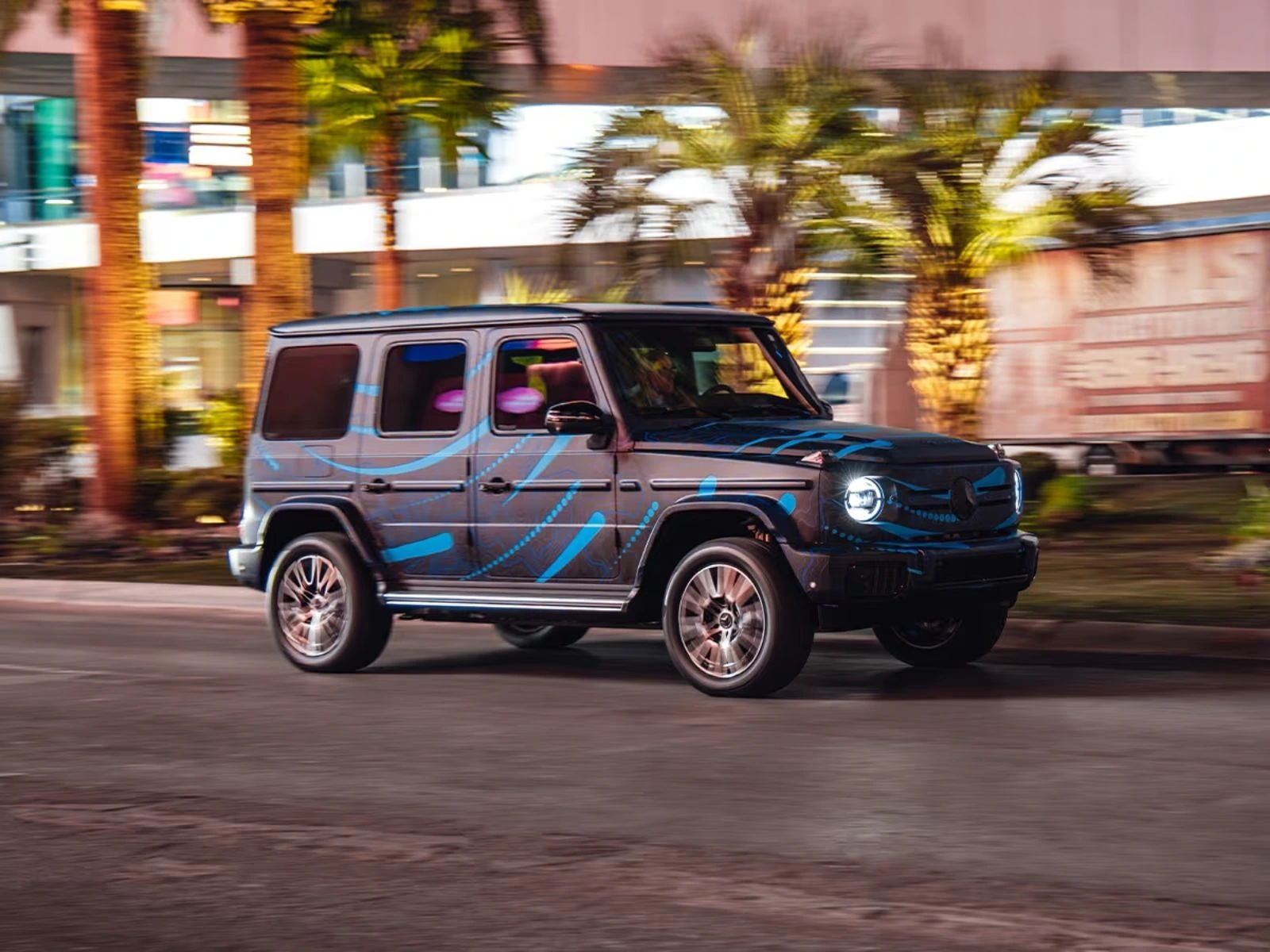
The camouflage did little to disguise what Mercedes-Benz was building. Beneath the patterned wrap, the electric prototypes retained the G-Class’s boxy silhouette, upright stance and slab-sided bodywork, preserving the familiar shape that has made the G-Wagen instantly recognizable for decades.
Mercedes-Benz still made several changes to help the famously brick-shaped SUV move through the air more efficiently. The electric model received a more enclosed grille, aerodynamically optimized bumpers, revised A-pillar trim and redesigned wheels, while the traditional rear-mounted spare-wheel carrier was reimagined as a lockable Design Box capable of holding a charging cable, tools or snow chains.
Advertisement · Continue Reading Below
More importantly, Mercedes-Benz resisted moving the electric G-Class onto the dedicated architecture used by models such as the EQS and EQE. Instead, it retained a heavily modified ladder-frame chassis, allowing the SUV to carry its electric hardware without abandoning the rugged construction and off-road ability expected from anything wearing a G-Class badge.
What was still referred to as the EQG during the Las Vegas demonstration eventually entered production as the Mercedes-Benz G 580 with EQ Technology. Its hardware includes a usable 116kWh battery and four individually controlled electric motors producing a combined 579 horsepower and 859 lb-ft of torque—enough to match the V8-powered AMG G 63 for horsepower while comfortably exceeding it for torque.
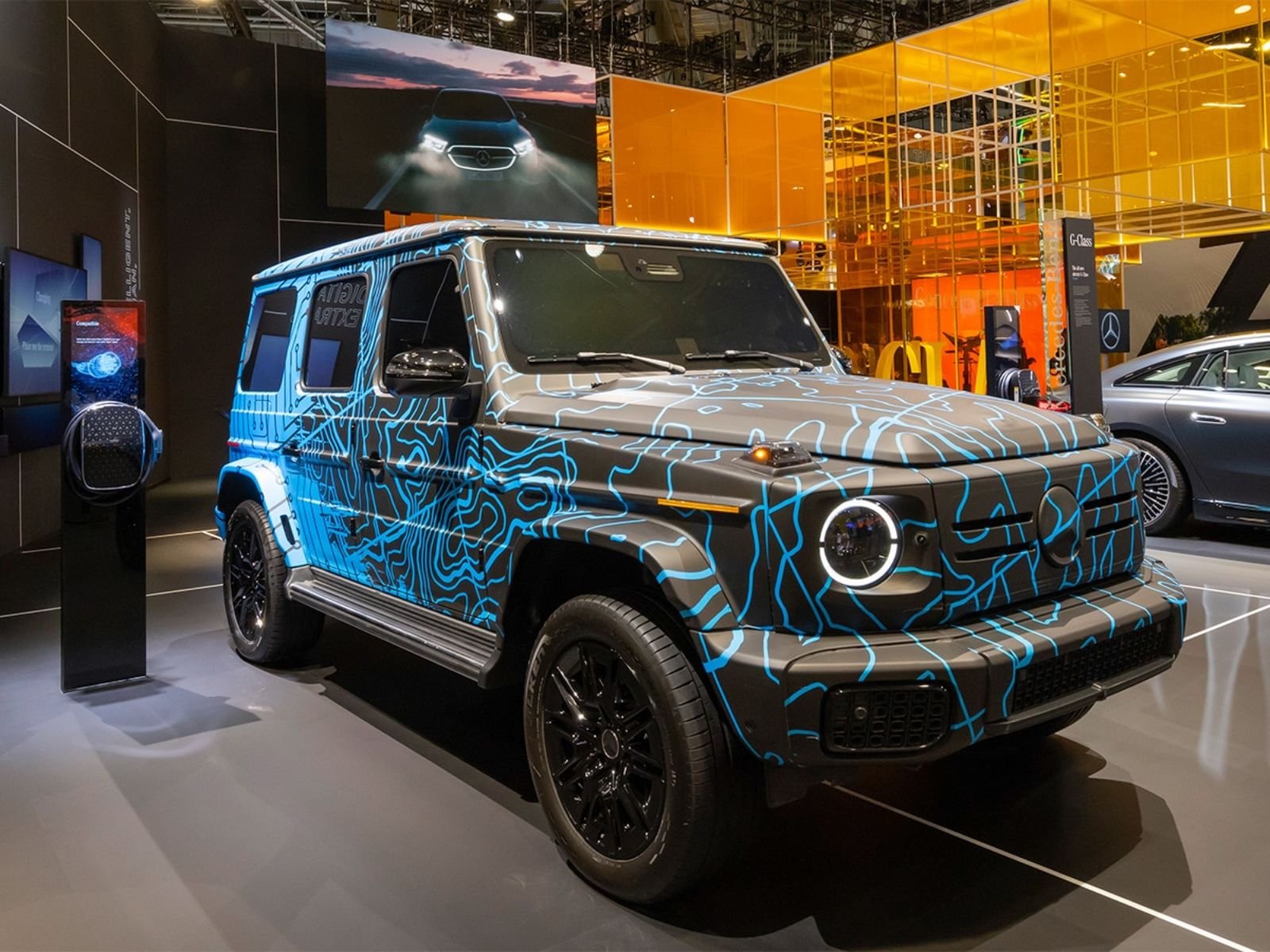
Each motor is paired with its own two-speed transmission, including a selectable low range for tackling difficult terrain. That setup also makes features such as G-Turn and G-Steering possible, although the electric G-Wagen’s upright body means it cannot match the driving range of the far more aerodynamic EQS. Its official EPA-estimated range sits at 239 miles, proving that keeping the classic silhouette comes with a fairly predictable compromise.
Inside, Mercedes-Benz avoided turning the dashboard into one enormous Hyperscreen. Instead, the cabin combines a 12.3-inch digital instrument display with a matching 12.3-inch central touchscreen, alongside an Off-Road Cockpit that can show elevation, steering angle, torque output and tire pressure. It is more powerful, more digital and considerably quieter than the G-Wagen of old, but it still looks and feels like a proper G-Class—and that may be its most important feature of all.
The Las Vegas performance may have been a carefully choreographed publicity stunt, but it delivered a clear message — electrification has not taken the personality out of the G-Class. Mercedes-Benz has preserved the unmistakable design and serious off-road hardware while adding a four-motor powertrain capable of tricks no V8 G-Wagen could replicate. Most owners will probably never need to spin their electric G-Class through 720 degrees, but knowing it can is exactly the kind of wonderfully excessive engineering that keeps the G-Wagen interesting.
Advertisement · Continue Reading Below